
Miluna Acquisition Corp: The Stakes and Catalysts of the CADV Ventures SPAC Combination
Miluna Acquisition Corp has reached a definitive agreement to bring CADV Ventures S.A. public via SPAC merger, with execution risks and opportunity stakes now shifting from capital raise to deal closure and post-combination value creation.
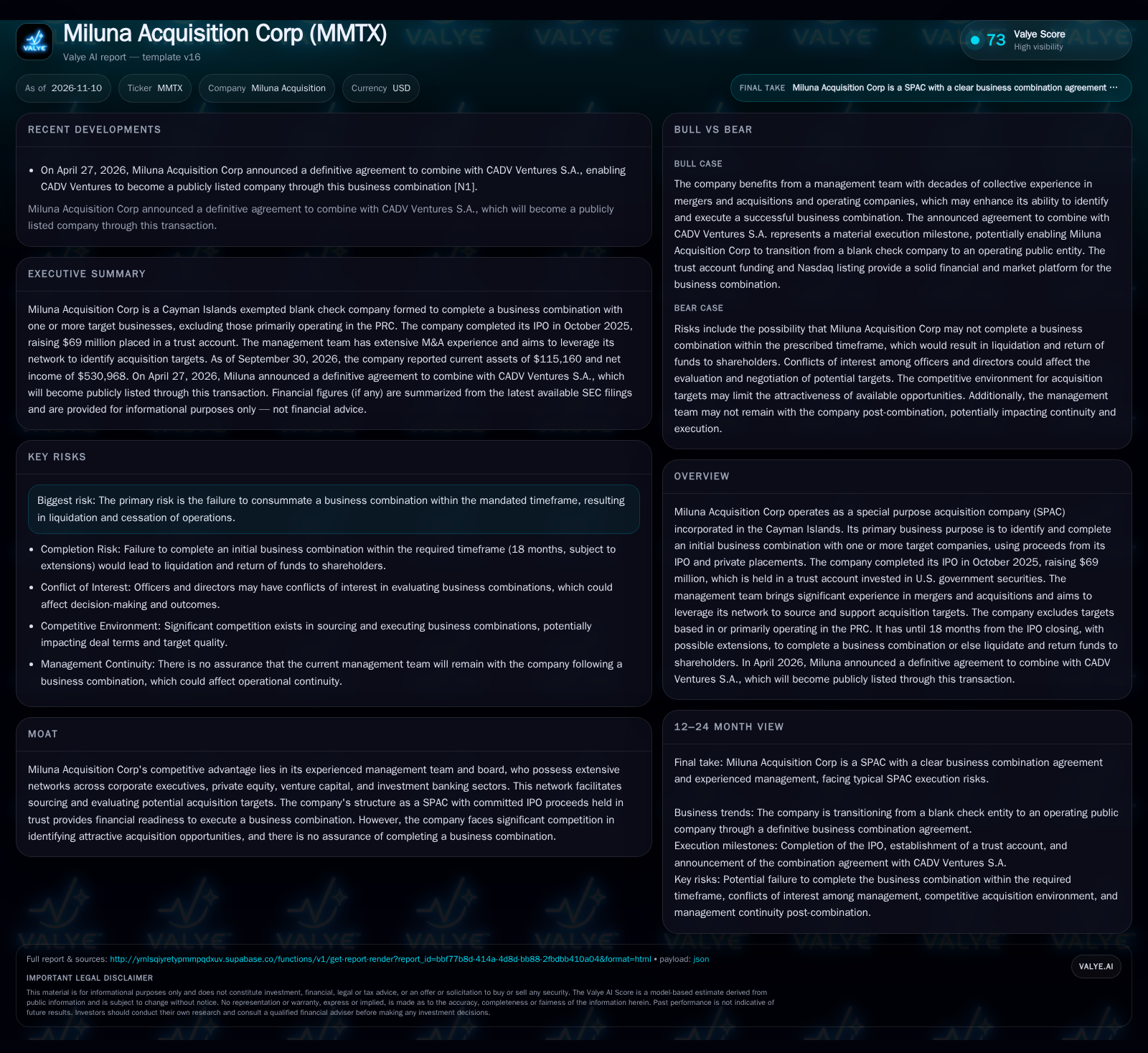
Miluna Acquisition Corp, a Cayman Islands-based SPAC, completed a $69 million IPO and trust placement in late 2025, establishing a deadline-driven mandate to acquire a non-PRC target. In April 2026, Miluna announced a definitive agreement to merge with CADV Ventures S.A., setting up a transition from blank check to operating public company. The window to close the deal and realize value is now tightly bounded by the 18-month post-IPO clock, with risks centering on deal execution, competitive SPAC dynamics, and post-combination management continuity. [S1] [N1]
Miluna Acquisition Corp’s evolution from a capital-holding shell to a catalyst for public market entry now hinges on the successful closure of its definitive agreement with CADV Ventures S.A. The trust-backed SPAC structure provides both a platform and a deadline: Miluna must close a qualifying deal within 18 months of its October 2025 IPO, or else unwind and return funds to shareholders. With the CADV merger announced in April 2026, the company has moved decisively to escape the fate of SPACs that fail to find a target. The critical questions now shift to deal execution, post-merger value creation, and whether Miluna’s management and network can translate capital and access into lasting public company value. [S1] [N1]
From IPO to CADV Merger: Miluna’s Transition Milestones
Miluna Acquisition Corp completed its IPO in October 2025, raising $69 million through the sale of 6 million units at $10 per unit, augmented by private placements and over-allotment options. These proceeds are held in a trust account, invested conservatively in U.S. government securities until a qualifying business combination is closed [S1].
On April 27, 2026, Miluna announced a definitive agreement to acquire CADV Ventures S.A., positioning CADV to become a publicly listed company through this SPAC transaction [N1]. This announcement marks a critical shift from the capital-raising and target-search phase to transaction execution and integration planning.
Under SPAC rules, Miluna faces an 18-month deadline from its IPO closing to complete a business combination, with the risk of liquidation and return of trust funds if the deal is not consummated in time [S1]. The definitive agreement with CADV now places the company on a clear but time-sensitive path to operational transition.
SPAC Economics: Fee Structures, Incentives, and Post-Combination Stakes
Miluna’s business model is archetypal for a SPAC: raise capital via IPO, invest proceeds in a low-risk trust, and seek a private operating company to bring public through merger. Until a deal closes, income is limited to interest on trust assets, with no operating revenue or cash flow [S2].
Economically, the SPAC structure creates strong incentives for sponsors and management: successful deal closure can yield founder shares, warrants, and potential board or management roles in the post-merger entity. Conversely, failure to close forces liquidation, forfeiture of upside, and loss of sponsor at-risk capital.
Deal economics post-combination will hinge on the operational performance and capital requirements of CADV Ventures. If CADV has robust revenue and margin profiles, the public listing could enable access to additional capital, attract institutional investors, and provide acquisition currency. However, if CADV is capital-intensive or lacks clear profitability, dilution, redemptions, and post-merger volatility could erode value for legacy SPAC shareholders.
Operating leverage, capital structure, and the ability to realize synergies or growth opportunities will determine whether the combined entity can outperform the typical SPAC cohort, many of which have struggled with post-merger execution and capital market reception.
Competing for Targets: SPAC Saturation, Deal Quality, and Management Networks
Miluna operates in a highly competitive environment for SPACs, with dozens of blank check companies vying for a shrinking pool of attractive targets, especially as the post-2021 SPAC market has become more discerning and investor-friendly. The exclusion of PRC-based targets narrows the field but may also shield Miluna from regulatory and geopolitical complications [S1].
The management team’s extensive M&A background and connections to corporate executives, private equity, and investment banking are positioned as differentiators for deal sourcing and diligence. In practice, the ability to secure a definitive agreement with CADV Ventures S.A. suggests some advantage in access or negotiation, but the ultimate quality of the target and deal terms will determine competitive success.
SPACs increasingly face competition not just from each other but from direct listings, private equity buyouts, and traditional IPO routes. The challenge is to convince both the private target and public market investors that the SPAC route offers superior speed, certainty, and value creation potential.
If CADV Delivers: Value Creation Through Strategic Fit and Market Reception
The most favorable outcome for Miluna shareholders would be if CADV Ventures S.A. proves to be a high-quality, growth-oriented operating company with a compelling public market story. If the business combination closes as planned, and CADV achieves robust revenue growth, margin expansion, or executes on a differentiated strategy, the merged entity could command a strong valuation and attract follow-on capital.
Key confirming evidence would include: clear SEC disclosures of CADV’s revenue, profitability, and growth metrics; limited shareholder redemptions at deal closing; strong aftermarket trading and analyst coverage; and visible post-merger management continuity and operational execution.
Falsification would come from weak or deteriorating financials at CADV, high redemption rates depleting trust funds, or loss of key management post-merger. A failed integration or lack of investor interest could undermine the upside even if the deal closes.
The Most Likely Path: Deal Closure, Integration, and SPAC Market Realities
The most plausible scenario is that Miluna completes the CADV merger within the required timeframe, transitioning from a blank check to an operating public company. Initial trading may be volatile, with redemption levels and early market reaction setting the tone for the post-combination period.
Post-merger, value creation will likely hinge on CADV’s ability to deliver on its business plan, retain key management, and meet or exceed financial projections disclosed in the merger proxy. Like many recent SPAC deals, there may be a period of market skepticism until operating results and capital market engagement demonstrate the merits of the combination.
Confirmation would come from the timely completion of the deal, successful listing of the combined entity, and stable trading volume. Evidence against this scenario would be deal delays, renegotiation of terms, or last-minute regulatory or shareholder hurdles.
Failure to Close: Liquidation Risks and SPAC Sponsor Losses
The principal downside risk is that the CADV combination fails to close—whether due to regulatory, shareholder, or operational hurdles—before the 18-month deadline. In this scenario, Miluna would be forced to liquidate, returning trust funds to public shareholders and leaving sponsors with sunk costs and lost upside.
Other adverse outcomes include a high level of redemptions that deplete the trust account, reducing the capital available to CADV and undermining the rationale for the public listing. If the post-merger entity fails to attract investor interest or quickly falters operationally, Miluna’s transition could be marred by poor trading, management turnover, or even the need for follow-on capital raises at punitive terms.
Confirmation of the downside would be a terminated merger agreement, public disclosures of insurmountable regulatory or diligence issues, or a shareholder vote failing to approve the transaction. Early warning signs could include persistent deal delays, lack of communication about the closing process, or management departures.
Miluna’s Value Creation Hinges on These Outcome Drivers
Progress and timing of regulatory filings (including SEC registration statements and proxy materials for the CADV merger) would help test the likelihood of timely deal closure.
Disclosure of CADV Ventures S.A.’s detailed financials—revenue, EBITDA, growth rates, and capital needs—will be essential for evaluating the combined entity’s post-merger economics.
Shareholder redemption rates at the merger vote will directly impact the capital available to the combined company and serve as a referendum on investor confidence.
Public communication about post-merger management continuity and governance structure will clarify whether Miluna’s sponsor and leadership remain involved and aligned.
Market reaction—trading volume, price volatility, and analyst coverage—after the combination closes will indicate whether the public market sees value in the newly listed CADV.
If disclosed, the pipeline of potential future acquisitions or growth initiatives by CADV Ventures would signal the company’s ability to leverage its new public status.
Any amendments to the combination agreement, timeline extensions, or regulatory interventions would be key signals of execution risk or deal fragility.
Disclaimer: This is research-only, informational analysis and not investment advice. It may include AI-generated interpretation and general industry context. Always verify important details using primary sources.

Comments