
Abeona Therapeutics: Commercializing Gene Therapy Amid Manufacturing Complexities and Pipeline Expansion
Abeona’s ZEVASKYN® launch for RDEB wounds marks a pivotal commercial step, but manufacturing hurdles and the integration of late-stage assets like ABO-801 will pressure execution. The company’s rare-disease focus, in-house cGMP capacity, and expanding gene therapy pipeline create long-term optionality, yet the near-term hinges on scaling supply, treatment center activation, and royalty realization.
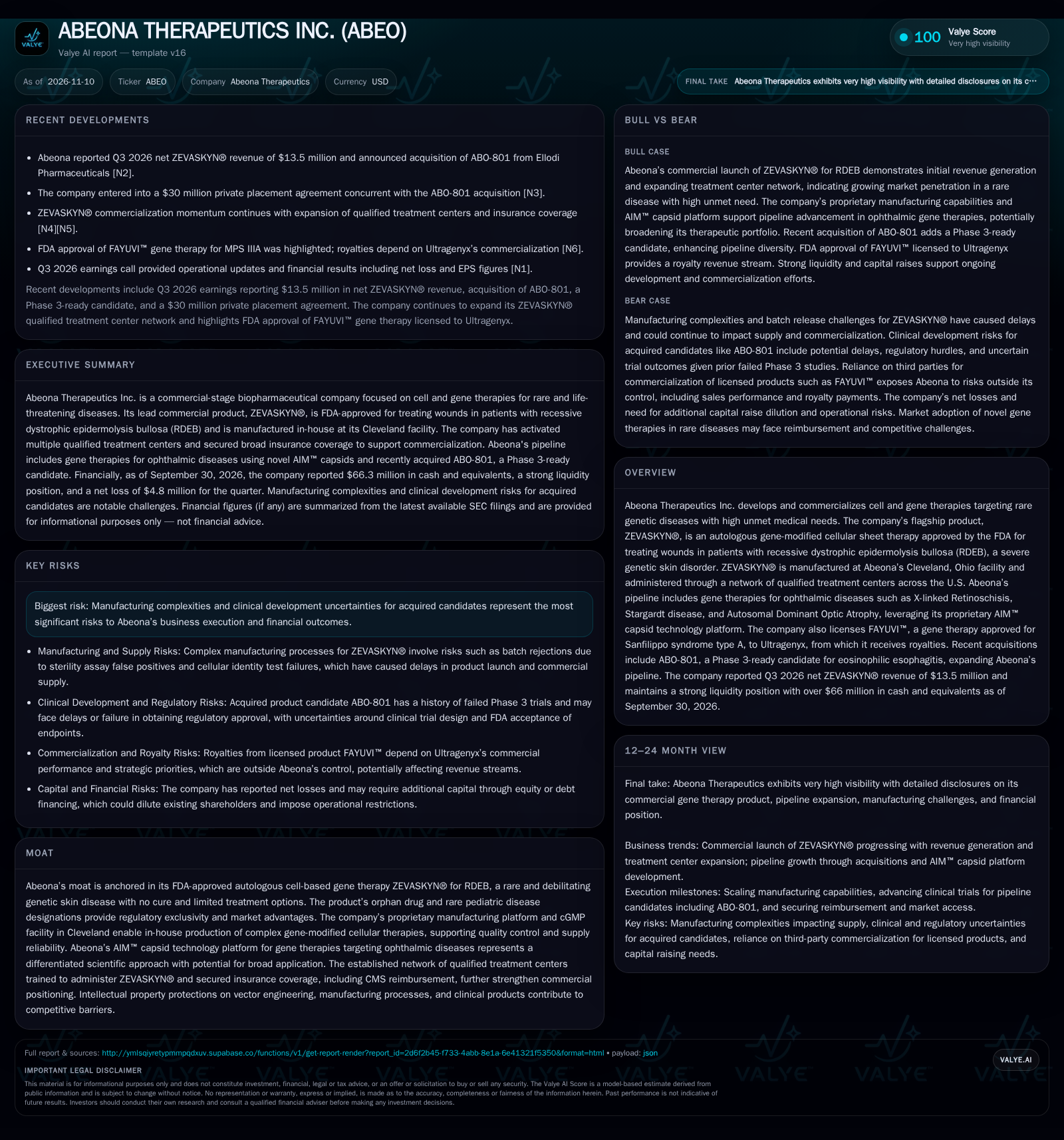
Abeona Therapeutics has achieved initial commercial traction with ZEVASKYN® for RDEB, reporting $13.5 million in Q3 2026 revenue and activating four treatment centers. With the acquisition of ABO-801 and a $30 million private placement, the pipeline now includes late-stage and preclinical gene therapy candidates. However, manufacturing complexity has already caused delays, and future value depends on scaling ZEVASKYN® access, navigating clinical risk for new assets, and realizing royalties from licensed products like FAYUVI™. [S2] [N2] [N3] [S1]
Abeona Therapeutics has transitioned into a commercial-stage gene therapy company, led by the launch of ZEVASKYN® for recessive dystrophic epidermolysis bullosa (RDEB). Early commercial results and a growing treatment center network underscore demand in this high-unmet-need population. However, the company’s manufacturing complexities have already caused supply delays—a reminder that autologous cell-based therapies pose unique operational risks. Recent strategic moves, including the acquisition of Phase 3-ready ABO-801 and the addition of a $30 million private placement, signal pipeline ambition but introduce new clinical and executional variables. The next phase for Abeona will test its ability to scale supply, deepen market penetration, and convert pipeline promise into durable revenue streams.
ZEVASKYN® Launch, Pipeline Acquisition, and Financial Position Define the Moment
Abeona Therapeutics’ commercial launch of ZEVASKYN®—the only FDA-approved single-application gene therapy for RDEB wounds—generated $13.5 million in net revenue for Q3 2026, with four qualified treatment centers activated as of March 2026 [S1] [N2]. This initial market entry demonstrates both clinical and payer acceptance, aided by broad insurance coverage and a permanent CMS J-code effective January 2026 [S1]. [N2] [N3] [S2] Manufacturing delays due to complex sterility and identity assays have already impacted ZEVASKYN® supply and rollout, highlighting the operational bottleneck risk [S1].
Unit Economics and Scaling Challenges in Autologous Gene Therapy Commercialization
ZEVASKYN®’s economics are shaped by its status as the sole FDA-approved treatment for RDEB wounds, allowing for premium pricing justified by orphan drug exclusivity and rare pediatric disease designation. Revenue per patient is likely high due to the single-application nature and the severity of the target population, but the addressable market is intrinsically limited by RDEB’s ultra-rare prevalence. Manufacturing is capital- and labor-intensive: each autologous therapy batch is individualized, requiring cGMP compliance and rigorous quality control. This introduces high fixed costs and batch-level variability, constraining gross margin scalability relative to traditional biopharma or allogeneic platforms. Manufacturing setbacks—such as batch rejection due to assay issues—can disrupt revenue recognition and inflate COGS, especially at low initial volumes.
On the pipeline front, the acquisition of ABO-801 introduces a Phase 3 candidate that, if successful, could diversify revenue and leverage existing manufacturing infrastructure, but also requires further investment in clinical development and regulatory submissions. Royalty revenue from FAYUVI™, licensed to Ultragenyx, provides a capital-light income stream, but is contingent on external commercialization and cannot be controlled or forecast with precision. [S2] [N3]
Market Exclusivity, Platform Potential, and the Challenge of Entrants
Abeona’s competitive position in RDEB therapy is anchored by ZEVASKYN®’s FDA approval, orphan drug exclusivity, and rare pediatric disease designation, which confer regulatory barriers and a period of market protection [S1]. The lack of alternative FDA-approved single-application therapies for RDEB wounds creates a near-term monopoly, supported by established insurance coverage and a growing network of specialized treatment centers. The company’s proprietary AIM™ capsid technology for ophthalmic gene therapies offers a differentiated scientific platform with potential for future pipeline growth.
However, the sustainability of this moat is not guaranteed. While autologous manufacturing creates technical and operational entry barriers, it also limits scalability and exposes Abeona to supply disruptions. Future competitors—including larger gene therapy players or next-generation allogeneic technologies—could target RDEB or adjacent indications, potentially leveraging broader commercial infrastructure or more scalable platforms. The pipeline’s diversification into ophthalmology and eosinophilic esophagitis is strategically sound but will be contested by established gene therapy developers and emerging biotech with alternative delivery vectors. Intellectual property around vector engineering and process know-how provides some protection, but the pace of scientific innovation in gene and cell therapy means that exclusivity windows may be shorter than traditional small-molecule drugs.
Unlocking Value Through Manufacturing Scale, Pipeline Success, and Royalty Upside
A favorable outcome for Abeona hinges on three reinforcing mechanisms: (1) ZEVASKYN® achieves broad adoption in the RDEB patient population as manufacturing reliability improves, leading to consistent revenue growth and higher operating leverage; (2) the pipeline delivers clinical and regulatory success, with ABO-801 progressing through Phase 3 and ophthalmic gene therapies advancing toward IND filings, expanding the company’s addressable market; (3) Ultragenyx’s commercial launch of FAYUVI™ for MPS IIIA generates meaningful royalty income, providing non-dilutive cash flow.
Evidence confirming this scenario would include a sustained increase in ZEVASKYN® treatment center activation and patient throughput, public disclosure of manufacturing yield improvements and reduced batch rejection rates, successful clinical trial readouts for ABO-801 and AIM™-capsid ophthalmic candidates, and royalty receipts from FAYUVI™ that materially impact Abeona’s income statement. Additional pipeline in-licensing or partnerships could further accelerate growth if accompanied by non-dilutive capital or co-development support.
Execution Hurdles and Gradual Expansion Dominate the Next Phase
The most probable trajectory for Abeona is measured progress: ZEVASKYN® revenue grows as more centers come online, but manufacturing complexity continues to cause intermittent supply constraints and limits rapid scaling. The pipeline advances incrementally, with ABO-801 entering or enrolling in a confirmatory Phase 3 trial, but clinical and regulatory timelines extend over several years, reflecting the inherent risks of late-stage rare disease development. Ophthalmic gene therapy programs remain in preclinical or IND-enabling stages, contributing little to near-term financials.
Confirmation of this scenario would come from moderate quarterly revenue increases, steady (but not rapid) treatment center growth, and pipeline updates that show progress but not transformative acceleration. Falsification would require either a major manufacturing breakthrough, a pipeline clinical win, or a significant external setback such as regulatory or reimbursement headwinds.
Commercial and Operational Setbacks Expose Financial Strain
In a downside scenario, manufacturing bottlenecks for ZEVASKYN® intensify, leading to missed revenue targets and loss of provider or payer confidence. Ongoing batch rejections or regulatory scrutiny could delay supply, erode the treatment center network, and jeopardize market access. ABO-801 or other pipeline candidates may experience clinical trial setbacks or regulatory delays, forcing impairment charges or reallocation of resources. FAYUVI™ royalties disappoint due to slow uptake or strategic deprioritization by Ultragenyx, removing a key source of non-dilutive income.
Under this scenario, Abeona’s cash burn accelerates, and the company is forced to raise additional capital under unfavorable terms, diluting shareholders or relinquishing pipeline rights. Confirmation would include declining or stagnant ZEVASKYN® revenues, public disclosure of manufacturing or regulatory setbacks, pipeline trial discontinuations, or equity/debt financings with punitive terms. Falsification would require clear evidence of operational turnaround, such as improved batch yields, pipeline de-risking, or unexpected royalty upside.
Testing Abeona’s Execution: Metrics and Milestones That Will Shape the Thesis
Quarterly ZEVASKYN® revenue growth and patient volume as a direct measure of commercial adoption and supply reliability [N2].
Number and geographic distribution of activated qualified treatment centers, indicating progress in market coverage and provider engagement; a useful metric would be center-level utilization if disclosed.
Manufacturing metrics—such as batch acceptance rates, yield improvements, and turnaround time—would help test whether supply constraints are being resolved.
Clinical trial updates and regulatory milestones for ABO-801, including enrollment rates, interim data, and FDA feedback, will determine pipeline value realization.
Advancement of AIM™-capsid ophthalmic programs from preclinical to IND-enabling or clinical stages, with partnership or out-licensing activity as a potential catalyst.
Actual royalty receipts from FAYUVI™ and any updates on Ultragenyx’s commercialization plans, given the reliance on third-party execution.
Cash burn rate and timing/terms of any new capital raises, which will impact dilution risk and operational runway.
Disclaimer: This is research-only, informational analysis and not investment advice. It may include AI-generated interpretation and general industry context. Always verify important details using primary sources.

Comments