
James River Group: Navigating Net Losses and Reinsurance Volatility in Specialty P&C Insurance
James River Group faces acute profitability pressures amid a challenging reinsurance market, as evidenced by a steep Q3 2026 net loss. The cited source reports dividend-related activity; that disclosure alone does not establish dividend-policy continuity, management confidence, or a material constraint on capital flexibility.
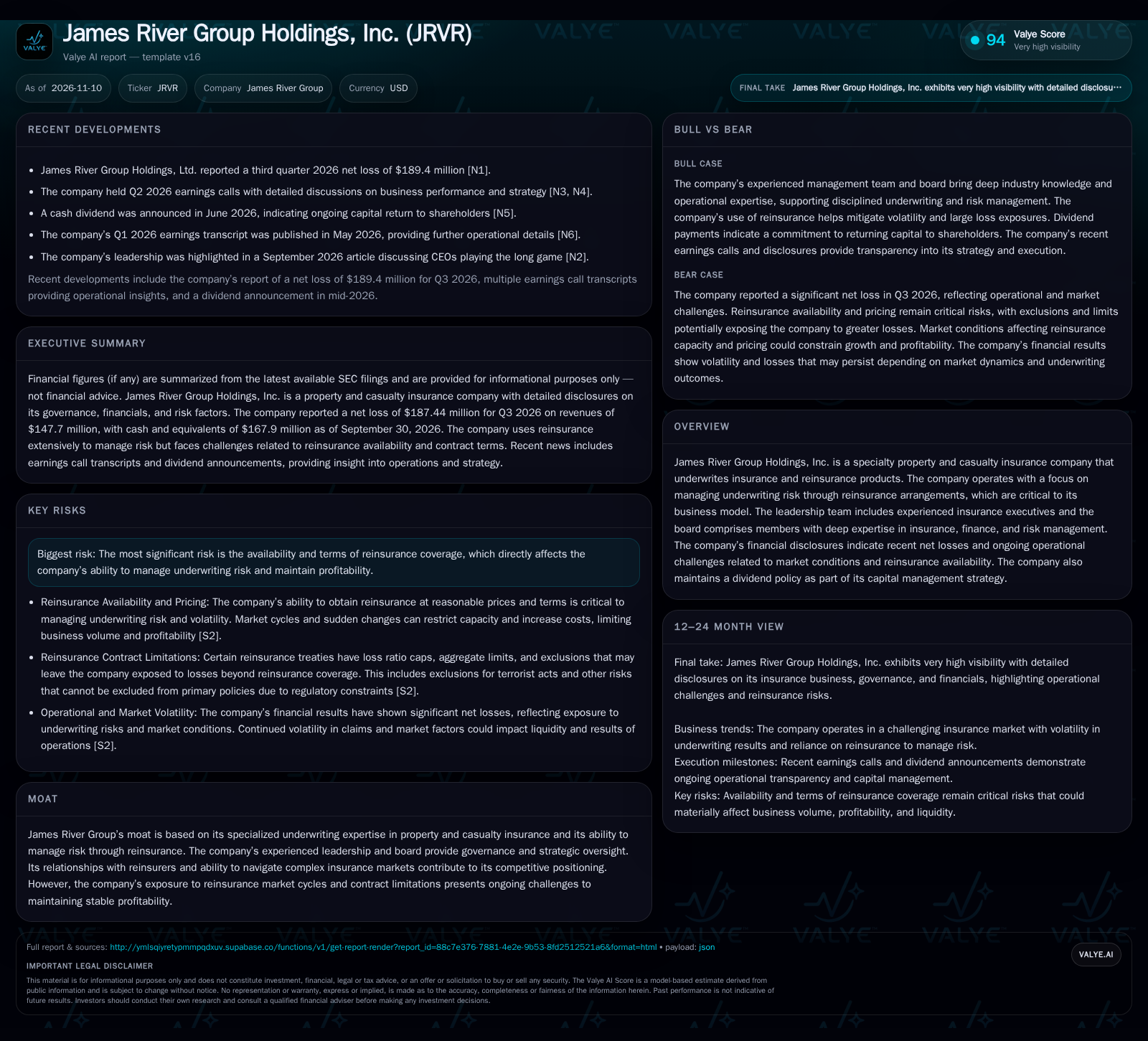
James River Group Holdings, Inc. reported a $187.44 million net loss in Q3 2026 on revenues of $147.7 million, highlighting significant volatility in underwriting results. The company’s heavy use of reinsurance to manage risk exposes it to fluctuations in reinsurance pricing and availability, which can impact both business volume and profitability. Despite recent losses, James River continues to pay dividends, suggesting ongoing attention to shareholder returns and capital policy. The key question is whether the company can recalibrate underwriting or reinsurance strategies to restore sustainable profitability in a turbulent market environment. [S2] [N1] [N5]
James River Group Holdings, Inc., a specialty property and casualty insurer, is at a critical juncture. The company’s Q3 2026 net loss of $187.44 million on $147.7 million in revenue underscores the volatility inherent in its business—much of it tied to the terms and availability of reinsurance. While James River continues to pay dividends and is led by a seasoned team, its dependence on reinsurance as both a risk mitigant and a source of business constraint is sharpening the focus on operational execution and strategic flexibility. The central issue is whether the company can adapt its underwriting and risk-transfer strategies fast enough to weather current headwinds and restore sustainable returns. [S2] [N1] [N5]
Recent Net Losses and Reinsurance Dependence Define the Immediate Outlook
James River Group Holdings reported a net loss of $187.44 million for Q3 2026, with revenues of $147.7 million for the same period [S2] [N1]. This marks a period of pronounced financial pressure, reflecting underwriting volatility and possible adverse claims development. The company’s cash and cash equivalents stood at $167.9 million as of September 30, 2026, and it maintained a shareholder dividend with a payment announced in June 2026 [S2] [N5].
James River’s business model continues to rely heavily on reinsurance to manage risk and volatility. However, reinsurance availability and pricing have become more challenging, with contract exclusions and limits that may leave the company exposed to outsized losses [S2]. This dynamic is central to both recent results and the path forward.
How James River’s Economics Are Shaped by Underwriting and Risk Transfer
James River Group’s revenue is generated primarily from premiums written on specialty property and casualty insurance policies. The company’s underwriting profit—or loss—is determined by the relationship between premiums, claims, and operating expenses. To reduce the volatility of claims and protect capital, James River cedes a significant portion of its risk to reinsurers, paying reinsurance premiums in exchange for limiting potential large losses.
This structure introduces both a benefit and a cost: while reinsurance can reduce volatility and protect against catastrophic claims, it also compresses margins, especially when reinsurance pricing is elevated or capacity is restricted. In addition, reinsurance treaties may include exclusions, aggregate limits, or loss ratio caps, which can leave the company exposed beyond certain thresholds [S2].
The company’s cost structure includes a mix of variable claims costs and relatively fixed expenses for personnel, technology, and regulatory compliance. Operating leverage can be positive when premium growth outpaces expense growth, but recent losses suggest negative leverage, with claims and reinsurance costs overwhelming revenues.
Capital needs are cyclical and linked to both underwriting risk and regulatory requirements. Dividend payments, though maintained, must be balanced against the need to preserve capital during periods of elevated loss.
Specialty Underwriting Expertise Meets Market Headwinds and Peer Pressures
James River’s competitive positioning is rooted in specialized underwriting expertise and longstanding relationships with reinsurers. The company competes with other specialty insurers and reinsurers that offer tailored solutions for complex or non-standard risks. Key differentiators in this space typically include underwriting discipline, risk selection, and the ability to price risk accurately.
However, the company’s reliance on reinsurance as a risk management tool exposes it to the cyclicality of the reinsurance market. When reinsurance capacity tightens or prices rise, all specialty insurers face pressure, but those most dependent on reinsurance—such as James River—may be at a relative disadvantage. Moreover, exclusions and tighter contract terms can erode the effectiveness of risk transfer, increasing the risk of outsized losses.
Alternative capital (e.g., insurance-linked securities), direct competition from larger diversified insurers, and technology-enabled new entrants may also create substitution threats, particularly if they can offer more cost-effective risk transfer or superior underwriting analytics.
Profitability Recovery if Underwriting Discipline and Reinsurance Markets Stabilize
In a favorable scenario, James River could restore profitability through a combination of improved underwriting discipline and stabilization in reinsurance markets. If the company can tighten risk selection, adjust pricing, and negotiate more favorable reinsurance terms, underwriting losses could abate. A stabilization—or even softening—of reinsurance pricing, coupled with fewer adverse claim developments, would support margin recovery.
Evidence for this scenario would include a return to underwriting profitability, declining loss ratios, and improved terms on reinsurance treaties. Management commentary on successful renewal negotiations or selective reduction in exposure to unprofitable lines would further support the case.
Volatility Persists as Reinsurance and Claims Trends Remain Challenging
The most plausible near-term scenario is that James River continues to operate in a volatile environment, with underwriting results pressured by both elevated claim activity and challenging reinsurance market conditions. The company may tighten underwriting standards and attempt to pass higher reinsurance costs onto policyholders, but competitive dynamics could limit pricing power.
Performance may stabilize somewhat if loss experience normalizes and the company successfully reins in exposure to problematic risks. However, with reinsurance exclusions and aggregate limits still presenting downside risk, results are likely to remain uneven. Confirmation of this scenario would come from continued quarter-to-quarter swings in earnings, persistent but narrowing net losses, and management focus on remediation rather than growth.
Further Deterioration if Reinsurance Tightens and Claims Escalate
In a negative scenario, reinsurance market conditions could deteriorate further, with even higher prices, reduced capacity, or more onerous exclusions and limits. James River could be forced to retain more risk or reduce business volume, both of which could pressure results. A spike in large or unexpected claims—especially those falling outside reinsurance coverage—would exacerbate losses and potentially threaten regulatory capital requirements.
Indicators of this scenario would include a sustained or widening net loss, mounting adverse reserve development, or a reduction or suspension of dividends to preserve capital. Deterioration in reinsurance renewal terms or an inability to place adequate coverage would be especially concerning. In an extreme case, the company could face ratings downgrades or regulatory intervention.
Testing the Thesis: Operational, Underwriting, and Capital Markers to Track
Quarterly underwriting results and combined ratios: Improvement or further deterioration would directly test the success of remediation efforts.
Trends in loss ratios and reserve development: Persistent adverse development would signal ongoing risk selection or claims management problems.
Details of reinsurance treaty renewals: More favorable terms, increased capacity, or reduced exclusions would support the upside scenario; tightening would be a warning sign.
Premium growth and business mix: Shifts toward more profitable or less volatile lines, if disclosed, would indicate strategic recalibration.
Management commentary on risk appetite and portfolio repositioning: Guidance on de-risking or exiting unprofitable segments would be telling.
Book value per share and capital adequacy: Erosion would point to persistent losses or reserve charges; stabilization would be a positive marker.
If disclosed, retention rates and client renewal trends: Loss of key accounts or a shrinking book could indicate franchise erosion.
Disclaimer: This is research-only, informational analysis and not investment advice. It may include AI-generated interpretation and general industry context. Always verify important details using primary sources.

Comments