
Puma Biotechnology: Commercial Execution, Pipeline Risk, and the Stakes of Single-Product Dependence
Puma Biotechnology’s fortunes hinge on continued U.S. commercialization of NERLYNX for HER2-positive breast cancer and the clinical progression of alisertib.
Puma Biotechnology remains defined by the commercial trajectory of NERLYNX and the uncertain pipeline prospects of alisertib. Success depends on expanding NERLYNX’s market presence, successful development of alisertib, and maintaining supply chain and partner execution.
Puma Biotechnology stands at a crossroads where commercial execution and pipeline development are both opportunity and existential risk. With NERLYNX as its sole marketed product addressing HER2-positive breast cancer, the company’s revenue stream is concentrated and exposed. Its next phase depends on the clinical advancement of alisertib and the resilience of its operational partnerships.
NERLYNX’s Market Position and the Pipeline Pivot
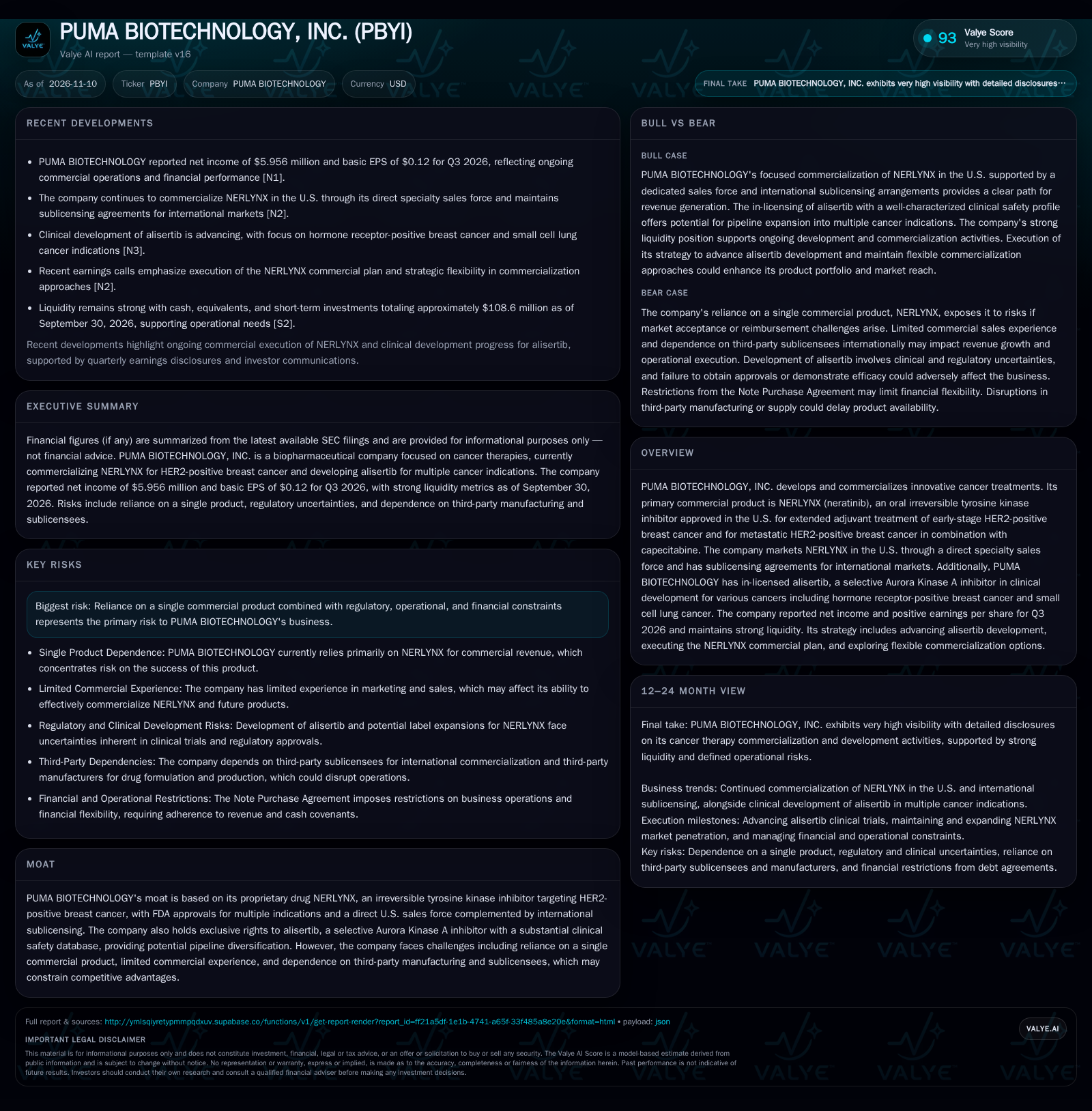
As of November 2026, Puma Biotechnology’s business is anchored by NERLYNX, an oral irreversible tyrosine kinase inhibitor approved for extended adjuvant treatment of early-stage HER2-positive breast cancer and for metastatic disease in combination therapy. U.S. commercialization relies on a direct specialty sales force, while international sales depend on sublicensing partners covering more than 40 countries [N2].
The company is advancing alisertib, a selective Aurora Kinase A inhibitor in clinical development for multiple cancer indications, notably hormone receptor-positive breast cancer and small cell lung cancer [N3]. Alisertib’s prior clinical history—over 1,300 patients across 22 trials—gives Puma a well-characterized safety profile to build upon.
Liquidity is a relative strength, with $41.5 million in cash and $67 million in short-term investments as of September 30, 2026, and a current ratio of 3.03 [S2]. However, Puma’s reliance on NERLYNX as its only commercial product, and on third parties for manufacturing and international sales, shapes its risk profile and future options.
How Puma’s Model Concentrates Both Margin and Risk
Puma’s revenue generation is currently almost entirely dependent on NERLYNX. In the U.S., the company retains higher margins by selling directly through its own specialty sales force, but this approach implies fixed costs for sales and marketing that may not scale down easily if revenue falters. Internationally, sublicensing allows access to broader markets with lower operational overhead, but at the cost of sharing economics and ceding commercial control.
The economics of NERLYNX are likely characterized by high gross margins typical of branded oncology drugs, but also by the risks of payer pushback, evolving treatment paradigms, and the finite size of the HER2-positive breast cancer population. Pricing power may be eroded over time as competitive therapies emerge or if generics enter the market.
Pipeline investment is skewed to alisertib, where large-scale clinical trials and regulatory submissions require significant capital. The company reported cash and liquidity metrics for the period; these figures do not by themselves establish operating runway, investment capacity, financial flexibility, or financing capacity. Operating leverage remains high: success in pipeline expansion or market share gains could drive disproportionate profit growth; failure could leave fixed costs uncovered and force strategic retrenchment.
The fixed-cost structure inherent in Puma’s direct U.S. sales model creates a double-edged sword; while it enables control over messaging and closer physician relationships, it also limits cost flexibility in response to revenue volatility. If NERLYNX sales plateau or decline, the inability to proportionally reduce sales force expenditures could compress margins significantly. Conversely, successful market penetration or label expansions could leverage these fixed costs to generate outsized profit growth. This dynamic underscores the importance of accurate forecasting and agile resource allocation to balance growth ambitions with financial prudence.
Where Puma Stands Among Oncology Peers and Substitutes
Puma’s competitive landscape is shaped by the crowded market for HER2-positive breast cancer therapies, where large-cap pharmaceutical companies and biotech peers offer both established and emerging treatments. NERLYNX’s differentiation as an oral irreversible TKI with extended adjuvant and metastatic indications gives it a clinical niche, but its commercial success depends on physician adoption, patient tolerability, and payer acceptance.
Internationally, Puma’s sublicensing model allows rapid market entry but creates dependence on partners’ execution and local regulatory success. This can dilute brand equity and limit direct feedback from the market, making it harder to adjust strategy in response to competitive threats.
Alisertib’s prospects depend on its ability to demonstrate clear clinical benefit in cancers where unmet need remains high. However, the development field for Aurora Kinase inhibitors is competitive, with multiple candidates vying for similar indications. Puma’s lack of in-house manufacturing and exclusive reliance on third parties for formulation and supply further exposes it to supply chain risk and cost variability.
Puma’s reliance on sublicensing partners internationally introduces a layer of complexity that affects competitive agility. Partners’ varying capabilities, market insights, and strategic priorities can lead to inconsistent execution and delayed responses to competitive threats or regulatory changes. This fragmentation may hinder Puma’s ability to rapidly optimize pricing, marketing, and patient access strategies across diverse geographies. In contrast, companies with fully integrated global commercial operations can more swiftly adapt to evolving market dynamics, suggesting that Puma’s model may constrain its competitive responsiveness outside the U.S.
Catalysts for Breakout: Clinical Wins and Market Expansion
The most favorable scenario for Puma involves a combination of NERLYNX maintaining or expanding its market share—possibly through label expansions or broader guideline inclusion—and alisertib achieving positive late-stage clinical results that support regulatory submissions in major cancer indications.
A clinical breakthrough with alisertib, especially in large or high-unmet-need cancer populations, could transform Puma from a single-product story to a diversified oncology company. This would likely attract partnership interest, provide leverage for co-commercialization deals, and justify further investment in the pipeline.
Confirmation of this scenario would come from: successful phase 3 trial results for alisertib, regulatory filings or approvals in new indications, sustained or rising NERLYNX sales, and expansion of international sublicensing arrangements. Announcements of new partnerships or non-dilutive funding for development would further validate the upside thesis.
Commercial Stability Amid Development Uncertainty
The most plausible path for Puma involves steady but limited growth from NERLYNX in the U.S., modest incremental revenue from international sublicensing, and a protracted clinical development timeline for alisertib. In this scenario, NERLYNX maintains its current market position without major share gains or losses, with revenue fluctuations driven by competitive dynamics or payer changes.
Alisertib progresses through clinical trials, but faces the usual delays and risks inherent in oncology development—meaning approval and meaningful revenue are not imminent.
Evidence for this scenario would include stable to slightly growing NERLYNX sales, ongoing clinical updates for alisertib without major breakthroughs or setbacks, and continued emphasis on operational discipline in earnings commentary.
What Could Derail Puma: Commercial Erosion or Pipeline Failure
A negative turn for Puma could result from a combination of NERLYNX sales decline—due to loss of market share, payer restrictions, or adverse changes in treatment guidelines—and a clinical or regulatory setback for alisertib. Such an outcome would leave Puma with a shrinking revenue base and no near-term pipeline catalyst.
Operational risks could compound the problem: disruptions in third-party manufacturing or international sublicensee underperformance could interrupt supply or slow geographic expansion. If costs remain fixed and revenue contracts, Puma would be under pressure to cut spending or raise capital under less favorable terms.
Downside confirmation would be indicated by declining NERLYNX revenues, negative data or trial discontinuations for alisertib, and disclosures of supply chain or partner execution problems. Any move to restructure, seek strategic alternatives, or raise capital at punitive valuations would point toward this scenario.
Milestones and Metrics That Will Define Puma’s Trajectory
NERLYNX U.S. sales trends—quarterly prescription volume and revenue growth or contraction, if disclosed.
Progress and outcomes in alisertib’s clinical trials, especially initiation, enrollment rates, and topline data from pivotal studies.
Updates on international sublicensing—new territories, amended agreements, or changes in partner performance.
Any changes in regulatory status for NERLYNX or alisertib, including label expansions or setbacks.
Manufacturing and supply chain disclosures—interruptions, cost changes, or new contract manufacturing arrangements.
Operating expense discipline and R&D investment levels relative to pipeline milestones.
Liquidity and capital-raising activity—shifts in cash, short-term investments, or new financing arrangements.
Partnering activity for alisertib or other pipeline assets—new co-development, co-commercialization, or out-licensing deals.
Disclaimer: This is research-only, informational analysis and not investment advice. It may include AI-generated interpretation and general industry context. Always verify important details using primary sources.

Comments