
Take-Two Interactive: Narrowing Losses, Franchise Leverage, and the Stakes of Content Pipeline Execution
Take-Two Interactive’s recent results show progress toward profitability and a reaffirmed bookings outlook, but the real test lies in franchise monetization, execution on major game releases, and the company’s ability to navigate a maturing, competitive gaming landscape.
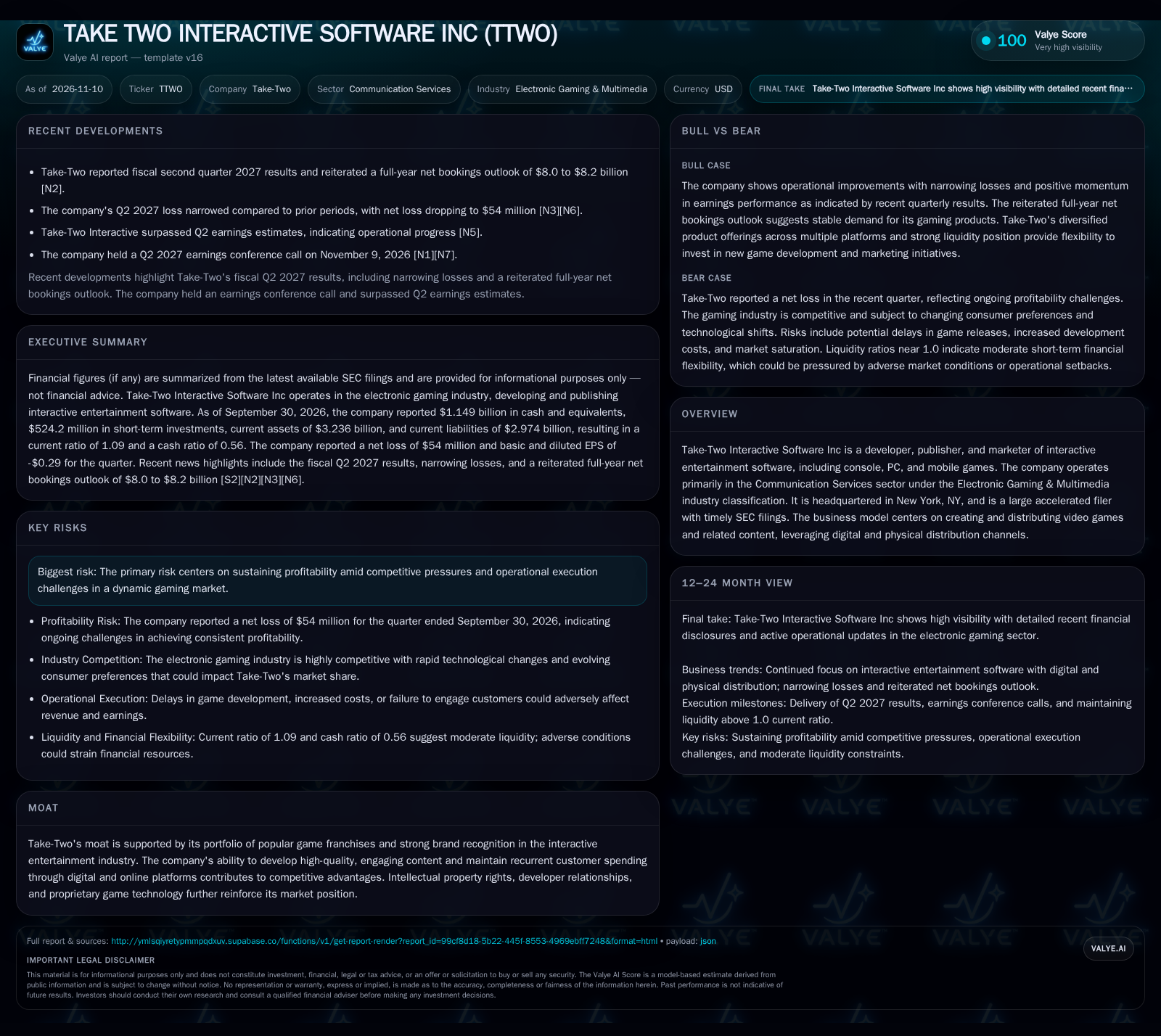
Take-Two Interactive narrowed its Q2 2027 net loss and reaffirmed a strong full-year net bookings outlook, signaling operational improvement. The near-term thesis hinges on successful new releases, sustained engagement from key franchises, and the ability to manage costs as the digital gaming ecosystem evolves [S2] [N2] [N3].
Take-Two Interactive, the publisher behind some of the gaming industry’s most iconic franchises, reported a significant narrowing of its net loss in Q2 2027 and reaffirmed its full-year bookings outlook, suggesting operational improvement amid a challenging market. Yet, the company’s liquidity ratios remain only moderately above breakeven, and the path to sustained profitability is still uncertain. The company’s future will be shaped by the commercial performance of new blockbuster titles, the durability of its recurring revenue streams, and its ability to manage development costs as the gaming industry matures and competition intensifies [S2] [N2] [N3].
Recent Financial Results: Progress and Remaining Hurdles
Take-Two reported a Q2 2027 net loss of $54 million, a marked improvement from previous periods, with basic and diluted EPS at -$0.29. This narrowing loss, coupled with the company surpassing earnings estimates, signals incremental operational progress. The company reiterated its full-year net bookings outlook of $8.0 to $8.2 billion, indicating confidence in its game pipeline and stable consumer demand. The company reported cash and liquidity metrics for the period; these figures do not by themselves establish operating runway, investment capacity, financial flexibility, or financing capacity. [S2] [N2] [N3] [N6]
Beyond headline financials, a nuanced understanding of Take-Two's operational cadence is essential. The timing of revenue recognition, heavily influenced by release schedules, can create pronounced quarter-to-quarter variability that complicates trend analysis. Furthermore, the company's ability to convert bookings into cash flow depends on the mix of digital versus physical sales, regional market dynamics, and the effectiveness of its pricing and discounting strategies. Monitoring changes in deferred revenue balances and the cadence of in-game monetization events would provide additional clarity on the sustainability of reported bookings and the quality of earnings.
How Franchise Economics Drive Take-Two’s Profit Engine
At its core, Take-Two’s business model relies on developing and publishing blockbuster games—most notably through recurring franchises like Grand Theft Auto, NBA 2K, and Red Dead Redemption—supplemented by ongoing monetization via downloadable content (DLC), microtransactions, and online services. Revenue mix is increasingly digital, with upfront sales (new releases) typically driving spikes in bookings, followed by a tail of recurrent consumer spending. This model creates high operating leverage: major releases require substantial upfront investment in development and marketing, but successful titles yield outsized margins on digital distribution and recurring in-game revenue.
The economics are characterized by a hit-driven cycle: a single franchise release can dramatically affect annual performance, while gaps between blockbusters tend to compress margins and elevate risk. Fixed costs are significant due to large development teams and technology investments, but variable costs for digital distribution are relatively low. This means that the profitability of each new title is highly sensitive to both unit sales and sustained player engagement post-launch. Capital needs are lumpy, tied to the timing and scale of development pipelines; the company’s reported liquidity position suggest that maintaining pace with industry content demands will require careful cash management, especially if a major release is delayed or underperforms.
The high fixed cost structure inherent in AAA game development imposes significant operating leverage, which means that incremental improvements in player engagement or monetization efficiency can disproportionately enhance profitability. However, this leverage also magnifies downside risk if a title underperforms. The recurring revenue components, such as microtransactions and subscriptions, serve as stabilizers by smoothing revenue volatility, but their growth rates and player acceptance are subject to evolving consumer preferences and regulatory scrutiny. Strategic investments in live-service capabilities and data analytics to optimize player lifetime value are critical levers that could enhance margin profiles if executed effectively.
Franchise Strength vs. Industry Headwinds: Where Take-Two Stands
Take-Two’s competitive standing is anchored by its portfolio of highly recognizable, often culturally influential franchises. This intellectual property moat provides both pricing power and a base of recurrent revenue. However, the company faces intense competition from other AAA publishers, well-capitalized platform holders, and a rising tide of free-to-play and live-service titles that compete for player engagement.
The industry landscape is evolving: development costs are rising, consumer tastes are fragmenting, and platform dynamics (including subscription services and cloud gaming) are shifting the economics of game publishing. Substitutes include not only traditional competitors but also user-generated content ecosystems and emerging entertainment formats. Take-Two’s ability to retain top development talent and maintain quality across sequels is critical to defending its moat. While its franchises offer switching friction and brand stickiness, the risk of franchise fatigue or a major release misstep remains high.
In an industry increasingly shaped by platform ecosystems and network effects, Take-Two's competitive moat depends not only on IP strength but also on its ability to integrate with emerging distribution channels and community platforms. The rise of cloud gaming and subscription services may compress traditional revenue streams but also offer opportunities for broader reach and recurring revenue models. The company’s capacity to innovate in game design, deliver compelling live-service content, and foster engaged player communities will be pivotal in differentiating its offerings. Additionally, the talent war for developers skilled in next-generation technologies and live operations introduces a cost and execution risk that could impact product quality and time-to-market.
What Could Drive a Step-Change in Profitability?
The most favorable scenario for Take-Two is successful execution on multiple high-profile releases—particularly if a flagship franchise launch (such as a new Grand Theft Auto installment) achieves record-breaking sales and sustains high engagement for several quarters. This would drive both a bookings surge and high-margin digital revenue, leveraging the company’s fixed cost base and producing significant operating leverage.
Upside could be further amplified if player retention and recurrent spending accelerate, either through new online features, expanded DLC, or successful live-service extensions. Confirmation of this scenario would come from a sharp uptick in net bookings, a return to GAAP profitability, and evidence of extended engagement metrics post-launch.
Sustaining Momentum Through the Content Cycle
The most plausible trajectory is continued incremental improvement in profitability as Take-Two monetizes its existing franchises and manages costs between major releases. This scenario assumes no blockbuster flop or major delay, but also no unprecedented breakout. Net bookings would remain within the guided range, with digital and recurrent revenue offsetting the volatility of launch cycles.
In this scenario, modest operating leverage would gradually narrow losses or allow for breakeven performance, and liquidity would remain stable but not ample. The company would be able to fund its development pipeline and maintain its brand equity, but would need to carefully balance investment in new IP with the risk of overextending its resources. Confirmation would come from steady bookings growth, stable or improving margins, and absence of major negative surprises in game launches or player engagement.
Execution Risk: What Happens If a Blockbuster Misses?
The primary threat to Take-Two’s thesis is a major stumble in its content pipeline—such as a high-profile title delay, underperformance of a marquee release, or a broader shift in consumer preferences away from its core franchises. Given the company’s still-narrow liquidity cushion and the high fixed costs of AAA development, a significant miss could quickly translate into deeper losses and potential pressure on development timelines or investment capacity.
Additional warning signs would include declining engagement metrics for flagship titles, evidence of franchise fatigue, or a deterioration in developer retention and product quality.
What Will Reveal If Take-Two’s Turnaround Is Real?
Net bookings growth and mix, especially the proportion of digital and recurrent consumer spending, will be crucial for gauging underlying demand and margin potential.
Performance of upcoming flagship game releases—unit sales, engagement metrics, and post-launch monetization—will test both franchise health and execution capability.
GAAP profitability trends and free cash flow generation, particularly after major launches, will indicate whether operating leverage is being realized.
Liquidity management: changes in cash, short-term investments, and current ratio, especially if a major release is delayed or costs overrun.
Player retention and engagement rates for live-service and online components of key franchises, if disclosed, would provide early signals of monetization durability.
Cost discipline in R&D and marketing spend, with visibility into major development projects, would help assess risk of margin compression.
Competitive developments: new entries from rival publishers, shifts in platform economics, or disruptive business models (e.g., subscription gaming) that could erode Take-Two’s moat.
Disclaimer: This is research-only, informational analysis and not investment advice. It may include AI-generated interpretation and general industry context. Always verify important details using primary sources.

Comments