
Office Properties Income Trust: Capital Structure Maneuvers, Asset Sales, and the Uncertain Road for Office REITs
OPI’s latest quarter underscores the high-stakes balancing act in office real estate: sizable losses, aggressive refinancing, and asset sales aimed at buying time and preserving value. With sector headwinds and liquidity pressures mounting, the company’s ability to execute disposals and stabilize cash flows will define its future.
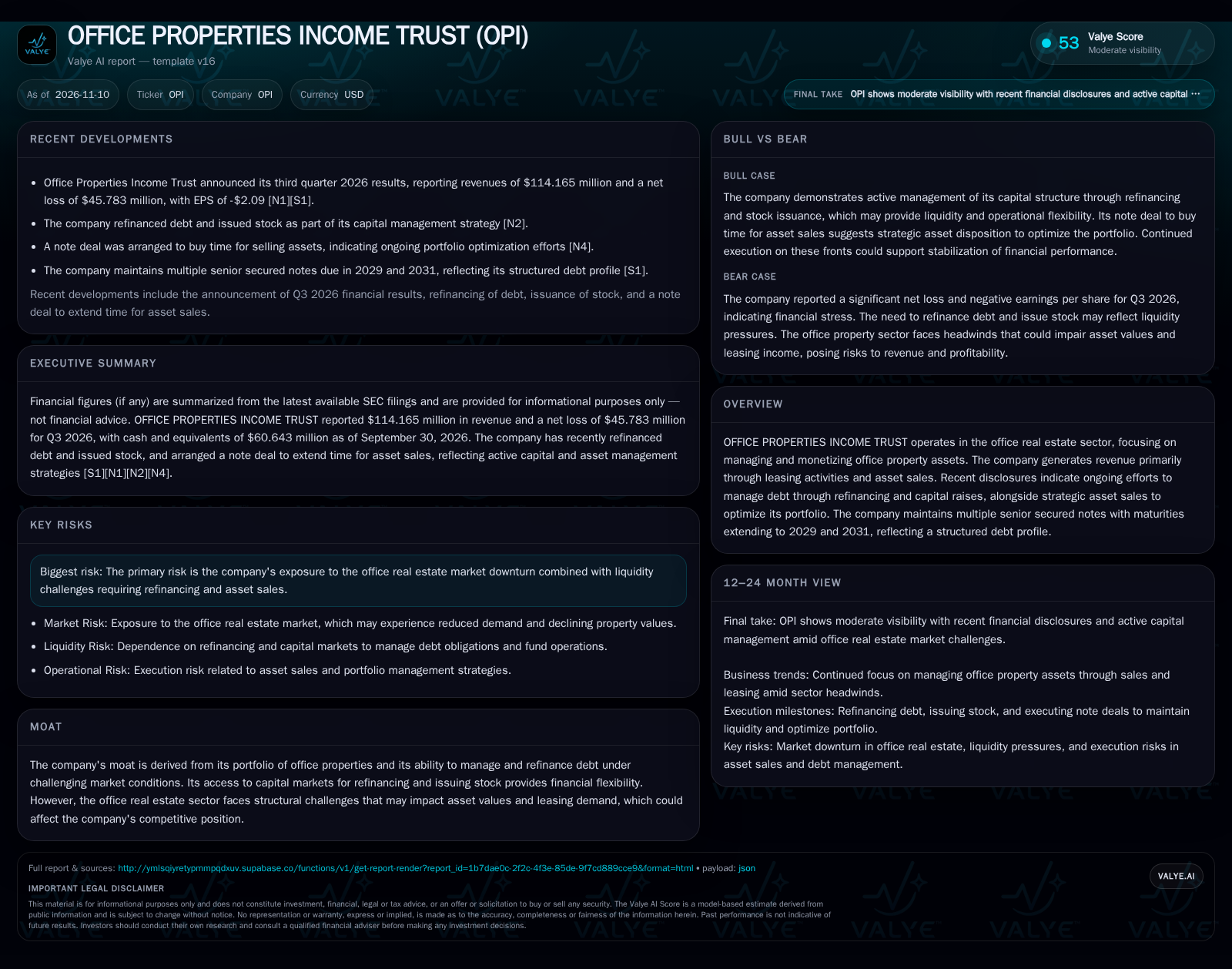
Office Properties Income Trust (OPI) reported a $45.8 million net loss for Q3 2026 alongside $114.2 million in revenue, while actively refinancing debt and arranging note deals to extend asset sale timelines. The company’s future hinges on successful portfolio optimization, capital market access, and navigating persistent office sector headwinds. Execution risk around asset sales and refinancing remains high. [S1] [N1] [N2] [N4]
Office Properties Income Trust’s (OPI) recent financials paint a picture familiar to many office-focused REITs: persistent net losses, active capital structure management, and a race against time to reposition or monetize assets in a structurally challenged sector. With $114 million in Q3 revenue but a net loss of nearly $46 million, OPI is relying on debt refinancing, equity issuance, and strategic note deals to extend its runway for asset sales and operational turnaround. The company’s ability to execute disposals, manage leverage, and withstand ongoing sector headwinds will be central to its future trajectory. [S1] [N1] [N2] [N4]
Recent Results Highlight Urgency of Capital Maneuvers
Office Properties Income Trust reported $114.165 million in revenue for Q3 2026, but also posted a significant net loss of $45.783 million and negative earnings per share of $2.09. The company held $60.643 million in cash and equivalents as of September 30, 2026. To address liquidity and operational challenges, OPI has refinanced debt, issued stock, and arranged a note deal specifically to buy time for asset sales. This sequence of moves reflects a pressing need to stabilize finances amid ongoing office sector instability and looming debt maturities. The presence of senior secured notes maturing in 2029 and 2031 further underscores the long-dated, layered nature of OPI’s capital structure. [S1] [N1] [N2] [N4]
Leasing, Asset Sales, and the Strain of Fixed Obligations
OPI’s core business economics revolve around leasing office properties and, where necessary, disposing of non-core or underperforming assets. Leasing provides recurring rental income, but the sector’s headwinds—such as weak demand, tenant downsizing, and higher vacancy rates—exert pressure on both top-line growth and lease renewal pricing. Asset sales, while a potential source of liquidity and portfolio optimization, are subject to market conditions that may force discounts or protracted timelines.
The company’s cost base is dominated by property operating expenses, maintenance, and fixed interest payments on its layered senior secured notes. These fixed obligations create high operating leverage: small declines in occupancy or rent can materially impact profitability. Refinancing and equity issuance inject liquidity but can dilute existing shareholders and increase long-term interest burdens. Capital expenditures required to maintain or reposition assets are another drain on resources, and successful asset sales may be required to fund these investments or meet debt maturities.
If OPI can execute disposals at reasonable valuations and stabilize occupancy, its cash flow profile could improve. However, persistent sector weakness may require ongoing capital raises or further asset sales, keeping the company in a cycle of defensive maneuvers.
The fixed nature of OPI’s interest expenses combined with volatile rental income creates a scenario where operating leverage can amplify financial stress during downturns. In particular, the company’s ability to pass through operating cost increases to tenants or reduce vacancy-related losses is constrained by market conditions. If leasing velocity slows further, the mismatch between cash inflows and fixed outflows could necessitate additional capital infusions or asset monetization. Furthermore, capital expenditures aimed at upgrading or repositioning assets to attract tenants may yield uncertain returns, especially if broader demand remains subdued, making investment timing and scale a delicate balancing act.
Navigating a Crowded, Structurally Challenged Office Market
OPI operates in a highly competitive office real estate market, contending with both traditional REIT peers and alternative asset managers seeking distressed opportunities. The sector’s structural risks—remote work adoption, tenant consolidation, and rising interest rates—have eroded pricing power and increased vacancy rates across many markets. Larger, diversified REITs may enjoy scale advantages and access to cheaper capital, while private buyers can sometimes move faster on opportunistic acquisitions.
OPI’s potential advantages include an established portfolio and demonstrated willingness to actively manage its capital structure. However, these strengths are counterbalanced by market-wide pressures and the risk that forced or time-sensitive asset sales could occur at below-book values. The company’s ability to differentiate on tenant mix, property quality, and capital agility is constrained by broader demand-side weakness. Substitution risk remains high, as tenants increasingly seek flexibility or shift away from traditional office footprints.
In the context of a structurally challenged office market, OPI’s competitive positioning is also influenced by geographic and tenant mix considerations. Properties located in markets with diversified economies or strong government and technology sector presence may experience less pronounced demand shocks. Conversely, exposure to markets heavily reliant on sectors undergoing transformation or contraction could exacerbate vacancy and pricing pressures. The company reported cash and liquidity metrics for the period; these figures do not by themselves establish operating runway, investment capacity, financial flexibility, or financing capacity. OPI’s ability to strategically manage these factors will affect its resilience relative to peers.
Effective Disposals and Market Stabilization Could Reignite Value
In a favorable scenario, OPI successfully executes its asset sale program, disposing of non-core properties at reasonable valuations and using proceeds to pay down debt and reinvest in higher-performing assets. Simultaneously, the broader office market experiences some stabilization—perhaps as hybrid work trends mature and leasing activity modestly recovers. Improved occupancy and reduced interest expense from deleveraging would allow OPI to return to operating profitability and enhance cash flow.
Evidence that would confirm this scenario includes a series of asset sale announcements at or near book value, declining leverage ratios, and sequential improvement in net operating income (NOI). Signs of lease renewal activity picking up or reduced vacancy rates across the portfolio would further support the bull case.
Prolonged Portfolio Restructuring and Ongoing Capital Pressure
The most plausible outcome is that OPI continues to navigate a prolonged period of portfolio optimization, with asset sales proceeding but often at discounted prices due to sector-wide distress. Leasing conditions remain challenging, leading to continued pressure on occupancy and rental rates. The company relies on serial refinancing and occasional capital raises to manage near-term obligations and buy time for strategic repositioning.
This scenario would be confirmed by steady but modest asset sale progress, persistent net losses or only marginal improvement in profitability, and recurring announcements of refinancing or debt extensions. Stagnant or slowly improving NOI, combined with limited improvement in occupancy rates, would further indicate the persistence of sector headwinds.
Asset Sale Delays or Distressed Disposals Intensify Financial Stress
In a bearish scenario, OPI encounters significant obstacles in executing asset sales, either due to weak buyer interest or deteriorating market conditions that force deeply discounted disposals. As a result, liquidity becomes strained, refinancing options narrow, and the company may face covenant breaches or be forced into highly dilutive financing. Prolonged high vacancy rates and declining rental income would exacerbate the cash flow shortfall, increasing the risk of default or distressed restructuring.
Indicators supporting this scenario would include missed or delayed asset sales, sharp declines in reported asset values, significant increases in leverage, or emergency capital raises at punitive terms. Sudden spikes in vacancy or tenant bankruptcies would further worsen the outlook.
Milestones and Metrics That Will Clarify OPI’s Trajectory
Progress on announced or anticipated asset sales, including pricing versus book value and transaction timelines.
Trends in occupancy rates and lease renewals across the portfolio—improvement would signal operational stabilization.
Changes in leverage ratios and interest coverage, particularly following major asset sales or refinancing events.
Net operating income (NOI) trends, as a gauge of underlying property performance and cash flow generation.
Details of future refinancing terms—cost of capital, covenant requirements, and maturity extension success.
Additional equity issuance or capital raises, and their impact on existing shareholder dilution.
Sector-wide signals, such as stabilization in office property values or major tenant announcements, that could influence OPI’s leasing environment.
Disclaimer: This is research-only, informational analysis and not investment advice. It may include AI-generated interpretation and general industry context. Always verify important details using primary sources.

Comments