
Xenon Pharmaceuticals: The Stakes of Transitioning from Clinical Development to Commercialization in CNS Therapeutics
Xenon Pharmaceuticals faces a pivotal period: it has filed for regulatory approval of its lead epilepsy drug azetukalner, paused psychiatry trials for tolerability review, and reported continued losses with no commercial revenues.
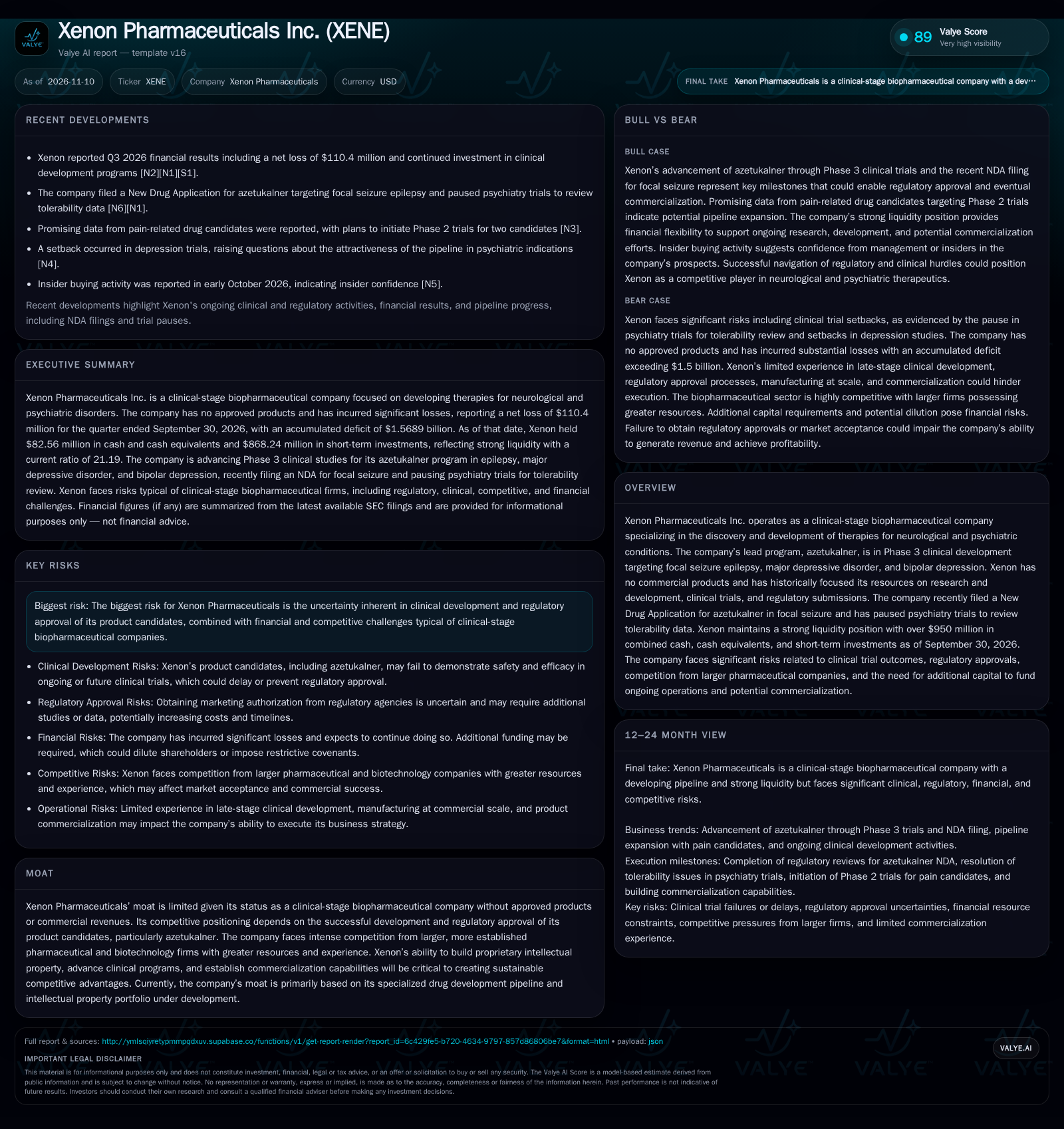
Xenon Pharmaceuticals faces a pivotal period: it has filed for regulatory approval of its lead epilepsy drug azetukalner, paused psychiatry trials for tolerability review, and reported continued losses with no commercial revenues. While its cash and investments exceed $950 million, its ability to execute late-stage development, secure approvals, and commercialize independently remains unproven in a competitive CNS drug landscape. Success depends on clinical outcomes, regulatory progress, and the conversion of pipeline promise into actual market traction. [S1] [N1] [N2] [N6]
The company’s lead asset, azetukalner, has reached the critical milestone of a New Drug Application in focal seizure epilepsy, but ongoing challenges—such as paused psychiatry trials and a lack of commercial infrastructure—underscore the company’s vulnerability in a fiercely competitive neurological and psychiatric drug market. Xenon’s ability to convert scientific promise and financial runway into regulatory success and sustainable value will shape its next chapter.
Regulatory Milestones and Pipeline Setbacks Define Xenon's Current Position
Xenon Pharmaceuticals’ most consequential development is the filing of a New Drug Application (NDA) for azetukalner in focal seizure epilepsy, representing a potential gateway to its first commercial product and revenue stream. This regulatory step is juxtaposed against a pause in psychiatry trials for the same molecule, due to tolerability concerns, and a recent setback in depression studies—both of which temper near-term expectations for broader CNS indications. The company reported a net loss of $323.5 million for the first nine months of 2026 and an accumulated deficit of $1.57 billion, underscoring the capital intensity and risk profile of late-stage drug development. The company reported cash and liquidity metrics for the period; these figures do not by themselves establish operating runway, investment capacity, financial flexibility, or financing capacity. However, Xenon remains pre-revenue, with all value contingent upon clinical and regulatory outcomes. [S1] [N1] [N2] [N6]
How Value Could Be Created: The Economics of CNS Drug Commercialization
Xenon’s business model is typical of clinical-stage biopharma: heavy upfront investment in R&D, clinical trials, and regulatory submissions, with the prospect of high-margin sales if a drug is approved. For CNS indications like epilepsy and depression, successful commercialization can yield substantial returns due to large patient populations and chronic use dynamics. Pricing for novel antiepileptics is often premium, but actual realized value depends on formulary access, insurer coverage, and competitive positioning.
Operating leverage in this model is extreme: R&D and SG&A costs are largely fixed until a drug is approved, after which incremental revenue from drug sales can drop to the bottom line if sales infrastructure and manufacturing scale-up are managed efficiently. However, the transition from clinical-stage to commercial-stage is notoriously difficult—requiring investments in sales force, distribution, pharmacovigilance, and payer engagement. If Xenon secures approval for azetukalner, it will face decisions about direct commercialization versus partnership or licensing, each with different margin, capital, and risk implications.
The company’s large cash and investment reserves reduce near-term dilution risk but do not eliminate the eventual need for additional capital if commercialization is slower or more expensive than planned. The economics of pipeline expansion—such as advancing pain candidates into Phase 2—may also strain resources if not carefully sequenced.
Assessing Xenon's Place in the CNS Therapeutics Landscape
Xenon operates in a CNS therapeutics market dominated by large pharmaceutical and biotechnology companies with proven drug development and commercialization infrastructure. These incumbents benefit from established sales channels, payer relationships, and the ability to bundle CNS portfolios—raising the bar for new entrants. For epilepsy, competition includes both generic and branded antiepileptics, some with multi-decade safety records and broad prescriber familiarity.
Xenon’s competitive edge will depend on the clinical profile of azetukalner—particularly efficacy, safety, and tolerability compared to standard of care. Intellectual property protection and any differentiated mechanism of action may provide some insulation, but these factors alone rarely constitute a durable moat in CNS unless paired with compelling clinical evidence and effective market access strategies.
The pause in psychiatry trials is a reminder that expansion into depression or bipolar markets is fraught with higher clinical risk and even greater competition from entrenched players. As a late-stage but pre-commercial firm, Xenon must also contend with the risk that larger companies could outcompete or outbid for key commercial opportunities, especially if Xenon lacks scale or execution experience.
What Would a Transformative Win Look Like for Xenon?
A favorable scenario unfolds if azetukalner receives FDA approval for focal seizure epilepsy, launches successfully, and demonstrates rapid uptake due to superior efficacy or safety, leading to meaningful market share against incumbents. This would validate Xenon’s R&D approach, generate its first recurring revenue, and potentially unlock pipeline value in pain and psychiatric indications if tolerability issues are resolved.
Additional upside could come from strategic partnerships or licensing deals that accelerate commercialization and reduce execution risk, allowing Xenon to leverage the infrastructure and payer access of a larger partner while retaining significant economics.
Evidence confirming this scenario would include: positive regulatory feedback and approval for azetukalner; early prescription trends outpacing analyst expectations; resolution and resumption of paused psychiatry trials; and/or the announcement of commercial partnerships with established CNS players. Progression of pain candidates into advanced clinical trials would further bolster the pipeline story.
Likely Trajectory: Incremental Progress, Measured Risk Management
The most plausible path for Xenon involves a mix of progress and setbacks: azetukalner may secure regulatory approval for epilepsy, but initial launch would likely be measured, with market penetration constrained by entrenched competitors and the need to build or partner for a commercial infrastructure. Psychiatry indications may remain on hold or advance only after further safety work, delaying any contribution from those markets.
Pipeline expansion into pain indications could proceed, but with typical attrition risk and long timelines to potential approval. Xenon would continue to consume cash as it invests in commercialization and further R&D, with periodic reassessment of capital needs and partnership structures.
Confirmation of this scenario would come from a modest but successful epilepsy launch, ongoing but cautious investment in the pipeline, and measured hiring or partnership moves in commercial functions. Falsification would come from either a regulatory setback or an unexpectedly rapid and profitable launch.
Risks of Clinical Failure or Commercial Execution Missteps
The adverse scenario materializes if azetukalner fails to win regulatory approval or is approved but fails to gain traction due to safety, efficacy, or reimbursement challenges. Delays or negative outcomes in psychiatry or pain trials would further erode pipeline value, while ongoing cash burn without commercial revenue forces Xenon to seek dilutive financing or scale back operations.
Operationally, Xenon’s lack of experience in large-scale manufacturing and commercialization could exacerbate launch difficulties, leading to slow adoption, missed forecasts, or costly missteps in market access strategy. The company could also become a takeover target at distressed valuations if pipeline setbacks accumulate.
This scenario would be confirmed by regulatory rejections or major label restrictions, persistent setbacks in pipeline trials, rapid cash burn without offsetting revenue, and/or announcements of restructuring or emergency financing.
Milestones and External Forces That Will Shape Xenon's Trajectory
FDA decision and label specifics for azetukalner in focal seizure epilepsy—timelines, restrictions, and post-marketing requirements.
Resolution status of tolerability issues in paused psychiatry trials, and whether those trials resume or are terminated.
Early prescription and market uptake data for azetukalner, if commercialized, including formulary wins and payer coverage (if disclosed).
Announcements of commercial partnerships, co-promotion deals, or out-licensing for any pipeline asset.
Progression of pain candidates into and through Phase 2 trials, including initial efficacy and safety signals (if disclosed).
Changes in cash burn rate and updated forecasts for runway given commercialization investments and ongoing R&D.
Management or board changes, especially those adding commercial or late-stage development expertise.
Material shifts in the competitive landscape, such as new CNS drug approvals or major M&A among peer companies.
Disclaimer: This is research-only, informational analysis and not investment advice. It may include AI-generated interpretation and general industry context. Always verify important details using primary sources.

Comments