
Praxis Precision Medicines: Regulatory Catalysts, Cash Position, and the Stakes of Neurology Drug Development
With a PDUFA date for Relutrigine and Breakthrough Therapy Designation for Elsunersen, the company’s progress—and value—hinges on clinical outcomes, regulatory success, and eventual commercialization prospects.
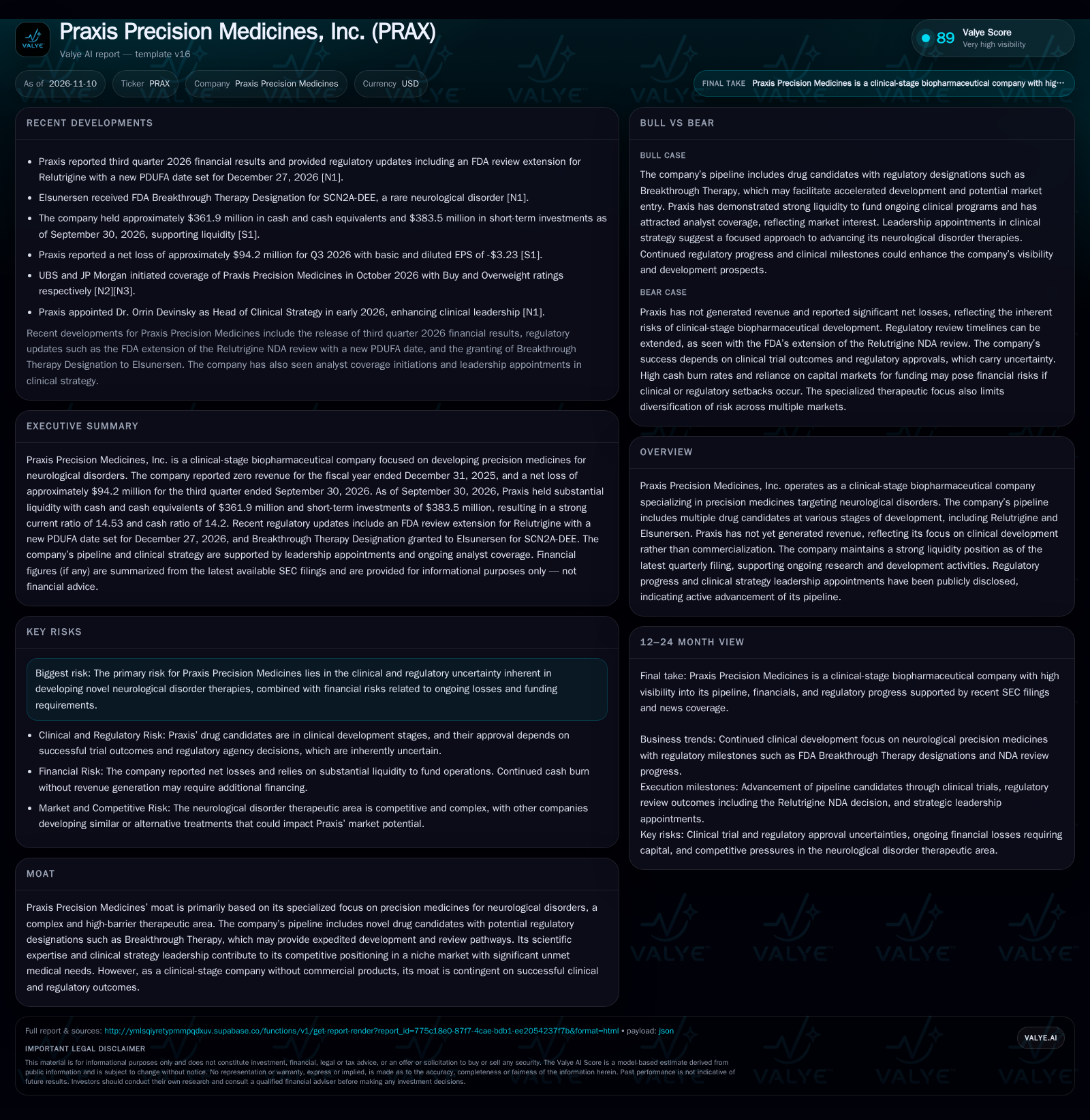
Praxis Precision Medicines is a clinical-stage biopharma with no product revenue, a substantial cash and investment cushion (~$745M as of September 2026), and key late-stage pipeline assets for neurological disorders. Forthcoming regulatory milestones—including an FDA decision on Relutrigine and Breakthrough Therapy status for Elsunersen—set the stage for potential value inflection, but the company remains exposed to clinical, regulatory, and funding risks typical of its stage. Analyst interest and new clinical leadership underscore market attention and strategic focus, but ultimate success depends on pipeline execution and regulatory approvals. [S1] [N1]
Praxis Precision Medicines, Inc. is approaching a defining moment in its evolution as a clinical-stage biotech. With no commercialized products and ongoing net losses, Praxis’s future now turns on the outcomes of late-stage regulatory reviews—most notably the pending FDA decision on Relutrigine and the advancement of Elsunersen, which holds Breakthrough Therapy Designation for a rare neurological disorder. [S1] [N1]
Why the Next 12 Months Are Crucial for Praxis
Praxis Precision Medicines reported zero revenue for 2025 and a net loss of $94.2 million in Q3 2026, underscoring its status as a clinical-stage company focused entirely on R&D, not commercial sales. Its liquidity is substantial, with $361.9 million in cash and equivalents plus $383.5 million in short-term investments as of September 30, 2026. This reported cash balance supports ongoing trials and regulatory processes. Most notably, Relutrigine’s FDA review has been extended, with a new PDUFA date of December 27, 2026—a potential inflection point if approved. Elsunersen’s Breakthrough Therapy Designation for SCN2A-DEE signals another high-impact regulatory opportunity. These developments put Praxis at a crossroads: clinical and regulatory outcomes in the next year could determine whether it achieves commercial viability or must return to capital markets. [S1] [N1]
How Praxis Could Monetize Neurology Innovation
Praxis’s economics are currently defined by R&D expenditure and cash burn, typical of late-stage biotechs. Until regulatory approval and commercialization, the company’s only inflows are from financing activities. If Relutrigine or Elsunersen are approved, Praxis would likely pursue specialty pharma launch models—targeting neurologists and rare disease centers with relatively high per-patient pricing justified by unmet need and limited competition. The gross margin profile for innovative neurology drugs can be attractive, but commercialization requires significant investment in medical affairs, market access, and possibly a specialty sales force.
The fixed cost base is dominated by ongoing clinical trials, regulatory submissions, and pre-launch activities, while variable costs would rise markedly if the company transitions to commercial operations. High operating leverage is possible if product launches are successful, as incremental revenue from high-value drugs can outpace the need for proportional increases in SG&A. However, failure in late-stage trials or regulatory rejection would leave Praxis with a large fixed cost base and no offsetting revenue, making capital raise timing and terms critical.
The company reported cash and liquidity metrics for the period; these figures do not by themselves establish operating runway, investment capacity, financial flexibility, or financing capacity. The transition from clinical to commercial stage would require new investments in infrastructure, but if successful, could create a step-change in the company’s economics.
Specialization in Neurology: A Double-Edged Sword
Praxis’s focus on precision medicines for neurological disorders creates both opportunity and risk. The company’s pipeline targets high-barrier, complex indications like SCN2A-DEE and epilepsy, where few effective therapies exist and regulatory agencies may be more accommodating to novel, well-validated mechanisms. The FDA’s Breakthrough Therapy Designation for Elsunersen is a sign of potential differentiation, as expedited review pathways are typically reserved for treatments addressing significant unmet need.
However, this specialization also means Praxis is highly exposed to the scientific and regulatory risks of its lead programs: failure in a key asset can significantly erode its value. The competitive landscape features established neurology players and emerging biotechs with overlapping targets—anyone achieving superior clinical outcomes or faster approval could outflank Praxis. Moreover, generic and off-label therapies remain entrenched in neurology, making market access and reimbursement complex even after approval.
Switching costs in rare neurology are high for patients but less so for prescribers and payers, who may be incentivized to adopt new therapies only if they show clear, meaningful benefit. Praxis’s moat, if established, will depend on robust clinical data, regulatory exclusivity, and successful engagement with specialist prescribers and payer gatekeepers.
What Success Looks Like: Regulatory Wins Drive Value Creation
The most favorable scenario for Praxis is regulatory approval of Relutrigine at the December 2026 PDUFA date, followed by positive clinical and regulatory milestones for Elsunersen. This would immediately transform Praxis from a pre-commercial R&D company into a commercial-stage rare disease player, unlocking revenue and possibly attracting partnership or acquisition interest. Commercial launch in high-value neurology markets could yield rapid revenue growth, particularly if the company secures premium pricing and reimbursement.
Confirmation of this scenario would include: FDA approval of Relutrigine with a broad label; positive pivotal readouts or accelerated approval for Elsunersen; rapid buildout of commercial infrastructure; and signals of payer acceptance. Additional upside could come from pipeline expansion or out-licensing deals. Evidence refuting the upside would be regulatory rejection, clinical failures, or inability to secure reimbursement even after approval.
Steady Progress with Delayed Commercialization
The most plausible path is one of continued clinical development and regulatory engagement, with at least one pipeline asset achieving approval within 12-24 months, but with launch timelines and uptake slower than optimistic projections. Praxis would remain focused on advancing its lead programs, with liquidity sufficient for near-term operations but a likely need for additional capital before achieving cash flow breakeven.
This scenario would be confirmed by progress toward NDA submission or regulatory approval, incremental clinical milestones, and prudent cost management. Delays in regulatory review, additional data requests, or slower-than-expected uptake post-approval would support this base case. Evidence against the base scenario would be either rapid, unimpeded approvals and launches (upside) or major clinical/regulatory setbacks (downside).
Clinical or Regulatory Setbacks Undermine the Investment Case
A negative scenario would see Praxis’s lead candidates fail pivotal trials or receive regulatory rejections, eliminating the near-term path to commercialization. In this case, the company would continue to incur significant fixed costs, rapidly drawing down its cash reserves and likely forcing a dilutive capital raise or strategic pivot. The absence of approved products would also weaken its position in partnering discussions and could prompt restructuring or asset sales.
This scenario would be confirmed by negative clinical data, FDA complete response letters, or public statements regarding failed endpoints or insurmountable regulatory hurdles. Evidence against this scenario would be any regulatory or clinical win that restores a path to commercialization.
Milestones That Will Define Praxis’s Trajectory in the Next Year
The outcome of the FDA PDUFA decision for Relutrigine, currently set for December 27, 2026, will be pivotal. [N1]
Any public update on Elsunersen’s clinical progress, regulatory filings, or accelerated approval pathway would help clarify the commercialization timeline. [N1]
Announcements regarding commercial infrastructure buildout, sales force hiring, or payer engagement would signal readiness for launch—if and when approval is secured.
Detailed clinical data releases for Relutrigine, Elsunersen, or other pipeline assets would allow assessment of true differentiation and market potential.
Any indication of partnership, licensing, or acquisition discussions would provide external validation and potentially de-risk the story.
Management commentary on prioritization of pipeline assets, cost discipline, or strategic pivots in the face of setbacks would inform the company’s adaptability.
Disclaimer: This is research-only, informational analysis and not investment advice. It may include AI-generated interpretation and general industry context. Always verify important details using primary sources.

Comments