
Bakkt’s Institutional Pivot: Stablecoin Infrastructure, Regulatory Scale, and the Stakes of Counterparty Exposure
Bakkt, Inc. has emerged from a strategic overhaul with a focus on institutional digital asset infrastructure, integrating stablecoin payment rails and scaling regulatory coverage—yet its model now faces new credit and operational complexities as it targets $6 billion in first-half 2027 transaction volume.
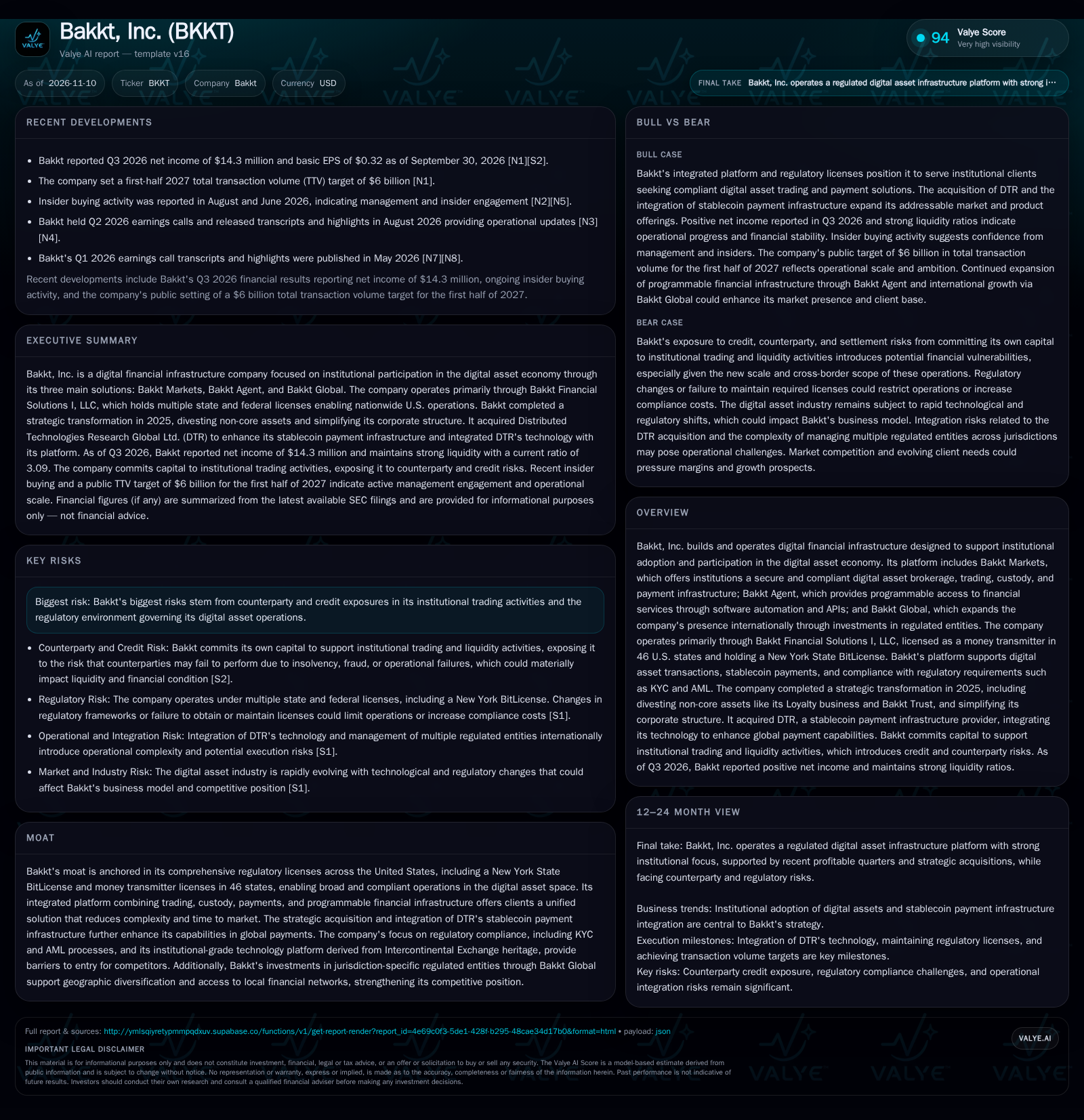
Bakkt’s transformation into a focused institutional digital asset platform has yielded positive net income, expanded stablecoin capabilities via the DTR acquisition, and a high bar for 2027 transaction volume. [N1] [S1] [S2]
Bakkt, Inc. has completed a major strategic transformation, shedding non-core assets and consolidating its corporate structure to focus squarely on regulated digital asset infrastructure for institutions. The integration of DTR’s stablecoin payment technology and a series of regulatory licenses across the U.S. have set the stage for Bakkt to scale its programmable finance platform globally. With positive net income for Q3 2026 and a public $6 billion TTV goal for the first half of 2027, Bakkt’s ambitions are clear. [S1] [S2] [N1]
Bakkt’s Strategic Overhaul: Profitability, Stablecoins, and Ambitious Volume Targets
Bakkt reported Q3 2026 net income of $14.3 million, with basic EPS of $0.32, marking a return to profitability as of September 30, 2026. [S2] [N1]
The company has completed a multi-year transformation, selling its Loyalty business and Bakkt Trust, and acquiring DTR—a stablecoin payment infrastructure provider. The DTR acquisition aims to unify global stablecoin payments with Bakkt’s regulated trading and compliance platform. [S1]
Bakkt has publicly set a $6 billion total transaction volume (TTV) target for the first half of 2027, highlighting its growth ambitions. Recent insider buying in 2026 signals management’s alignment. [N1] [N2] [N5] [N6]
How Bakkt’s Platform Could Monetize Institutional Digital Asset Flows
Bakkt’s business model is designed around providing compliant digital asset infrastructure—trading, custody, payments, and programmable financial services—for institutional clients. Revenue likely derives from transaction fees (trade execution, payment flows), custody fees, and potentially value-added services such as compliance automation and API integrations. The company’s shift to institutional focus and programmable infrastructure (via Bakkt Agent) suggests a mix of usage-based and possibly recurring revenue streams, though the specific contract and pricing mechanisms are not disclosed in the report.
The acquisition of DTR extends Bakkt’s reach into global stablecoin payments, which could enable higher-margin cross-border payment volumes and new revenue channels if adoption scales. However, Bakkt now commits its own capital to support trading and liquidity activities, introducing variable funding costs and credit exposures. If volumes and spreads are sufficient, this model could deliver operating leverage, but adverse credit events or market volatility could quickly erode these gains.
Fixed costs are driven by regulatory compliance, licensing, technology infrastructure, and personnel; scaling transaction volumes over this fixed-cost base is essential for margin expansion. Capital needs may increase as Bakkt supports larger trading books and cross-border settlements, amplifying the importance of risk management and efficient capital allocation.
Regulatory Coverage and Integrated Infrastructure: Where Bakkt Stands Versus Peers
Bakkt’s competitive edge is rooted in its broad regulatory footprint—licensed as a money transmitter in 46 U.S. states with a New York State BitLicense—enabling it to serve institutions requiring fully compliant digital asset services. The integrated platform, combining custody, trading, payments, and programmable APIs, reduces onboarding and operational friction for clients versus piecemeal solutions.
The addition of DTR’s stablecoin payment rails differentiates Bakkt in the growing institutional stablecoin settlement space, where regulatory clarity and compliance are increasingly valued. However, the market remains highly competitive, with incumbent financial infrastructure providers, crypto-native exchanges, and fintechs all vying for institutional flows.
Barriers to entry include regulatory approvals, technology integration, and reputational trust. Yet, as stablecoin regulation evolves and global jurisdictions set new requirements, Bakkt’s multi-entity structure and need for ongoing license maintenance could be both a strength and a source of cost and complexity. Competitors with greater scale or deeper integrations into legacy financial networks may challenge Bakkt’s expansion, especially if switching costs for institutions remain moderate.
What Success Looks Like: Institutional Adoption and Stablecoin Payment Scale
If Bakkt achieves its $6 billion TTV target for 1H 2027, it would signal meaningful institutional adoption of its platform and stablecoin payment infrastructure. Success would likely stem from seamless integration of DTR’s technology, robust risk controls preventing material credit or counterparty losses, and continued expansion of regulatory licenses supporting new client onboarding.
Upside could be amplified if programmable financial infrastructure (Bakkt Agent) drives sticky, recurring software/API revenue and if Bakkt secures anchor clients in cross-border payments or institutional trading. Operating leverage would become visible through margin expansion as transaction volumes rise faster than fixed costs.
Evidence confirming this scenario would include TTV growth outpacing sector averages, large-scale client wins, and stable or improving net income margins. Additional signals would be successful international expansion and regulatory milestones enabling entry into new markets or asset classes.
Sustained Growth Hinges on Integration and Prudent Risk Management
The most plausible outcome is that Bakkt achieves moderate TTV growth, benefits from new stablecoin payment capabilities, and maintains profitability, but faces periods of margin volatility as it adjusts to the operational realities of cross-border credit and counterparty exposures.
Integration of DTR’s systems and processes may proceed incrementally, with some delays or cost overruns as Bakkt adapts to new jurisdictions and regulatory requirements. The company’s fixed-cost base in compliance and technology remains high, but steady onboarding of institutional clients supports gradual operating leverage.
This scenario would be confirmed by TTV growth aligning with public targets (even if not dramatically exceeding them), absence of major credit losses, and incremental improvement in net income. Falsification would come from integration setbacks, regulatory license challenges, or material losses due to counterparty defaults.
How Counterparty or Regulatory Shocks Could Disrupt Bakkt’s Momentum
Bakkt’s expanded trading and liquidity activities expose it to the risk that one or more counterparties fail to perform, causing significant credit or settlement losses. A major default—especially in a volatile or illiquid market—could rapidly deplete Bakkt’s capital, force deleveraging, and erode client and regulator confidence.
Regulatory setbacks—such as loss of a key license, failure to comply with evolving stablecoin regulations, or cross-border legal disputes—could restrict Bakkt’s ability to operate in critical markets or onboard new clients, compressing revenue and increasing compliance costs.
This scenario would be confirmed by sharp declines in TTV, negative net income, disclosure of material credit events, or regulatory enforcement actions. Early warning could come from persistent negative operating cash flow, difficulty renewing licenses, or client attrition due to operational or reputational issues.
Milestones and Metrics That Will Define Bakkt’s Institutional Trajectory
Progress toward the $6 billion first-half 2027 TTV target—monthly or quarterly TTV disclosures, if provided, would clarify adoption pace.
Material credit or counterparty loss events—disclosure of any significant trading losses or settlement failures would test risk management.
Integration milestones for DTR technology—updates on platform unification and new client launches would indicate execution quality.
International expansion and new regulatory licenses—additions or losses of licenses would signal ability to scale in new jurisdictions.
Recurring revenue mix and client retention rates—if disclosed, these would reveal the stickiness and scalability of Bakkt’s programmable infrastructure.
Gross and net margin trends as transaction volumes grow—margin expansion would support the operating leverage thesis.
Insider buying/selling activity—continued insider engagement could reinforce or challenge confidence in the strategy.
Regulatory or legal developments impacting stablecoin or digital asset infrastructure—new rules, guidance, or enforcement actions would directly affect Bakkt’s business model.
Disclaimer: This is research-only, informational analysis and not investment advice. It may include AI-generated interpretation and general industry context. Always verify important details using primary sources.

Comments