
TG Therapeutics: BRIUMVI’s Commercial Trajectory, Financial Resilience, and MS Franchise Potential
With BRIUMVI’s U.S. and European launches gaining traction, TG Therapeutics’ recent profitability and reported balance sheet position highlight operational progress. The core question for investors is whether commercial execution and pipeline expansion can overcome entrenched competitors and reimbursement challenges in the evolving MS therapy landscape.
TG Therapeutics is leveraging BRIUMVI’s expanding commercial presence in the MS market, recent net profitability, and reported liquidity position to fuel further growth. The company’s long patent runway and pipeline initiatives provide strategic options, but market acceptance, pricing pressures, and intense competition remain key uncertainties. Progress in subcutaneous formulations and ex-U.S. partnerships could meaningfully alter the growth trajectory if execution is sustained.
TG Therapeutics has moved beyond clinical promise to demonstrate commercial traction with BRIUMVI, its anti-CD20 antibody for relapsing multiple sclerosis. The company’s challenge is to translate early commercial wins and a deep patent moat into durable market share in a competitive MS landscape dominated by established incumbents and evolving payer expectations.
Profitability Trends and Revenue Outlook Reflect Commercial Advances
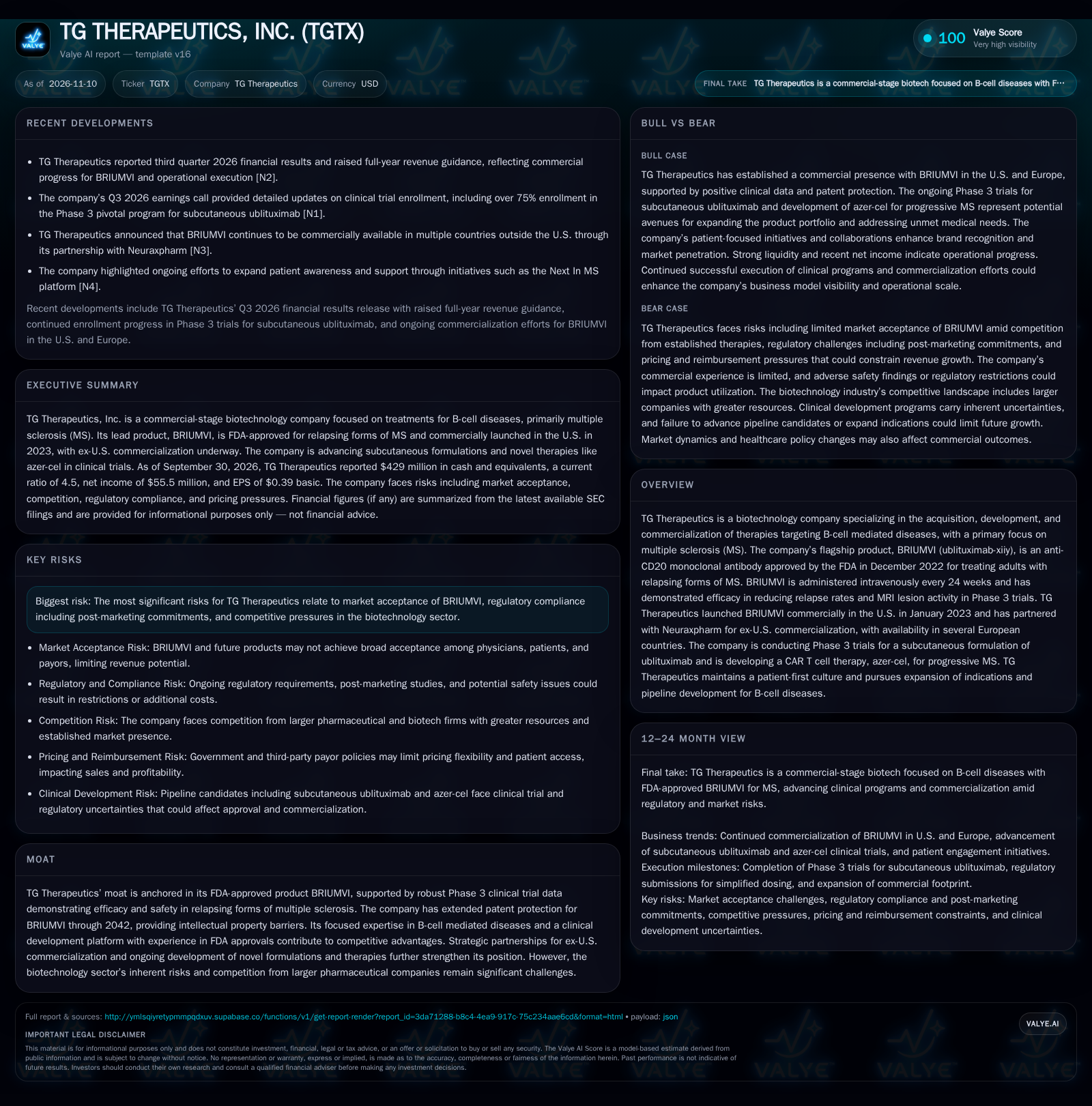
TG Therapeutics reported net income of $55.5 million for the third quarter of 2026, with basic earnings per share of $0.39 and diluted EPS of $0.35 [S2]. This marks a period of sustained profitability, reflecting improved operational scale as BRIUMVI gains commercial traction. The company raised its full-year revenue guidance, indicating confidence in ongoing BRIUMVI uptake and its ability to navigate the competitive MS therapy market [N2]. As of September 30, 2026, TG Therapeutics had $429.4 million in cash and equivalents, $75.3 million in short-term investments, and a current ratio of 4.5 [S2]. The company reported cash and liquidity metrics for the period; these figures do not by themselves establish operating runway, investment capacity, financial flexibility, or financing capacity. The combination of positive earnings and increased revenue expectations signals that BRIUMVI is beginning to achieve meaningful commercial penetration, at least in the near term.
Beyond the headline financial metrics, a deeper examination of TG Therapeutics’ cash flow dynamics and capital allocation strategy would provide additional insight into its operational resilience. For instance, understanding the proportion of cash flow derived from operating activities versus financing activities would help clarify whether profitability is translating into sustainable internal funding or if external capital remains a significant contributor. Moreover, the company's investment in research and development relative to sales could indicate the balance between maintaining current commercial momentum and supporting future pipeline growth. Such analysis is critical given the capital-intensive nature of biopharmaceutical commercialization and the long timelines often required to realize returns on pipeline investments.
BRIUMVI’s Potential Impact on TG Therapeutics’ Earnings Dynamics
The economics of TG Therapeutics hinge on BRIUMVI’s market performance and the company’s ability to leverage fixed investments in commercialization infrastructure. BRIUMVI, an anti-CD20 monoclonal antibody, is administered as a one-hour infusion every 24 weeks, positioning it as a potentially more patient-friendly alternative to competitors requiring longer administration or more frequent dosing. If physicians and payers recognize clinical parity or superiority, this profile could enable premium pricing or facilitate volume capture. However, the MS therapy market is crowded, with multiple established anti-CD20 agents already on the market—suggesting price competition and formulary negotiations will be persistent features.
TG Therapeutics’ path to operating leverage depends on scaling BRIUMVI sales faster than incremental costs associated with salesforce expansion, medical affairs, and post-marketing commitments. The company’s current profitability indicates that fixed costs are being absorbed by revenue growth, but future margin expansion likely depends on successfully driving further adoption and managing rebate/discount dynamics.
The pricing strategy for BRIUMVI will be a pivotal factor influencing TG Therapeutics’ earnings trajectory, particularly in light of the competitive landscape and payer dynamics. If the company opts for a premium pricing model justified by clinical differentiation and patient convenience, it must also anticipate and manage payer pushback that could manifest as restrictive formulary placements or heightened rebate demands. Conversely, adopting a more aggressive pricing strategy to rapidly gain market share could compress margins, impacting profitability despite volume gains. Additionally, the durability of reimbursement arrangements over time will be crucial; shifts in payer policies or the introduction of biosimilars could alter the economics substantially. Therefore, ongoing monitoring of pricing trends and payer relations will be essential to assess the sustainability of the current earnings profile.
Maintaining Market Position Amid Intense MS Competition
TG Therapeutics faces entrenched competitors in the MS space, including large pharmaceutical companies with established anti-CD20 monoclonal antibodies and deep payer relationships. BRIUMVI’s patent protection through 2042 provides a critical intellectual property barrier, but success will depend on more than IP: clinical differentiation, patient/provider experience, and payer acceptance are all essential. The company’s focus on B-cell mediated diseases and experience with FDA approvals lend credibility, while partnerships for ex-U.S. commercialization extend its reach without requiring a full-scale global infrastructure.
However, the risk of substitution is real: existing therapies for MS, including ocrelizumab and ofatumumab, are well-known to clinicians and payers, and may benefit from established reimbursement pathways. Switching costs for patients and prescribers are significant but not insurmountable, especially if BRIUMVI can demonstrate either superior efficacy, safety, or convenience. Pricing pressure from payers, especially in the U.S., could erode margins if BRIUMVI is not clearly differentiated. The development of subcutaneous formulations and expansion into additional B-cell diseases may provide future levers for competitive advantage, but these are not yet proven in the market.
The competitive dynamics in the MS therapy market also suggest that TG Therapeutics must continuously innovate beyond initial product offerings to maintain and grow its market position. This could include enhancements in patient support programs, digital health integrations to improve adherence, or real-world evidence generation to substantiate BRIUMVI’s value proposition. Such initiatives may increase upfront costs but could strengthen relationships with providers and payers, creating higher switching costs and improving long-term retention. Moreover, strategic collaborations or licensing arrangements could expand geographic reach and diversify risk, but these require careful alignment of incentives and execution capabilities. The interplay between these factors will determine how effectively TG Therapeutics can defend its market share against both established incumbents and emergent entrants.
Characteristics of a Successful BRIUMVI Franchise Expansion
A favorable trajectory for TG Therapeutics would be characterized by continued acceleration in BRIUMVI sales, driven by growing acceptance among neurologists and payers, and supported by positive real-world evidence of efficacy and safety. If the subcutaneous formulation in development demonstrates comparable efficacy with a superior administration profile, TG Therapeutics could gain a meaningful edge over competitors, potentially expanding its addressable market to patients and providers who prioritize convenience.
Ex-U.S. partnerships, particularly in Europe, could scale more rapidly than anticipated if reimbursement is secured and local physician education efforts succeed. Expanding BRIUMVI’s label or securing new indications in related B-cell mediated diseases would further leverage the current commercial infrastructure. Confirmation of this scenario would come from consecutive quarters of accelerating revenue growth, increased market share disclosures (if provided), and positive physician and patient feedback in independent surveys. Regulatory approvals for new formulations or expanded indications would further validate the upside case.
Ongoing Commercial Efforts Driving Gradual Market Share Growth
The most plausible path for TG Therapeutics is a period of steady, but measured, BRIUMVI adoption in both the U.S. and select European markets. Revenue growth would be driven by gradual physician uptake, supported by ongoing patient and provider education initiatives.
In this scenario, BRIUMVI secures a modest share of the relapsing MS market, coexisting with incumbent anti-CD20 therapies. Margins remain healthy, but pricing concessions and higher rebates are necessary to secure formulary access. The company’s next wave of growth would depend on successful clinical development and approval of subcutaneous BRIUMVI or pipeline assets such as azer-cel. Evidence supporting this scenario would include stable quarter-over-quarter revenue growth, contained operating expenses relative to sales, and incremental progress on pipeline milestones.
Potential Impacts of Competitive and Regulatory Challenges on Progress
A less favorable outcome would stem from slower-than-expected BRIUMVI adoption, driven by entrenched physician prescribing habits, payer reluctance to add new high-cost therapies, or insufficient differentiation versus established anti-CD20 agents. Reimbursement challenges—such as exclusion from key formularies or aggressive step therapy requirements—could limit patient access and force deeper discounts, compressing margins.
Regulatory setbacks, including adverse post-marketing safety findings or delays in expanding the label, would further constrain growth. If clinical programs for new formulations or pipeline candidates underperform or are delayed, TG Therapeutics’ growth options would narrow. Confirmation of a downside scenario would include stagnating or declining BRIUMVI revenues, rising SG&A expenses without corresponding sales growth, or negative updates from regulatory agencies or major payers.
Upcoming Developments Influencing TG Therapeutics’ Future Value
Quarterly BRIUMVI revenue growth rates, with attention to sequential acceleration or deceleration.
Market share metrics for BRIUMVI in the relapsing MS segment, if disclosed by the company or third parties.
Progress and regulatory updates on subcutaneous BRIUMVI and other pipeline assets, including azer-cel.
Updates on ex-U.S. commercialization, particularly reimbursement wins and launch timelines in Europe.
Gross-to-net discount trends and the impact of payer negotiations on realized pricing.
Real-world safety and efficacy data, especially any emerging post-marketing safety issues.
SG&A expense trends relative to revenue, as a measure of commercial efficiency and scale.
Announcements of expanded indications or successful clinical trial results that could broaden BRIUMVI’s addressable market.
Disclaimer: This is research-only, informational analysis and not investment advice. It may include AI-generated interpretation and general industry context. Always verify important details using primary sources.

Comments