
Bain Capital Specialty Finance: Dividend Discipline, Middle-Market Exposure, and the Stakes of Credit Cyclicality
Bain Capital Specialty Finance, Inc. The cited source reports dividend-related activity; that disclosure alone does not establish dividend-policy continuity, management confidence, or a material constraint on capital flexibility. As credit markets fluctuate and economic headwinds loom, the company’s ability to sustain payouts and manage risk exposures will define its long-term value proposition.
The cited source reports dividend-related activity; that disclosure alone does not establish dividend-policy continuity, management confidence, or a material constraint on capital flexibility. However, the company faces risk from economic downturns, regulatory leverage limits, and the potential for shareholder dilution through its Dividend Reinvestment Plan. The durability of its earnings and payout depends on portfolio credit quality, market access, and active risk management as economic conditions evolve. [S2] [N1]
The cited source reports dividend-related activity; that disclosure alone does not establish dividend-policy continuity, management confidence, or a material constraint on capital flexibility. The cited source reports dividend-related activity; that disclosure alone does not establish dividend-policy continuity, management confidence, or a material constraint on capital flexibility. Yet, the company’s core exposure to middle-market loans leaves it vulnerable to economic cycles, while regulatory leverage caps and capital-raising constraints add structural complexity. The sustainability of BCSF’s strategy will depend less on current earnings snapshots and more on how it manages credit risk, maintains access to funding, and adapts to changing economic conditions. [N1] [S2]
Recent Earnings, Dividend Declaration, and Regulatory Framework
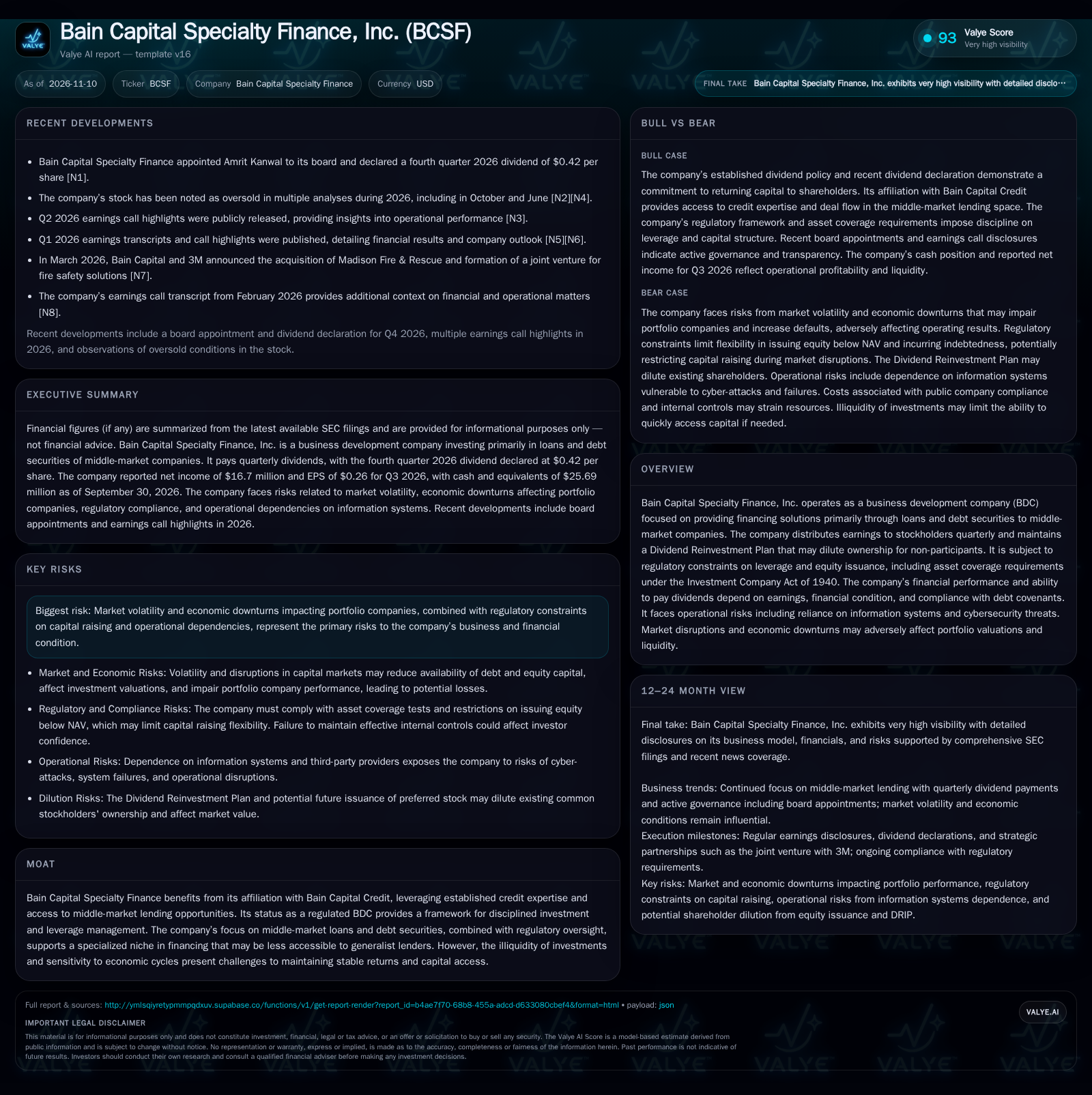
BCSF reported net income of $16.7 million and basic and diluted EPS of $0.26 for the quarter ended September 30, 2026. The cited source reports dividend-related activity; that disclosure alone does not establish dividend-policy continuity, management confidence, or a material constraint on capital flexibility. As of September 30, 2026, cash and cash equivalents stood at $25.69 million. The company operates under regulatory asset coverage requirements as a business development company, limiting leverage and restricting issuance of shares below net asset value without shareholder approval. The Dividend Reinvestment Plan (DRIP) can result in shareholder dilution for those not participating. These facts signal ongoing profitability, active capital return, and a capital structure shaped by both regulatory and company policy constraints. [N1] [S2]
How BCSF’s Model Translates Lending into Shareholder Returns
BCSF generates revenue primarily through the interest income and fees earned from its loan and debt security investments in middle-market companies. The company’s ability to pay dividends is directly linked to the interest yield, credit spreads, and repayment rates within its portfolio. While interest income is relatively predictable in stable macro environments, portfolio performance can be significantly impacted by rising defaults or restructurings in times of economic stress.
Cost structure is defined by management and incentive fees paid to its external advisor (Bain Capital Credit), interest expenses on any debt funding, and public company compliance costs. Operating leverage is limited, as much of the cost base is variable or semi-variable—linked to assets under management and the level of portfolio activity. Capital needs are driven by the pace of new investments, repayments, and the requirement to maintain regulatory asset coverage ratios. Since BCSF must distribute the majority of earnings to maintain its RIC status, retained earnings do not meaningfully buffer against shocks, making access to debt and equity markets critical during periods of rapid portfolio growth or impairment.
The DRIP, while offering a low-cost means to reinvest dividends and raise equity capital, introduces potential for dilution among non-participating shareholders and can complicate capital management if market prices diverge from NAV.
Where BCSF Fits in the Competitive Middle-Market Lending Landscape
BCSF operates in a competitive segment dominated by other business development companies, private credit funds, and some traditional banks. Its affiliation with Bain Capital Credit provides access to sourcing, underwriting expertise, and deal flow that may not be available to smaller or less well-connected BDCs. However, this advantage is tempered by the crowded nature of middle-market lending, where competition can compress spreads and make underwriting discipline paramount.
The regulatory BDC structure imposes leverage caps and dividend distribution requirements that both constrain and discipline risk-taking. Compared to banks, BDCs often have higher cost of capital and less access to low-cost deposits, but may offer more flexible financing solutions to non-investment-grade borrowers. Substitution risk arises from the potential entry or expansion of direct lending funds, insurance company affiliates, and alternative asset managers, all of which seek yield in the same market segment.
Switching costs for portfolio companies are relatively low, as lending markets remain competitive and borrowers can refinance when credit conditions are favorable. However, BCSF’s ability to offer certainty of execution and flexible structuring—leveraging Bain’s brand and resources—may offer modest qualitative differentiation.
If Credit Quality Holds and Market Access Remains, Dividend Growth Is Plausible
In a favorable scenario, credit markets remain stable, and middle-market borrowers continue to perform, limiting credit losses and supporting robust cash flows. BCSF is able to redeploy repayments into new, higher-yielding loans as rates remain elevated, supporting net investment income. The company’s affiliation with Bain Capital Credit enables it to source attractive deals even as competition increases, maintaining portfolio yields and limiting non-accruals.
This scenario would be confirmed by persistently low non-accrual rates, stable or rising portfolio yields, and continued growth in net investment income per share. The ability to raise additional capital at or above NAV (minimizing dilution) would suggest strong market confidence and validate the scalability of BCSF’s model.
Navigating Economic Fluctuations While Maintaining Core Distribution Policy
The most likely outcome is that BCSF experiences modest but manageable credit losses as some middle-market borrowers come under pressure from higher rates or slowing growth. Net investment income remains sufficient to cover the regular dividend, but payout growth is constrained. The company occasionally issues equity through the DRIP or at-the-market offerings, but is careful to avoid material dilution by aligning issuance with market demand and NAV. Regulatory leverage constraints force a disciplined approach to balance sheet management.
Temporary increases in non-accruals or realized losses may occur, but do not threaten overall viability or force dividend cuts. If disclosed, trends in portfolio company EBITDA, interest coverage ratios, and realized/unrealized gains would help confirm the resilience of earnings and capital base.
Credit Deterioration and Market Dislocation Could Pressure Dividends and Capital
A negative scenario unfolds if economic conditions deteriorate, causing a spike in defaults and payment delays among BCSF’s middle-market borrowers. Rising non-accruals reduce interest income, while the illiquidity of certain investments makes it difficult to reposition the portfolio or raise cash without incurring losses. Regulatory leverage caps limit the ability to borrow through a downturn, and if market prices fall below NAV, BCSF is unable to issue new equity without shareholder approval.
Dividend coverage becomes strained, potentially forcing a reduction in the payout or a partial return of capital. Shareholder dilution risk increases if the DRIP is used aggressively at depressed market prices. This scenario would be confirmed by a marked increase in non-accruals, declining NAV per share, dividend cuts, and negative trends in portfolio valuation marks or realized losses.
Thesis-Testing Developments for BCSF: Credit Health, Capital Access, and Dividend Stability
Quarterly trends in non-accrual rates and realized credit losses—if disclosed—would directly indicate portfolio risk and earnings durability.
NAV per share movements, especially relative to market price, would test capital-raising flexibility and potential dilution risk.
Details on new loan originations, yields on new investments, and portfolio turnover rates would provide insight into deployment capacity and market competitiveness.
The pace and terms of any equity issuance, including DRIP participation rates, would clarify dilution dynamics and shareholder alignment.
Updates on regulatory asset coverage ratios and leverage metrics would signal balance sheet discipline and risk-taking capacity.
Disclosures regarding portfolio company sector exposures, EBITDA trends, and refinancing activity would help assess underlying borrower health and macro vulnerability.
Any commentary on the impact of market volatility or capital market disruptions on investment valuation and liquidity would help gauge external risk factors.
Disclaimer: This is research-only, informational analysis and not investment advice. It may include AI-generated interpretation and general industry context. Always verify important details using primary sources.

Comments