
FiscalNote’s Subscription Model Under Pressure: Can AI-Driven Policy Intelligence Outpace Liquidity Constraints?
FiscalNote Holdings, Inc. has doubled down on its core policy intelligence platform, streamlining operations and divesting non-core assets.
Execution on cost controls and new product integration will be critical to a potential turnaround.
FiscalNote Holdings, Inc. has made bold moves to focus on its core: AI-powered policy intelligence for enterprise and government clients. The divestiture of non-core assets and a streamlined workforce are intended to realign the business around subscription-based offerings. The next phase will test whether operational discipline and product innovation can offset structural financial headwinds.
Liquidity Constraints and Revenue Contraction Define the Present
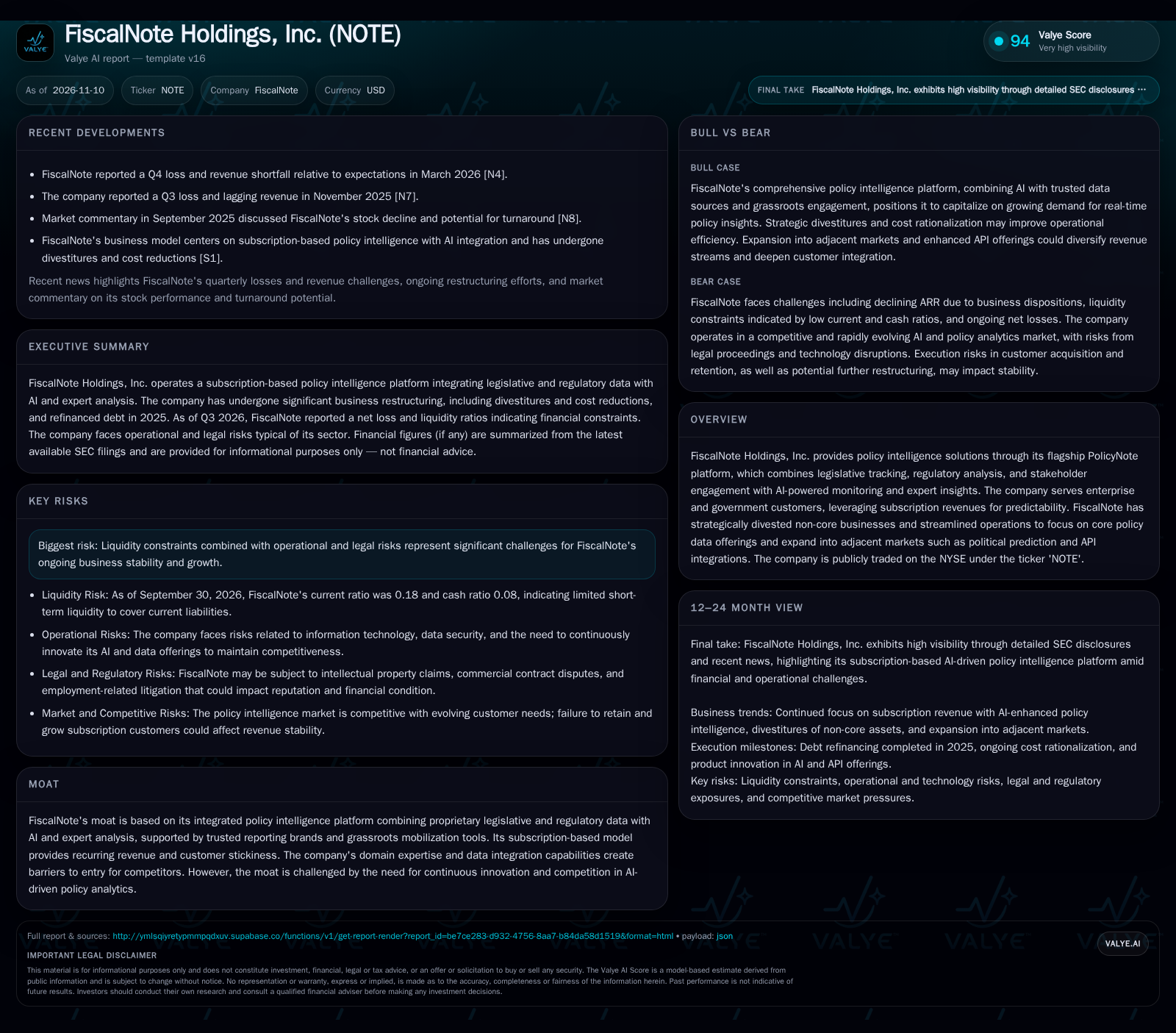
Several acute facts shape FiscalNote’s current outlook. As of September 30, 2026, the company held only $10.2 million in cash and cash equivalents, with current assets of $23.9 million dwarfed by $133.0 million in current liabilities. The company reported cash and liquidity metrics for the period; these figures do not by themselves establish operating runway, investment capacity, financial flexibility, or financing capacity. [S2]
Annual Recurring Revenue (ARR) fell from $107.5 million at the end of 2024 to $84.1 million at the end of 2025, a decline driven by both divestitures and other factors, suggesting organic pressures alongside structural changes [S1]. Net Revenue Retention (NRR) has been volatile but recently ranged from 93% to 98%, indicating some degree of customer churn or contraction [S1].
Despite cost reductions—including a reduction of 148 full-time equivalent employees since early 2024—and the sale of several non-core businesses, the company posted a net loss of $5.9 million for Q3 2026 and continues to lag revenue expectations, as highlighted in recent news coverage [S2] [N4] [N7].
Subscription Revenue Predictability Meets Margin and Scale Challenges
FiscalNote’s business model is fundamentally rooted in subscription revenue, which accounted for over 93% of total revenue as of the latest reporting period [S1]. This model typically offers high visibility and predictability, as customers—often large enterprises and government entities—license access to the PolicyNote platform for legislative tracking, regulatory analysis, and stakeholder engagement. The AI and expert-driven nature of the solution could, in theory, could support premium pricing and stickiness.
However, the sharp contraction in ARR following divestitures and the lack of evidence for organic ARR growth indicate that the subscription base is not expanding fast enough to offset lost business lines or customer churn. Net Revenue Retention in the 93–98% range means that the company is losing a portion of recurring revenue each year, which, absent strong new sales, can create a downward spiral in topline performance.
Cost structure is another pressure point. While recent headcount reductions and simplification may improve gross and operating margins, the company’s ongoing net losses suggest that fixed costs—such as data infrastructure, R&D, and sales—remain high relative to the current revenue base.
Data Integration and AI: Differentiators or Table Stakes?
FiscalNote’s competitive proposition rests on its PolicyNote platform, which integrates proprietary legislative and regulatory data with AI-powered analytics and expert insights. The company’s access to trusted brands like CQ and Roll Call, along with grassroots mobilization tools such as VoterVoice, creates a multifaceted solution that may be difficult for new entrants to replicate quickly [S1].
However, barriers to entry in policy intelligence are eroding as more competitors, including both established data providers and emerging AI-driven analytics firms, leverage advances in machine learning and public data aggregation. The increasing commoditization of data and analytics services means that differentiation must come from either unique data sets, superior user experience, or demonstrable outcomes for clients.
Switching costs for enterprise and government clients can be moderate if FiscalNote’s integrations are deeply embedded in customer workflows, but absent evidence of high retention or contractual lock-in, the risk of churn remains a concern. The company’s moat, while present, appears vulnerable to both technological substitution and aggressive moves by larger or better-capitalized competitors.
Operational Discipline Plus AI Innovation Could Reinforce Recurring Revenue Growth
A favorable outcome for FiscalNote would see the company capitalizing on its streamlined core, with cost reductions lowering its breakeven point and new AI-powered features driving both upsell and new client acquisition. Expansion into adjacent markets—such as political prediction, API integrations, and deeper workflow automation—could diversify and grow the subscription base.
If FiscalNote demonstrates improved Net Revenue Retention (NRR) moving toward or above 100%, and ARR stabilizes or begins to grow organically, it would suggest that the core business is not just resilient but capable of scaling. Strong uptake of new platform features and integrations, coupled with evidence of higher average contract values or customer expansion, would further validate the bull case.
Confirmation of this scenario would come through sequential ARR growth, a return to positive operating cash flow, and evidence of customer wins in new verticals or geographies.
Stabilization Hinges on Retention and Margin Recovery
The most plausible outcome in the near term is one of stabilization rather than rapid recovery or further decline. FiscalNote’s divestitures and cost-cutting likely prevent further steep losses, but revenue growth may remain sluggish as the company works to replace lost ARR and improve customer retention. The subscription-centric model provides a floor to revenue, but with NRR below 100%, the company must accelerate new sales to offset churn.
Operating leverage may slowly improve if the company maintains cost discipline and avoids significant new investment until revenue growth resumes.
This scenario would be confirmed by flat or modestly improving ARR, steady NRR in the mid-90s%, and narrowing but persistent net losses. Any improvement in the current ratio or cash position would suggest progress, while continued revenue contraction or renewed losses would falsify the stabilization thesis.
Liquidity Stress Triggers Forced Restructuring or Dilutive Financing
The adverse scenario centers on FiscalNote’s acute liquidity constraints. [S2]
Failure to reverse ARR decline or improve NRR could accelerate revenue contraction, further eroding the ability to cover fixed costs. In this environment, FiscalNote may be forced into emergency measures such as asset sales, layoffs, or highly dilutive equity or convertible debt offerings. Such steps could undermine customer confidence, damage the brand, and make it more difficult to retain key staff and clients.
A sustained inability to access capital markets or execute accretive financings would signal existential risk.
What Could Validate or Challenge FiscalNote’s Turnaround Potential
Sequential changes in Annual Recurring Revenue (ARR), particularly evidence of organic growth or stabilization, would be the clearest indicator of business health.
Net Revenue Retention (NRR) trends: a sustained move toward or above 100% would signal improving customer value and product stickiness.
Quarterly net loss and operating cash flow: narrowing losses or achieving cash flow breakeven would demonstrate that cost reductions are having the intended impact.
Customer acquisition and expansion rates, if disclosed, would help test whether new product features and integrations are driving growth.
Successful launches and adoption rates for new AI-powered features or adjacent product offerings could indicate traction outside the legacy core.
Any announced financings, debt covenant amendments, or asset sales would provide direct signals about the company’s ability to manage its capital structure under pressure.
Legal or regulatory developments, particularly outcomes in material litigation or compliance investigations, could materially affect both operations and reputation.
Disclaimer: This is research-only, informational analysis and not investment advice. It may include AI-generated interpretation and general industry context. Always verify important details using primary sources.

Comments