
Arbor Realty Trust’s Struggle with Profitability and Strategic Leverage in 2025
Persistent high interest rates and credit stress have pressured Arbor’s historically integrated commercial real estate lending model, leading to sharp declines in income and cautious capital deployment.
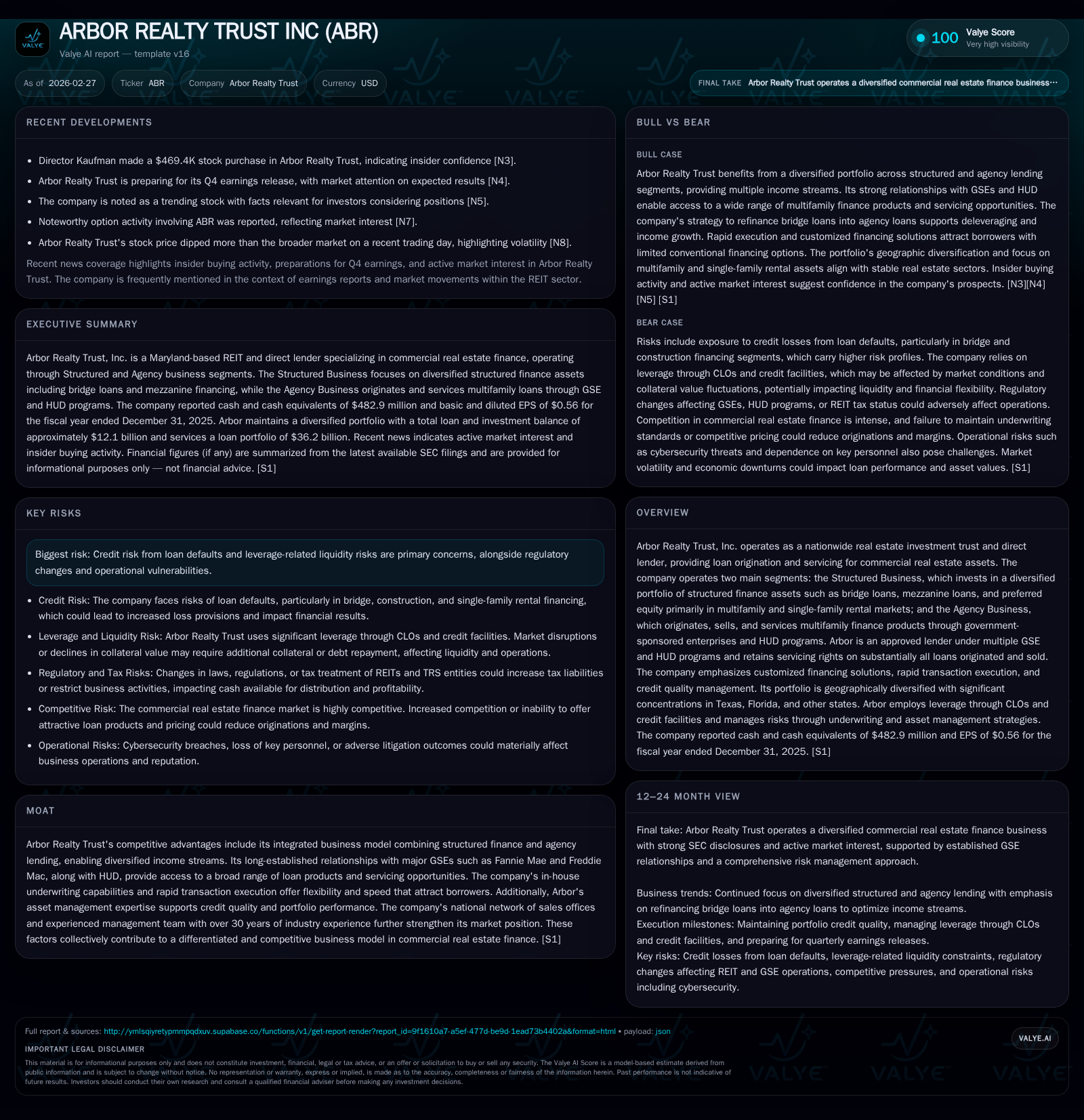
Arbor Realty Trust, a nationwide REIT focused on structured finance and agency multifamily lending, faced significant headwinds in 2025 as elevated interest rates and credit challenges undercut profitability. Operating income declined by over 40% year-over-year, reflecting rising loan loss reserves and credit costs amid tightening market liquidity. Despite stable operating cash flow generation, reduced share repurchases and dividend payments signal prudent capital management amid portfolio contraction risks. Arbor’s dual-segment strategy leveraging longstanding GSE relationships remains a competitive advantage but is constrained by refinancing challenges and higher credit risk concentrations.
From Growth to Contraction: Arbor’s Operating Income Trends and Drivers
Arbor Realty Trust’s financial performance from 2022 through 2025 illustrates a striking reversal from growth towards operational contraction. After generating operating income of $371 million in FY2022 that rose further to $428 million in FY2023, the company experienced a sharp downturn with operating income halving to $297 million in FY2024 before plummeting by an additional 40.6% year-over-year to just $177 million in FY2025 [F1]. This steep decline reflects the confluence of persistent high interest rates impacting borrowing costs across its portfolio, coupled with growing credit losses spurred by increasing delinquencies and loan loss provisions as highlighted in the company’s latest SEC filings [S1]. Operating cash flow has also waned from over $1 billion in FY2022 down to $372 million in FY2025 (a 19.3% annual decline). This divergence between top-line yield compression and cash generation signals stresses within both underwriting outcomes and portfolio composition.
Historical performance (annual)
| FY | CFO ($mm) | OpInc ($mm) |
|---|---|---|
| 2025 | 372 | 177 |
| 2024 | 462 | 297 |
| 2023 | 236 | 428 |
| 2022 | 1100 | 371 |
Source: SEC companyfacts cache [F1].
Capital returns and efficiency (annual)
| FY | Div ($mm) | Buybacks ($mm) |
|---|---|---|
| 2025 | 320 | 2 |
| 2024 | 395 | 11 |
| 2023 | 381 | 37 |
| 2022 | 322 | 34 |
Source: SEC companyfacts cache [F1].
Table: Historical Financial Performance of ARBOR REALTY TRUST INC (FY2022-FY2025) [F1]
Credit Quality Management Under High Interest Rate Stress
The core challenge underlying Arbor's earnings deterioration is its exposure to commercial real estate loans subject to elevated credit risk amid fluctuating interest rates [S1]. The Structured Business segment’s bridge loans and single-family rental portfolios have seen increased delinquencies and modifications as borrowers contend with higher financing costs exacerbated by the volatile rate environment. Underwriting protocols remain rigorous; however, the company acknowledges the inherent complexity and uncertainty around estimating CECL loan loss allowances given ongoing market dislocations [S1], [S6]. Borrower stress has also prompted loan workout strategies manipulating asset performance through proactive restructurings or potential foreclosures where necessary, with asset managers closely engaged throughout the loan lifecycle [S13]. These practices aim to mitigate losses yet weigh heavily on net interest margins when defaults escalate.
Agency vs Structured Lending: Portfolio Mix and Risk Profiles
Arbor operates a bifurcated model balancing its Structured Business that underwrites primarily short-term floating rate bridge loans with longer-duration Agency Business loans guaranteed or sold to GSEs like Fannie Mae/Freddie Mac and HUD agencies [S1]. The Agency segment benefits from stable fees derived from servicing considerable multifamily mortgage portfolios nationally, representing about two thirds of its servicing UPB (upwards of $24 billion) [S15]. Nonetheless, this segment faces margin pressures due to the fixed-rate nature of many agency-originated loans during prolonged periods of high long-term rates, resulting in borrower refinancing challenges and elongating prepayment timelines [S14], [S18]. The structured portfolio, consisting of diversified assets such as mezzanine loans, preferred equity stakes, and construction financing carries higher yield but correspondingly higher credit risk concentration including potential loss sensitivities in non-stabilized assets [S1], [S21]. This dual-segment composition provides diversification but also necessitates complex risk management.
Capital Structure and Leverage Strategy: Navigating Market Headwinds
Financing plantations predominantly leverage collateralized loan obligations (CLOs), repurchase agreements, varied credit facilities, supplemented by public/private equity issuances including preferred stock offerings [S4], [S5]. The firm targets an equity-to-assets ratio above approximately 20%, though actual leverage fluctuates per market condition constraints [S13], [S17]. Key challenges arise from restrictive covenants embedded within debt agreements—such as minimum liquidity thresholds, net worth tests, unencumbered asset requirements—and from collateral calls triggered by declining portfolio valuations forcing either asset sales or liquidity draws that can strain finances [S9], [S10]. Hedge instruments are deployed selectively for interest rate risk mitigation but involve cost trade-offs while the firm maintains careful matched funding strategies aligning asset maturities with borrowings [S8]. Overall leverage optimization is complicated by volatile capital markets reducing CLO issuance appetite.
Capital Allocation: Balancing Dividends, Buybacks, and Retained Earnings
Despite shrinking bottom-line profitability (ROE hovering near a modest 0.2% in FY2025), Arbor continued paying sizable dividends totaling nearly $320 million while sharply scaling back share repurchases to roughly $2 million from double-digit millions previously [F1], [S22]. This shift signals prioritization of shareholder income stability over aggressive capital return via buybacks amid sustainability concerns given latent credit risks. The company holds substantial cash balances ($483 million year-end FY2025) providing some financial cushioning but future allocation decisions will likely balance reinvestment for portfolio growth against cautious capital conservation given economic uncertainties.
What Wall Street Expects: Key Earnings Insights and Guidance Analysis
In its February Q4/FY2025 earnings release, Arbor missed consensus estimates primarily due to compressed net interest margins driven by higher funding costs amidst sustained elevated base rates and rising credit expenses associated with loan modifications or defaults [N1], [N2], [N5]. Management emphasized monitoring delinquency trends within bridge loan portfolios as well as originations volume as key near-term indicators for performance trajectory. Investors should watch for signs of stabilization or improvement in refinancing activity converting short-duration bridge exposures into agency-style finance products—a critical milestone for deleveraging balance sheet risk.
Risks on the Horizon: Market, Regulatory, and Credit Considerations
Multiple risks loom over Arbor's operational outlook presented comprehensively in its SEC disclosures. Prolonged economic weakness could amplify default rates especially within construction/BTR financing niche segments susceptible to cost overruns or lease-up delays [S1], raising impairment charges further. Regulatory changes impacting GSE conservatorship structures or HUD program terms may restrict lending capacity or increase reserve burdens impeding growth prospects [S25]. Cybersecurity threats escalate industry-wide concerns given reliance on data-intensive servicing platforms; breaches could impose reputational damage alongside financial penalties [S25]. Finally, restrictions imposed by debt covenants combined with potential capital market disruptions could constrain liquidity access if not carefully managed.
Disclaimer: This analysis is based solely on information available through official company disclosures dated February 27, 2026 ([F1], [S#]) and public news reports ([N#]). It does not constitute investment advice or recommendations regarding buying or selling securities. Forward-looking statements are interpreted using disclosed risks without speculation beyond sourced data.
Disclaimer: This is research-only, informational analysis and not investment advice. It may include AI-generated interpretation and general industry context. Always verify important details using primary sources.

Comments