
Arbutus Biopharma: Pipeline Focus, Capital Reset, and the Stakes of IP Leverage in Chronic Hepatitis B
Arbutus Biopharma has restructured around its chronic hepatitis B pipeline, executed a transformative share buyback, and bolstered its balance sheet through high-profile patent settlements. The company’s prospects now hinge on clinical execution and the monetization of its lipid nanoparticle (LNP) technology amid intensifying IP litigation and a shifting therapeutic landscape.
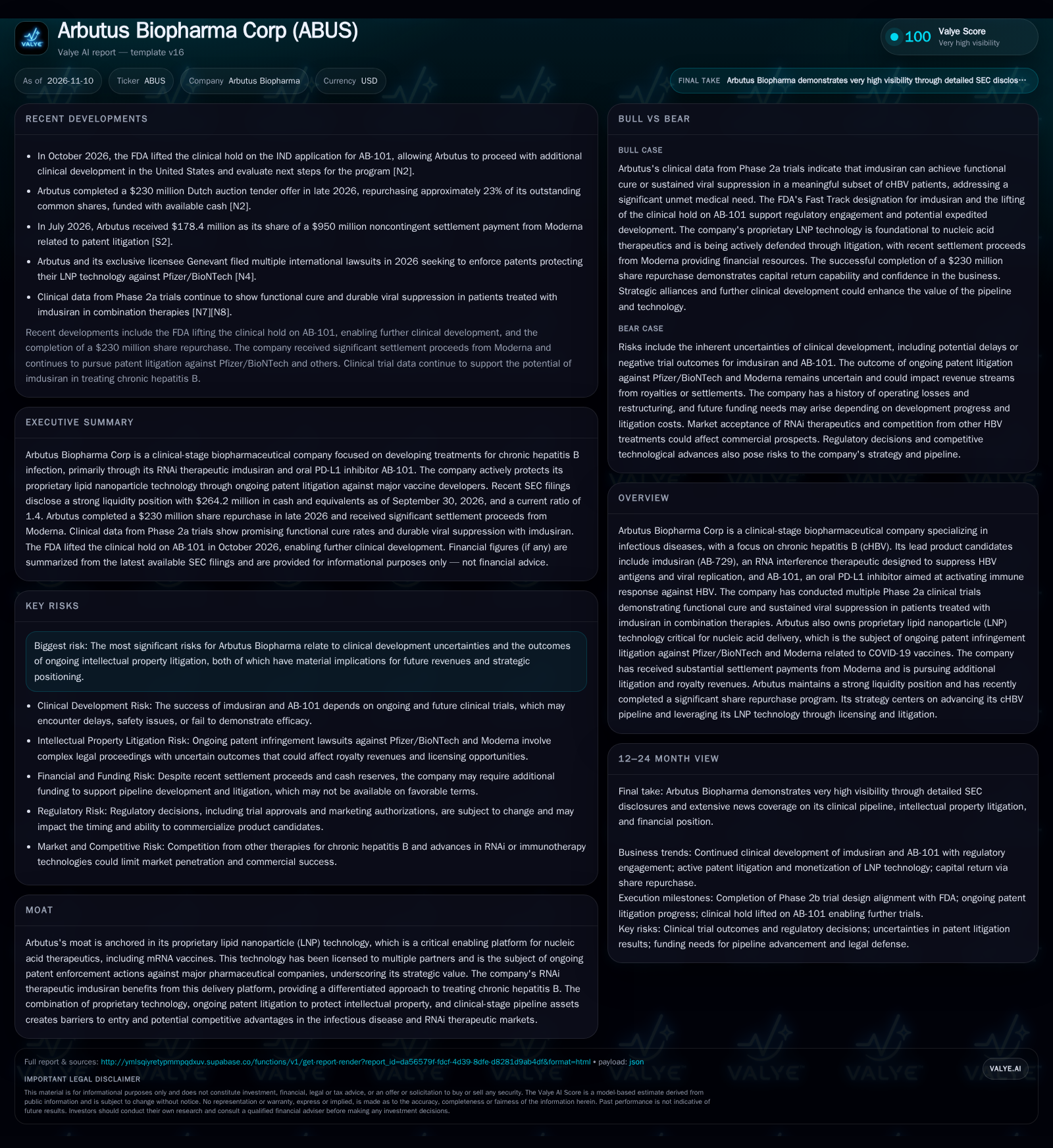
Arbutus Biopharma has narrowed its focus to late-stage chronic hepatitis B programs, completed a $230 million share repurchase, and received major settlement proceeds from Moderna. With $264 million in cash as of Q3 2026 and reduced operating expenses, the company is positioned to advance its RNAi and immunotherapy pipeline while pursuing further value from its LNP technology through both licensing and ongoing litigation. The next phase will test whether Arbutus can translate promising clinical data and IP leverage into sustainable value creation in a competitive and litigious field. [S2] [N2] [N7] [N8]
Arbutus Biopharma has entered a new strategic phase defined by focus and potential financial flexibility. The company’s recent $230 million share repurchase and substantial settlement income from Moderna mark a decisive capital reset. With its R&D efforts now centered on two late-stage chronic hepatitis B candidates and a sharpened approach to intellectual property enforcement, Arbutus is positioned to test the commercial and scientific value of its RNAi and LNP platforms. The company’s fate will depend on translating clinical promise into regulatory and market success while extracting further value from its foundational delivery technology in a crowded and litigious field. [S2] [N2] [N7] [N8]
Strategic Realignment: Capital Influx, Share Repurchase, and Pipeline Focus
Arbutus Biopharma’s most material recent developments are a $230 million Dutch auction tender offer completed in late 2026, repurchasing roughly 23% of its outstanding shares, and a $178.4 million settlement payment from Moderna related to patent litigation. These actions have resulted in a substantial cash reserve of $264.2 million as of September 30, 2026. Concurrently, Arbutus has streamlined its operations, reducing discovery-stage R&D and workforce to focus on the clinical advancement of its two lead cHBV programs: imdusiran (AB-729), an RNAi therapeutic, and AB-101, an oral PD-L1 inhibitor. The company’s clinical pipeline has produced encouraging data in Phase 2a trials, with imdusiran showing functional cure and durable suppression in combination regimens. These developments collectively reset the company’s financial and strategic foundation for the next phase of pipeline execution and IP monetization. [S2] [N2] [N7] [N8]
Pipeline Economics and the Leverage of Technology Licensing
Arbutus’s business model is a hybrid of clinical-stage drug development and IP-driven technology monetization. The core economic engine is potential future product revenue from successful cHBV therapies—primarily imdusiran and AB-101. Success would likely depend on pricing power for a functional cure in chronic hepatitis B, where current therapies rarely achieve a true cure, and on the scale of market adoption. However, commercial economics remain untested: pivotal trial results, regulatory acceptance, and payer willingness to reimburse innovative RNAi or immunotherapy regimens will critically shape future revenue.
In the interim, Arbutus generates non-product revenue streams from licensing its proprietary lipid nanoparticle (LNP) technology, which underpins several commercial nucleic acid drugs. The company receives royalties (e.g., on ONPATTRO) and milestone payments, though these are currently modest compared to operating costs. Major one-time windfalls, such as the Moderna settlement, have materially altered the near-term capital structure but are not recurring sources. Ongoing litigation against companies like Pfizer/BioNTech suggests the possibility of further significant settlements or royalty streams, but outcomes are highly uncertain.
Cost structure is currently dominated by R&D spending on clinical programs, but recent restructuring has reduced cash burn. The company reported cash and liquidity metrics for the period; these figures do not by themselves establish operating runway, investment capacity, financial flexibility, or financing capacity. Fixed costs are lower post-restructuring, yet the economics will ultimately hinge on the variable costs and gross margins of any eventual commercial product.
Therapeutic Innovation Meets a Crowded and Litigious Landscape
Arbutus operates in a fiercely competitive segment of infectious disease, with chronic hepatitis B attracting significant investment from both established biopharma and emerging RNAi or immunotherapy players. The company’s proprietary LNP technology provides a technical advantage in nucleic acid delivery, which is a critical bottleneck for RNAi efficacy and safety. However, this moat is partially shared with licensees and is under active legal challenge, as demonstrated by ongoing lawsuits against major mRNA vaccine developers.
On the therapeutic front, imdusiran’s differentiated approach—targeting HBV antigens for functional cure—is promising, but faces competition from other novel HBV agents, including siRNA drugs, capsid inhibitors, and immunomodulators in late-stage development. Larger firms may have greater resources for global development, regulatory engagement, and commercialization. Switching costs for prescribers and payers may be moderate if a therapy can demonstrate clear superiority, but market penetration will still depend on comparative data, safety, and cost-effectiveness.
Arbutus’s competitive strength will be tested by the pace of its clinical progress, the defensibility of its IP, and its ability to secure strategic alliances that can amplify its reach without diluting its economics. The company’s partial ownership in Genevant also exposes it to both upside and risk from partner execution.
A Pathway to Value: Clinical Validation and Monetization of LNP IP
The most favorable scenario for Arbutus is a combination of late-stage clinical success for imdusiran and/or AB-101 and a material expansion of recurring revenue from its LNP technology. If Phase 2b/3 trials confirm that imdusiran can deliver functional cure or sustained viral suppression with an acceptable safety profile, Arbutus could secure regulatory approval and position itself as a leader in curative HBV therapy. High unmet need and premium pricing for a functional cure could drive outsized value capture, especially if the company secures strategic partnerships or licensing deals that expand global reach while retaining significant economics.
On the IP front, successful litigation or settlements could unlock additional large one-time payments or even ongoing royalties from major commercial products using LNP technology. Evidence confirming this scenario would include: positive pivotal clinical results, regulatory submissions or approvals, new licensing deals or partnerships, and favorable court rulings or settlements yielding substantial cash or recurring royalties. Major pharma partnership announcements or ex-US commercial deals would further validate this pathway.
Clinical Progress Balanced by Cash Runway and Legal Uncertainties
The most plausible scenario is continued advancement of imdusiran and AB-101 through mid- and late-stage trials, with a gradual accumulation of supportive clinical data but no immediate inflection to commercial revenue. Modest revenue continues from royalties and milestones, but the bulk of funding is spent on R&D and IP defense.
Litigation outcomes remain uncertain and may take years to resolve, with the potential for further settlements but no guarantee of recurring IP revenue. The company may pursue strategic alliances or out-licensing to extend its runway as pivotal trials progress. Falsification would come from either clinical failure, unexpected legal setbacks, or a major out-licensing deal that changes the revenue mix.
Clinical Setbacks or Adverse Litigation Outcomes Erode Strategic Options
A negative scenario would unfold if late-stage clinical trials for imdusiran or AB-101 fail to demonstrate sufficient efficacy, safety, or regulatory acceptance, stalling the pipeline and undermining the company’s core value proposition. In this scenario, Arbutus would be forced to rely primarily on uncertain, lumpy IP and settlement revenues, which may be insufficient to sustain operations or attract new investment. A series of adverse court rulings could further diminish the value of its LNP technology and reduce leverage in future licensing negotiations.
If cash burn rises unexpectedly due to legal costs or failed cost controls, the company could face renewed funding needs, potentially on unfavorable terms. Evidence for this scenario would include negative or inconclusive pivotal trial results, major legal defeats, rising operating losses, and an inability to secure new partnerships or licensing deals.
Milestones That Will Determine Arbutus’s Trajectory in HBV and IP Monetization
Progression and outcome of pivotal trials for imdusiran and AB-101—positive efficacy and safety data would indicate pipeline value, while delays or setbacks would challenge the thesis.
Updates on major litigation and IP enforcement cases, particularly against Pfizer/BioNTech and other licensees—settlements, rulings, or trial outcomes could materially affect future cash flows.
Cash burn rate and quarterly operating expense trends—if disclosed—will test the sustainability of the current capital position and the need for future financing.
New licensing agreements or strategic alliances involving LNP technology or HBV programs, which would validate external demand and provide incremental non-dilutive funding.
Regulatory feedback and advancement toward approval for imdusiran or AB-101, including IND/CTA filings, Fast Track designations, or regulatory meeting outcomes.
Milestone and royalty revenue from existing licensees, such as ONPATTRO, and any new recurring revenue streams from IP settlements—if disclosed.
Disclaimer: This is research-only, informational analysis and not investment advice. It may include AI-generated interpretation and general industry context. Always verify important details using primary sources.

Comments