
Adagio Medical’s Pivotal Clinical Steps and Financial Strain: Can Innovation in Ventricular Ablation Translate into Sustainable Growth?
The company’s ability to convert technical progress into durable market share and financial stability will define its trajectory.
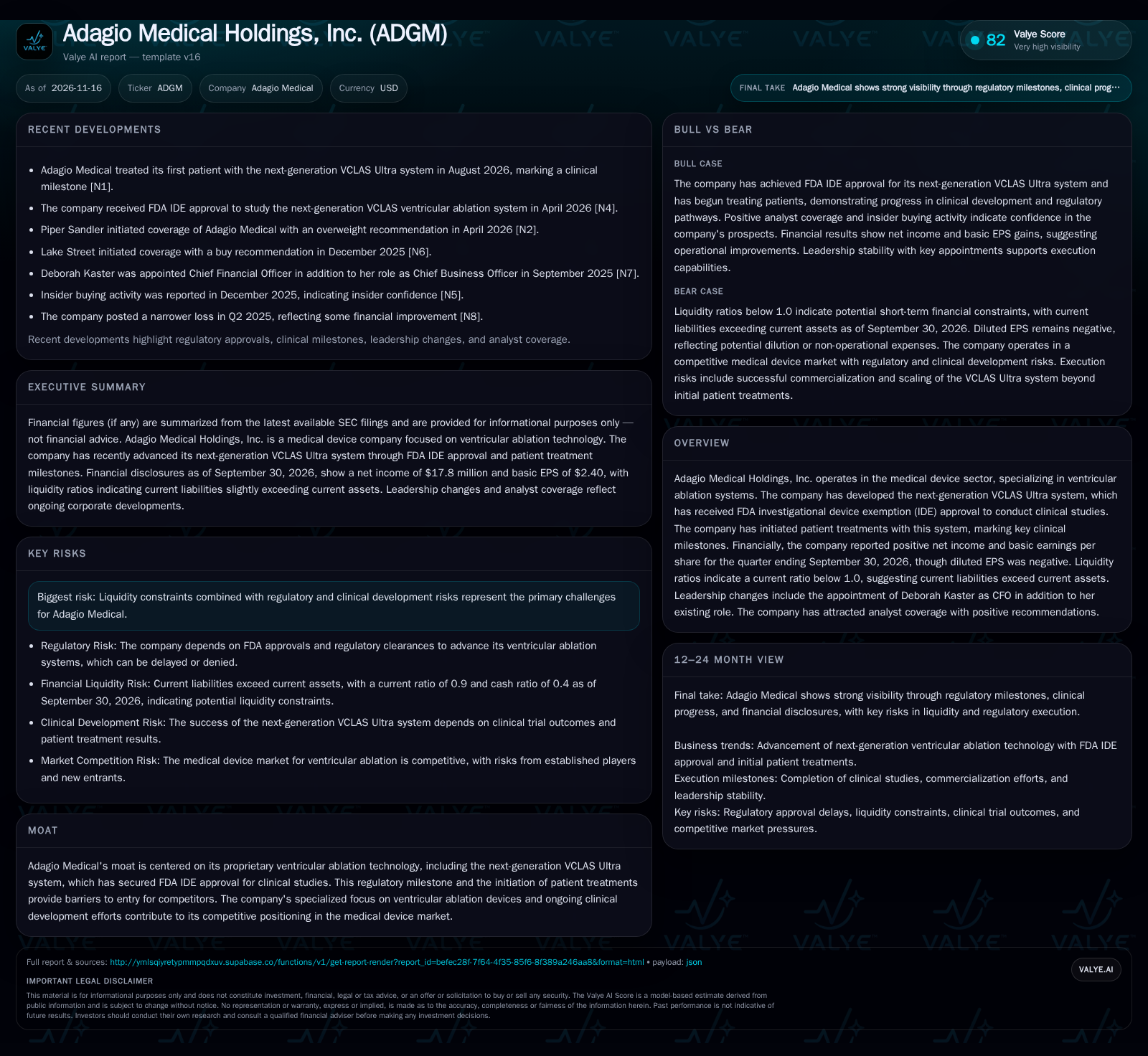
Adagio Medical has achieved FDA IDE approval and treated its first patient with the VCLAS Ultra system, signaling clinical momentum. Despite posting positive net income for Q3 2026, the company’s liquidity remains tight, with current liabilities exceeding current assets. Execution on clinical trials, regulatory navigation, and eventual commercialization will be critical, especially given the competitive landscape and ongoing financial pressures. [S2] [N1] [N4]
Adagio Medical Holdings, Inc. stands at a pivotal crossroads: its next-generation VCLAS Ultra ventricular ablation system has achieved FDA IDE approval and treated its first patient, signaling tangible progress in the high-stakes world of cardiac device innovation. Yet, beneath these clinical milestones, the company faces a precarious financial position, with current liabilities outstripping assets and a mixed earnings profile. The core question is whether Adagio can navigate the capital-intensive, competitive journey from clinical validation to broad commercial adoption before its financial runway narrows further.
Recent Milestones and Financial Snapshot: Progress Meets Pressure
Adagio Medical has made notable advances in 2026, including securing FDA IDE approval for its next-generation VCLAS Ultra ventricular ablation system in April and treating its first patient with the device in August. These achievements mark critical steps toward clinical validation and eventual market access in the U.S., a significant benchmark in the highly regulated medical device sector. [N1] [N4]
On the financial front, the company reported net income of $17.8 million and basic earnings per share of $2.40 for the third quarter of 2026. However, diluted EPS was negative at -$5.13, suggesting either non-operational losses, significant dilution, or the impact of convertible securities. Liquidity is a concern: as of September 30, 2026, Adagio held $3.1 million in cash and cash equivalents, with current assets of $6.9 million versus current liabilities of $7.7 million, producing a current ratio of 0.9 and a cash ratio of 0.4. [S2]
Leadership has also shifted, with Deborah Kaster taking on the CFO role in addition to her position as Chief Business Officer in September 2025, suggesting a tightening of executive functions. [N7]
Pathways to Value Creation: Device Economics, Funding Needs, and Operating Leverage
Medical device companies like Adagio Medical typically generate revenue through the sale and support of capital equipment (the ablation system itself) and recurring consumables (such as catheters and disposables). Pricing power in this sector is often driven by clinical differentiation, reimbursement coverage, and hospital purchasing dynamics. If successfully commercialized, the VCLAS Ultra system could command premium pricing due to its next-generation positioning, but this depends on demonstrated clinical superiority and regulatory approvals.
Operating leverage can be substantial in this business model: high fixed R&D and regulatory costs up front, with margins expanding as sales volumes scale and manufacturing efficiencies improve. However, the journey from clinical trial to commercial rollout is capital-intensive, often requiring bridge financing, especially when liquidity ratios are weak. The company reported cash and liquidity metrics for the period; these figures do not by themselves establish operating runway, investment capacity, financial flexibility, or financing capacity.
Unit economics will ultimately hinge on the mix of capital system placements versus recurring consumable sales, the pace of hospital adoption, and the ability to achieve favorable reimbursement. Until the company discloses contract terms, pricing, or adoption rates, the sustainability of margins and revenue growth remains a conditional outcome.
Differentiation in a Crowded Field: Proprietary Technology and Market Barriers
Adagio’s competitive proposition rests on the proprietary nature of its VCLAS Ultra ventricular ablation system, which has cleared initial regulatory hurdles with FDA IDE approval. In the broader cardiac ablation market, established players often benefit from entrenched hospital relationships, broad product portfolios, and significant sales infrastructure. For Adagio, the key to differentiation will be demonstrating clear clinical advantages—such as improved efficacy, safety, or procedural efficiency—relative to both incumbent technologies and emerging alternatives.
Barriers to entry in this market are substantial: regulatory complexity, physician training requirements, and the need for robust clinical evidence all slow new entrants. However, these same barriers mean that first-mover advantage can be fleeting without rapid scaling and ongoing innovation. Larger competitors may respond aggressively to new entrants showing promise by accelerating their own R&D or leveraging bundled product contracts to retain hospital accounts.
The market is also exposed to technology substitution risk: non-thermal ablation modalities, new mapping techniques, or drug-device combinations could shift the standard of care, impacting adoption curves for any single device platform.
From Clinical Validation to Market Entry: How Success Could Compound
The most favorable pathway for Adagio centers on successful completion of pivotal clinical trials demonstrating that the VCLAS Ultra system offers superior outcomes or procedure efficiency compared to current standards. If the company secures timely regulatory approvals and is able to convert early clinical momentum into commercial contracts with leading cardiac centers, rapid revenue growth could follow.
The upside scenario would be confirmed by a series of developments: positive top-line clinical results, expanded IDE or PMA approvals, early commercial orders from reference hospitals, and evidence of favorable reimbursement decisions. Analyst upgrades, insider buying, and additional capital raises on favorable terms could further validate the growth trajectory. [N2] [N5]
Falsification of this scenario would come from delayed or inconclusive trial results, regulatory setbacks, or slow initial uptake by hospitals, indicating that the product’s clinical differentiation is insufficient or commercialization hurdles are higher than anticipated.
Execution in Unforgiving Terrain: Navigating Clinical, Regulatory, and Funding Risks
The most plausible path for Adagio involves ongoing clinical trial execution and steady progress toward additional regulatory milestones, with incremental patient enrollment and data readouts. However, the company is likely to face serial funding events to bridge its current liquidity shortfall, which could dilute shareholders or constrain operational flexibility.
In this scenario, commercialization may begin at a modest scale, with initial placements at select academic centers or high-volume hospitals. Revenue growth could be lumpy, tied to the pace of hospital adoption and reimbursement approvals. Gross margins may be pressured by the costs of early manufacturing ramp and post-market studies.
Evidence supporting this scenario would include periodic positive clinical updates, successful interim financings, and early but limited commercial placements. Signs of stress would be repeated financing at onerous terms, delays in trial enrollment, or ongoing negative operating cash flow.
Where Progress Stalls: Clinical, Regulatory, or Financial Setbacks
A less favorable outcome would see Adagio’s clinical trials encountering safety or efficacy issues, leading to regulatory delays or outright denials. In parallel, persistent liquidity constraints could force the company to curtail development activities, seek distressed financing, or pursue strategic alternatives under duress.
Competitive pressure from incumbents or next-generation entrants could erode the company’s perceived differentiation, limiting hospital interest and slowing adoption. In this scenario, Adagio could become a takeout candidate at a depressed valuation or face the risk of insolvency if unable to secure bridge capital.
Confirmation of the downside would include negative or inconclusive trial data, a halt in patient enrollment, disclosure of going-concern risks, or unfavorable financing events that significantly dilute existing shareholders.
What Will Determine Adagio Medical’s Next Chapter?
Pace and outcomes of pivotal clinical trials for the VCLAS Ultra system, including safety and efficacy metrics.
Timing and scope of additional FDA or international regulatory approvals.
Updates on liquidity events, including bridge financings, strategic partnerships, or potential non-dilutive funding.
Evidence of early commercial adoption—number of system placements, reference hospital contracts, or consumable reorder rates, if disclosed.
Gross margin trends as manufacturing scales and the mix of capital equipment versus consumables evolves.
Progress on reimbursement decisions from major payors and hospital purchasing committees.
Insider transaction activity was reported in the cited source; this activity does not by itself establish insider confidence.
Any disclosures regarding competitive responses or emerging alternative technologies in ventricular ablation.
Disclaimer: This is research-only, informational analysis and not investment advice. It may include AI-generated interpretation and general industry context. Always verify important details using primary sources.

Comments