
KEEMO Fashion Group: Virtual Wholesaling, Structural Headwinds, and the Challenge of Scaling in China’s Apparel Market
The company’s next phase hinges on activating broader marketing and expanding its team—yet faces formidable structural and regulatory hurdles.
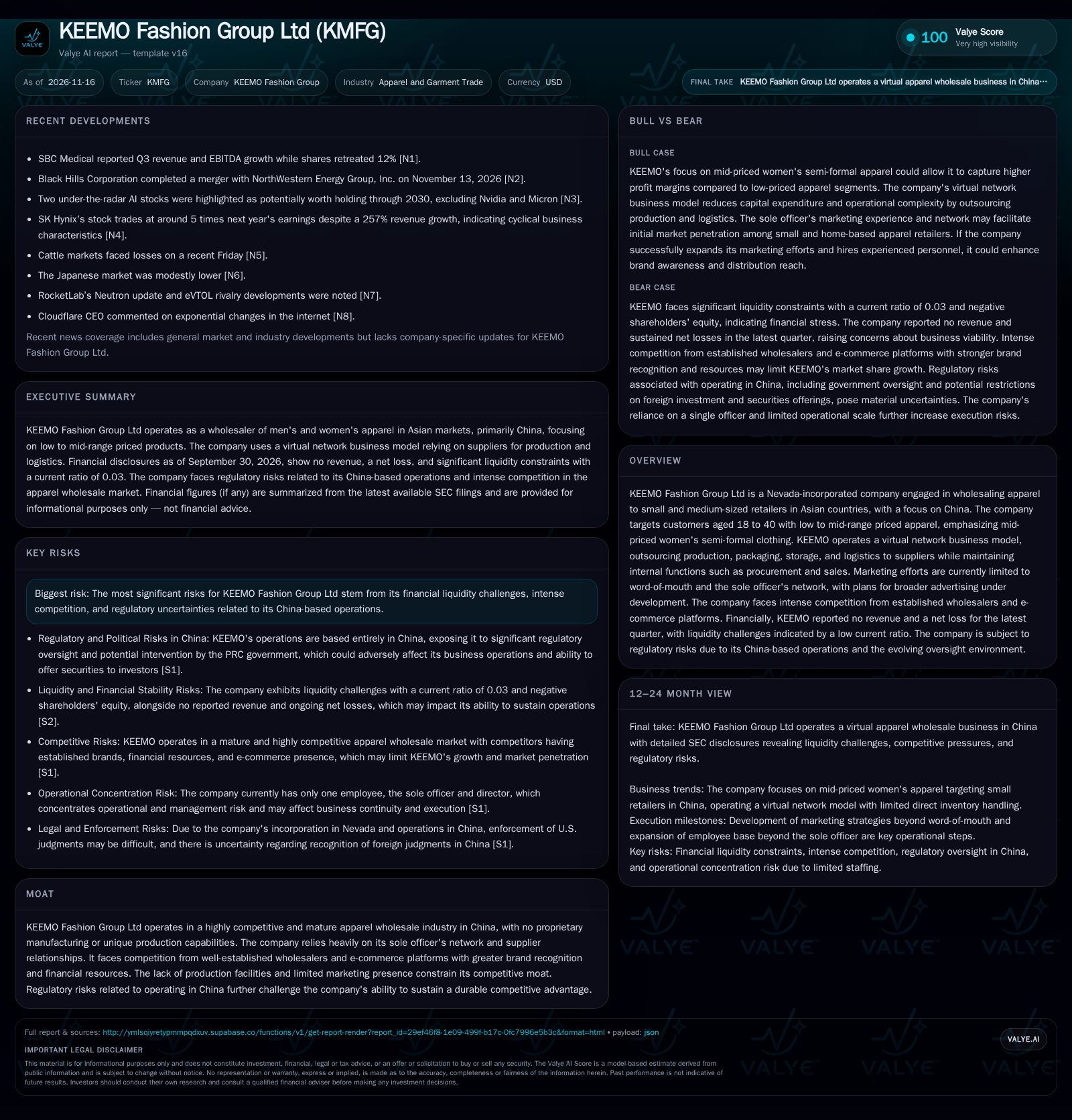
KEEMO Fashion Group Ltd operates as a virtual network apparel wholesaler targeting small retailers in China, emphasizing mid-priced women’s semi-formal wear. The company’s latest filings reveal no revenue, continued net losses, and severe liquidity pressure, with a sole officer managing all internal functions. Execution risk, intense competition, and China-specific regulatory exposure dominate the near-term outlook. Progress depends on activating planned marketing, growing the team, and demonstrating commercial traction in a crowded, fast-moving market.
KEEMO Fashion Group Ltd’s latest filings paint a stark picture of a virtual apparel wholesaler at a critical juncture. Despite ambitions to capture margin in China’s vast mid-priced women’s semi-formal segment, the company ended Q3 2026 with no revenue, ongoing losses, and a precarious liquidity position—managed solely by its president and sole director. With competitive dynamics intensifying and regulatory uncertainty ever-present, KEEMO’s ability to transition from network-driven sales to scalable, sustainable operations will define whether it can carve out any share in China’s crowded apparel landscape.
Acute Liquidity Pressures and Absence of Revenue Underscore Execution Risk
KEEMO Fashion Group Ltd’s most recent financial disclosures highlight several material facts that directly impact its business viability. As of September 30, 2026, the company reported no revenue for the quarter and a net loss of $14,496, with negative shareholders’ equity of $344,318 [S2]. Cash and cash equivalents stood at just $11,933, while current liabilities totaled $655,089, resulting in a current ratio of 0.03 and a cash ratio of 0.02 [S2]. The company reported cash and liquidity metrics for the period; these figures do not by themselves establish operating runway, investment capacity, financial flexibility, or financing capacity.
Operationally, KEEMO remains a one-person company: all internal functions are managed by its president and sole director, with no evidence of expanded staffing or execution of planned marketing initiatives as of the latest reporting date [S1]. These factors collectively signal a business at high risk of operational disruption, with little financial buffer or demonstrated market traction.
Virtual Wholesaling: Asset-Light Model Meets Structural Margin Challenges
KEEMO’s virtual network business model is structured to minimize fixed costs by outsourcing all production, packaging, storage, and logistics to suppliers while retaining internal control over procurement, sales, and marketing [S1]. In theory, this asset-light approach reduces capital expenditure and operational risk, allowing for scalability without the burden of manufacturing overhead or inventory risk. However, the model also exposes KEEMO to margin compression—suppliers may retain much of the value, and the company lacks bargaining power without scale or differentiated demand.
The company targets the mid-priced women’s semi-formal segment, which is believed to offer higher gross margins relative to basic or low-end apparel [S1]. Yet, the absence of proprietary design, brand, or exclusive sourcing limits pricing power. With no reported revenue and ongoing losses, it is unclear whether KEEMO’s pricing and volume assumptions are achievable in practice. The company’s reliance on a single officer for all internal functions further constrains its ability to execute at scale or absorb operational shocks.
Working capital needs are acute: with minimal cash and a negative equity position, KEEMO would require either rapid revenue generation, external financing, or both to fund even modest growth or marketing expansion. The lack of direct manufacturing assets reduces capital intensity but also limits collateral for borrowing or leverage.
Crowded Field, Thin Moat: KEEMO’s Place in China’s Apparel Value Chain
China’s apparel wholesale market is intensely competitive, populated by specialized wholesalers, large retail-based distributors, and rapidly expanding e-commerce platforms. KEEMO’s lack of proprietary product, brand, or exclusive supplier arrangements leaves it vulnerable to both price-based competition and rapid shifts in retailer preferences [S1].
E-commerce wholesalers, in particular, pose a structural threat: their ability to aggregate demand, offer broad product selection, and leverage digital marketing gives them scale advantages that asset-light virtual networks struggle to match. KEEMO’s current reliance on word-of-mouth and the personal network of its sole officer restricts its reach and makes customer acquisition cost (CAC) unpredictable and potentially high if it transitions to paid marketing.
Without established branding or unique service offerings, switching costs for retailers are negligible. The absence of recurring contract structures or platform-based lock-in means KEEMO could face high customer churn and limited pricing leverage. The company’s operational concentration in one leader exacerbates execution risk: any disruption in leadership or business relationships could materially impact continuity.
If Marketing and Talent Expansion Unlock Revenue, Margin Potential Emerges
A favorable scenario for KEEMO would require rapid execution of planned marketing initiatives—transitioning from word-of-mouth to targeted digital and print campaigns aimed at small and home-based retailers. If such efforts drive customer acquisition at a sustainable cost and result in consistent order flow, KEEMO could begin to leverage supplier relationships for better terms or volume discounts, modestly improving gross margins.
Hiring experienced industry personnel would be critical to scaling sales and managing supplier quality, reducing operational risk, and building institutional knowledge beyond the founder. If KEEMO succeeds in establishing a recognizable niche brand in the mid-priced women’s segment, it could begin to command modestly higher prices or secure preferred supplier arrangements.
Confirmation of this scenario would require evidence of recurring revenue, expanded customer base, and improved gross margin trends. Announcements of successful hires, marketing campaign launches, or new retailer contracts—if disclosed—would be early positive signals. Falsification would be indicated by continued lack of revenue, persistent reliance on the founder, or inability to show customer or supplier traction even after new initiatives.
Most Likely: Continued Strain as Execution Lags and Competition Intensifies
Absent rapid operational changes, KEEMO is likely to remain in a state of financial and executional strain. The company’s limited internal resources and lack of revenue-generating activity suggest that, even with some incremental marketing, customer acquisition may lag expectations. Intense competition from both traditional and digital wholesalers will likely continue to suppress pricing and margin opportunities, especially without brand recognition or proprietary offerings.
The company may be forced to seek external financing to bridge liquidity gaps, but negative equity and lack of revenue could make capital raising difficult or costly. Operating leverage remains limited given the outsourced model and single-person management structure.
Evidence supporting this scenario would include continued net losses, minimal or no revenue growth, and reliance on short-term liabilities to fund operations. Falsification would require clear signs of commercial traction, new hires, or a meaningful improvement in the company’s balance sheet.
Failure to Secure Revenue or Funding Triggers Business Disruption or Insolvency
The most adverse scenario is one where KEEMO is unable to generate revenue or secure external funding in the near term.
Operational concentration risk is high: with only one officer, any disruption—health, regulatory, or personal—could immediately halt business activity. Regulatory risk compounds the downside: adverse changes in PRC government policy or enforcement could further restrict operations or access to capital.
Evidence confirming this scenario would include delinquencies on payables, legal disputes, further reductions in cash, or disclosures of operational suspension. Falsification would require a clear alleviation of liquidity stress, such as a successful capital raise, or the emergence of revenue sufficient to cover operating expenses.
Signals That Will Define Whether KEEMO Can Transition from Concept to Commercial Reality
Reported revenue growth in any future quarter—would provide the first evidence of commercial traction and market acceptance.
Disclosure of new hires or an expanded management team—would help test whether operational concentration risk is being addressed.
Announcements or filings detailing the launch and results of new marketing campaigns—would clarify whether the company can scale customer acquisition beyond the founder’s network.
Supplier contract terms, if disclosed—would illuminate KEEMO’s ability to negotiate volume discounts or exclusive arrangements, which could affect gross margins.
Changes in current liabilities and cash balances—would indicate whether liquidity risk is intensifying or being managed through financing or improved collections.
Evidence of recurring sales, repeat customer orders, or multi-period contracts—would support a case for revenue visibility and lower churn risk.
Regulatory disclosures or policy changes affecting foreign-owned businesses in China—would directly impact KEEMO’s ability to operate and access capital.
Disclaimer: This is research-only, informational analysis and not investment advice. It may include AI-generated interpretation and general industry context. Always verify important details using primary sources.

Comments