
Aeries Technology’s AI-Powered GCC Model: Growth Ambitions Amid Liquidity and Competition
Aeries Technology’s recent swing to profitability and robust AI-driven revenue growth underscore the potential of its specialized Global Capability Center (GCC) services model.
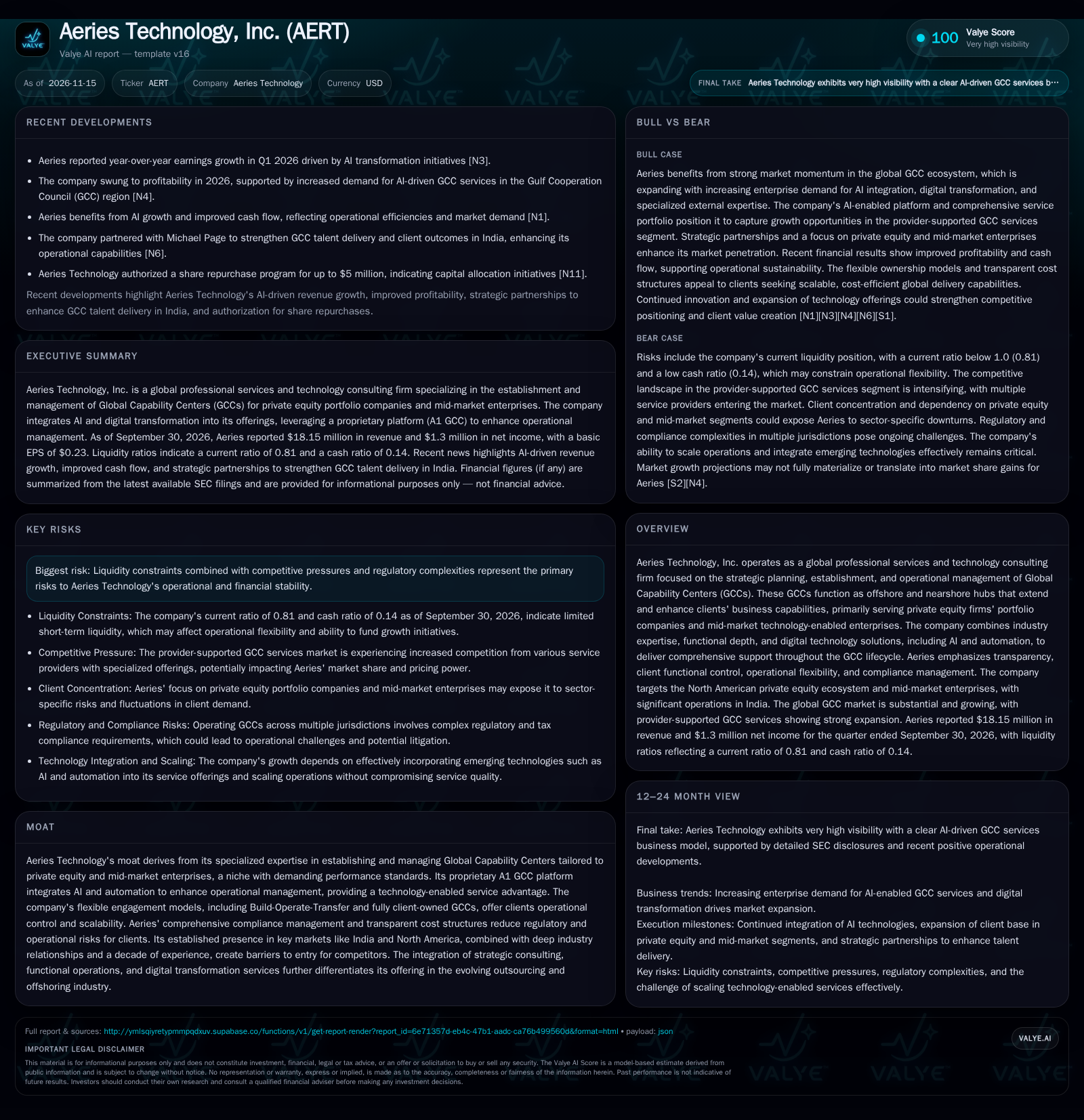
Aeries Technology’s Q3 2026 results show strong AI-driven earnings growth, a proprietary platform strategy, and expanding partnerships in India, positioning the firm for further GCC market share gains. Execution on scaling, compliance, and technology integration will be decisive as the company aims to capture a larger share of a $40 billion provider-supported GCC services market by 2027. [S2] [N1] [N3] [N4] [N6]
Aeries Technology, Inc. has emerged as a notable player in the global professional services and technology consulting arena, specializing in the establishment and management of Global Capability Centers (GCCs) for private equity and mid-market clients. The company’s integration of AI, automation, and proprietary platform technology has driven a recent swing to profitability and strong revenue growth. However, despite these operational gains, Aeries faces a competitive and capital-intensive landscape.
Profitability Trends, AI Adoption, and Liquidity Challenges Frame Current Dynamics
Aeries Technology reported $18.15 million in revenue and $1.3 million in net income for the quarter ending September 30, 2026, marking a sustained period of profitability and growth closely tied to increased demand for AI-driven GCC services. The company’s core adjusted EBITDA grew 365% in fiscal 2025, and it swung to profitability in Q1 2026, reflecting operational improvements and successful platform adoption. Partnerships in India, such as with Michael Page, are expanding talent delivery capacity in a critical GCC market. [S2] [N1] [N3] [N4] [N6] [N7] [N8]
Monetization of GCC Services Through Platform Innovation and Operational Efficiency
Aeries’ revenue model is built around the establishment and ongoing management of Global Capability Centers for clients, primarily private equity portfolio companies and mid-market technology-enabled enterprises. The firm’s economics center on a blend of technology platform fees, managed services, and professional staffing, with its proprietary A1 GCC platform enabling process automation, data analytics, and AI-driven workflow optimization. This approach allows for scalable, repeatable service delivery but also requires substantial upfront investment in technology, compliance, and talent acquisition—especially in cost-advantaged regions like India.
The business model features a mix of fixed and variable economics. Platform and consulting revenues likely provide higher margins and recurring characteristics if engagement contracts are structured on a subscription or retainer basis, while direct staffing and operational management services are more variable and potentially lower margin, sensitive to client volume and utilization. Operating leverage is achievable as the platform scales, but labor-intensive services can dilute margin expansion if not tightly managed.
The scalability of Aeries’ platform-centric model hinges critically on its ability to balance investment in technology with the operational realities of labor costs and client customization demands. While automation and AI can reduce reliance on manual processes, the heterogeneity of client requirements in private equity and mid-market segments often necessitates bespoke solutions, which can limit standardization benefits. Furthermore, the pace at which Aeries can onboard and integrate new clients into its platform will directly impact its fixed-cost absorption and margin trajectory. The interplay between client-specific customization and platform standardization thus represents a key tension point influencing long-term profitability and capital efficiency.
Platform Integration and Specialization Offer Edge as Competitive Barriers Weaken
Aeries’ competitive position stems from its focus on private equity and mid-market clients seeking turnkey GCC solutions, combined with the integration of AI and automation via its A1 GCC platform. The company’s flexible engagement models (such as Build-Operate-Transfer and client-owned GCCs), transparency, and compliance management could appeal to clients wary of traditional outsourcing risks.
However, the provider-supported GCC services sector is experiencing increased competition from global consulting firms, specialized outsourcing providers, and technology-driven entrants. Many competitors are also ramping up AI and automation capabilities, narrowing the technology differentiation gap. Furthermore, large, established players may leverage scale advantages, broader service portfolios, and deeper client relationships to win share in the same target segments. The stickiness of Aeries’ client relationships, and its ability to defend or expand share, will depend on continued innovation, execution on compliance, and the perceived value-add of its proprietary technology relative to generic outsourcing offerings.
As competitive barriers erode, differentiation through platform sophistication and client intimacy becomes paramount. The convergence of AI capabilities across providers raises the question of how Aeries can sustain a unique value proposition beyond technology alone. This may require deepening domain expertise in targeted verticals or enhancing integration with clients’ broader technology ecosystems to create sticky, embedded solutions. Additionally, the company’s ability to navigate regulatory complexities and data privacy concerns in offshore jurisdictions could serve as a competitive moat if managed proactively. Conversely, failure to keep pace with rapid innovation cycles or to anticipate shifting client preferences could accelerate client churn in a commoditizing market.
Wider AI Platform Use Spurs Margin Growth and Market Share Expansion
In the favorable scenario, client demand for AI-enabled GCC solutions continues to outpace market growth projections, and Aeries’ A1 GCC platform becomes a preferred solution for private equity and mid-market clients seeking scalable, cost-efficient offshore operations. The company leverages its Indian delivery footprint and strategic partnerships to rapidly onboard new clients, while automation and analytics enhance operational efficiency and expand margins.
Evidence supporting this scenario would include: sustained double-digit revenue and EBITDA growth, new multi-year client wins in the North American private equity ecosystem, rising platform penetration rates among existing clients, and a recovery in liquidity metrics (current and cash ratios moving above 1.0). Confirmation could also come from expanded disclosures of recurring revenue, improved gross margins, or announcements of technology upgrades and new partnerships that further differentiate the A1 GCC platform.
Cautious Growth Strategy in a Capital-Intensive, Competitive Environment
The most plausible outcome sees Aeries maintaining moderate revenue and earnings growth, supported by ongoing adoption of AI-driven GCC services but tempered by rising competition and the realities of its liquidity profile. The company continues to secure new client mandates and deepen relationships within its core verticals, but pricing pressure and higher client acquisition costs limit margin expansion.
This scenario is confirmed if Aeries sustains mid-single-digit revenue growth, maintains profitability, and keeps its liquidity metrics stable (even if below 1.0). Evidence that could challenge this view would be a sudden deterioration in cash flow, client loss to competitors, or inability to invest in technology upgrades due to capital constraints. Conversely, consistent news of new partnerships, improved operational efficiency, and stable or improving margins would support the middle-ground thesis.
Execution Risks and Liquidity Constraints Threaten Scaling Plans
Rising competition leads to lost mandates or margin compression, while concentrated exposure to private equity and mid-market tech clients amplifies vulnerability to sector downturns.
This scenario would be confirmed by further declines in the current or cash ratio, negative or sharply declining operating cash flow, missed technology milestones, or public evidence of client churn. Regulatory or compliance failures—especially in complex offshore jurisdictions—could trigger reputational damage or legal costs, exacerbating financial strain. Inability to access additional capital (debt or equity) would heighten the risk of operational disruption or forced restructuring.
Factors Influencing Aeries Technology’s GCC Expansion Trajectory
Revenue growth rate by segment (platform, managed services, staffing) if disclosed—will clarify the mix shift and scalability of higher-margin offerings.
Gross and EBITDA margin trends—improvement would support the case for operating leverage and successful AI/platform integration.
New multi-year client wins, especially in the North American private equity segment—would indicate competitive traction and revenue visibility.
Retention and renewal rates for existing client GCC contracts (if disclosed)—higher rates would signal service quality and stickiness.
Expansion of strategic partnerships, particularly in India—would demonstrate ability to scale talent and delivery infrastructure.
Disclosure of recurring revenue or subscription-based platform contracts—would help test the hypothesis of durable, high-margin revenue streams.
Evidence of regulatory or compliance issues in key delivery jurisdictions—would be an early warning of operational or legal risk.
Disclaimer: This is research-only, informational analysis and not investment advice. It may include AI-generated interpretation and general industry context. Always verify important details using primary sources.

Comments