
Amprius Technologies: Silicon Anode Ambition, Aviation Momentum, and the Stakes of Scaling Beyond Niche Markets
Amprius Technologies advances its silicon anode battery platform with growing traction in aviation and mobility, improved margins, and a major U.S. grant for EV cell production. The company’s challenge is to translate technical leadership and pilot-line momentum into profitable, defensible scale amid shifting supply chains and intensifying competition.
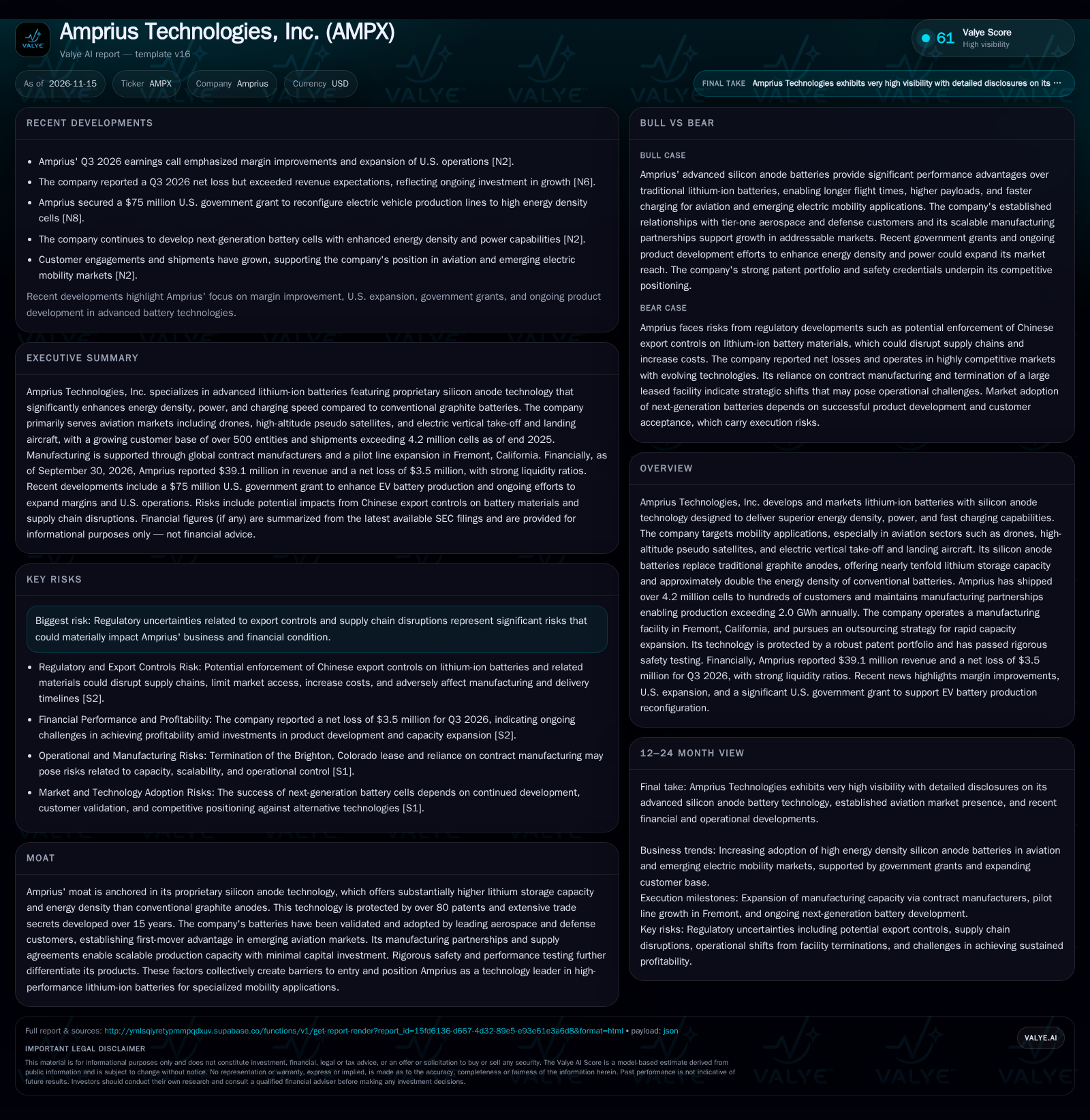
Amprius Technologies has shipped over 4.2 million cells leveraging proprietary silicon anode technology, achieving strong energy density and fast-charging performance. Q3 2026 revenues reached $39.1 million with a $3.5 million net loss, reflecting investment in growth and margin expansion. A $75 million U.S. government grant supports reconfiguration of EV production lines, signaling policy tailwinds and potential entry into new markets. The company’s patent portfolio and aerospace validation underpin its moat, but execution risks remain around supply chain resilience, manufacturing scale, and broader market adoption. [S2] [N2] [N6] [N8]
Amprius Technologies, Inc. stands at a pivotal moment in the evolution of advanced battery technology. With its proprietary silicon anode lithium-ion cells delivering superior energy density and charging capabilities, the company has carved out a leading position in aviation and high-performance electric mobility. Recent results highlight margin gains and growing U.S. manufacturing ambitions, underpinned by a $75 million government grant to adapt EV battery production lines. Yet, as Amprius seeks to scale beyond niche aerospace markets, it faces the dual challenges of achieving profitability and navigating geopolitical supply chain risks. The company’s next phase will test whether technical edge and early customer traction can translate into durable, broad-based commercial success. [S2] [N2] [N8]
Margin Expansion, U.S. Manufacturing, and the Push Beyond Aviation
Amprius Technologies reported $39.1 million in revenue and a net loss of $3.5 million for Q3 2026, reflecting ongoing investment in growth and innovation. The company’s most recent earnings call emphasized improvements in gross margin and discussed expanding U.S. operations, particularly in light of supply chain realignment and rising geopolitical risks. Amprius has shipped more than 4.2 million battery cells to a customer base numbering in the hundreds, establishing a foothold in aviation, high-altitude pseudo satellites, and electric vertical take-off and landing (eVTOL) platforms. The recent $75 million U.S. government grant will fund reconfiguration of EV battery production lines, signaling a potential broadening of addressable markets beyond aerospace. These developments matter because they demonstrate both commercial validation and the ambition to scale, while also highlighting the capital intensity and execution risk inherent in the next stage of the company’s growth. [S2] [N2] [N6] [N8]
How Silicon Anode Changes the Battery Value Equation
Amprius’ core business economics hinge on its proprietary silicon anode, which offers nearly ten times the lithium storage capacity of conventional graphite anodes and enables batteries with approximately double the energy density. In practice, this allows for longer flight times, higher payloads, and faster charging—critical advantages in aviation and high-performance mobility. The company’s revenue to date has been concentrated in specialized, high-value applications where customers are willing to pay a premium for performance, likely supporting higher average selling prices and gross margins relative to commodity battery suppliers. However, the capital requirements to scale production—whether through internal pilot lines or outsourced manufacturing—are significant, especially if Amprius targets broader EV markets. Fixed costs tied to R&D, manufacturing infrastructure, and compliance remain high, and variable costs are sensitive to raw material prices and supply chain constraints. Operating leverage could materialize if volume ramps and yields improve, but profitability will depend on the company’s ability to maintain pricing power as it moves into more competitive, price-sensitive sectors.
Technology Leadership, Patent Defensibility, and the Realities of Battery Competition
Amprius’ competitive edge is rooted in its first-mover status with silicon anode technology, which is protected by a portfolio of over 80 patents and years of accumulated trade secrets. Early validation and adoption by aerospace and defense customers provide strong external credibility and could increase switching costs in specialized markets where performance, safety, and reliability are paramount. However, the battery sector is intensely competitive, with deep-pocketed incumbents and emerging players—especially in Asia—pursuing next-generation chemistries including solid-state and advanced lithium-silicon hybrids. The company’s reliance on contract manufacturing and recent strategic shifts, such as the termination of a large leased facility, suggest a flexible but potentially less controlled approach to scaling. Counterforces include rapid technology cycles, customer risk aversion in mission-critical applications, and the possibility of regulatory or material-sourcing disruptions. Ultimately, Amprius’ moat is strongest in markets where its energy density and safety profile are critical differentiators, but may be less defensible in mass-market EV or consumer electronics segments absent sustained innovation and cost reduction.
Aviation Beachhead Converts to Mass Adoption—If Scale and Supply Align
The favorable scenario for Amprius sees its silicon anode batteries becoming the standard for high-performance aviation and unlocking substantial new demand in electric mobility and EV markets. The $75 million U.S. government grant could accelerate the company’s transition from niche to mainstream, enabling cost reductions through scale and process optimization. If Amprius can successfully ramp outsourced manufacturing to multi-gigawatt-hour levels, maintain yield and quality, and secure long-term supply agreements for critical materials, its revenue base could grow rapidly while margins expand on operating leverage. Confirmation of this scenario would come from sustained volume growth, further margin improvement, meaningful new customer wins in ground mobility or automotive, and evidence of price stability despite volume expansion. Falsification would involve persistent production bottlenecks, margin compression due to input costs or price competition, or failure to secure new high-volume contracts outside the core aviation segment.
Specialized Performance and Aviation Focus Drive Incremental Gains
The most plausible near-term trajectory for Amprius is continued leadership in specialized aviation and defense markets, with incremental expansion into adjacent high-value mobility niches. The company’s technology and customer relationships support modest volume and revenue growth, while ongoing investments in manufacturing partnerships and pilot line improvements yield gradual margin gains. The $75 million grant facilitates initial entry into EV or larger-format battery markets, but these remain a small contributor relative to aviation in the near term. This scenario is confirmed by steady order flow from existing aerospace customers, moderate increases in capacity utilization, and evidence that margin improvements are sustainable even as volumes rise. It would be challenged by lack of traction in broader mobility markets, execution issues in scaling production, or any regulatory/supply shock that constrains input availability or raises costs.
Supply Chain Disruptions and Cost Pressures Undermine the Growth Thesis
A negative outcome for Amprius would be triggered by regulatory developments (such as the enforcement of Chinese export controls on lithium or silicon battery materials) that disrupt supply chains, limit access to key inputs, or sharply increase costs. In this scenario, the company struggles to meet delivery timelines or maintain quality, resulting in delayed or lost contracts—particularly in segments where customers have alternative suppliers or lower switching frictions. Margin compression could accelerate if Amprius is forced to absorb higher raw material costs or discount pricing to retain business. Confirming evidence would include missed shipment targets, negative gross margin trends, or announcements of customer defections to competitors. Falsification would require clear demonstration of supply chain resilience, diversified sourcing, or the ability to rapidly pass through higher costs without losing share.
What Will Determine Amprius’ Transition from Niche to Scaled Operator?
Sustained gross margin improvement as volumes increase and as the company implements outsourced manufacturing at scale—if disclosed, this would show whether operating leverage is materializing.
Updates on capacity expansion milestones, especially progress in reconfiguring EV battery production lines with the $75 million grant, would clarify the pace and scope of market diversification.
Volume and revenue growth in non-aviation segments, particularly any new automotive or ground mobility contracts, would indicate progress beyond the aerospace niche.
Customer concentration and retention metrics—a useful disclosure would be the share of revenue from top customers, testing the durability of current relationships.
Disclosure of supply chain robustness and sourcing strategies, especially in light of potential Chinese export controls, would help assess vulnerability to input shocks.
Evidence of continued product innovation (e.g., new cell chemistries or safety benchmarks) and intellectual property filings, supporting the company’s moat.
Disclaimer: This is research-only, informational analysis and not investment advice. It may include AI-generated interpretation and general industry context. Always verify important details using primary sources.

Comments