
EnerSys: Growth, Integration, and Volatility in a Complex Energy Storage Market
EnerSys's latest results highlight strong profitability, active capital management, and a pending acquisition that could reshape its specialty battery segment. The company's diversified business model positions it to benefit from secular demand in data centers, defense, and electric vehicle infrastructure, but integration execution and exposure to commodity and currency swings remain central uncertainties.
EnerSys reported robust Q2 FY27 profitability, maintains a reported liquidity position, and is pursuing the acquisition of Ultralife Corporation. The company’s exposure to global macro forces and the complexities of integration execution will be critical in determining its ability to capitalize on growth opportunities across core and emerging markets. Monitoring integration progress, margin dynamics, and demand trends in key segments is essential for assessing the forward thesis.
EnerSys’s recent financial results and pending Ultralife acquisition mark a pivotal period for the global energy solutions provider. With diversified exposure across industrial, data center, defense, and electric vehicle markets, EnerSys stands to benefit from multiple secular growth drivers. However, the company faces significant execution risk as it integrates Ultralife and manages ongoing volatility in commodity prices and foreign exchange. The next 12 to 24 months will test EnerSys’s ability to translate operational strength and capital flexibility into sustainable long-term value.
Recent Performance and Strategic Initiatives Define Near-Term Prospects
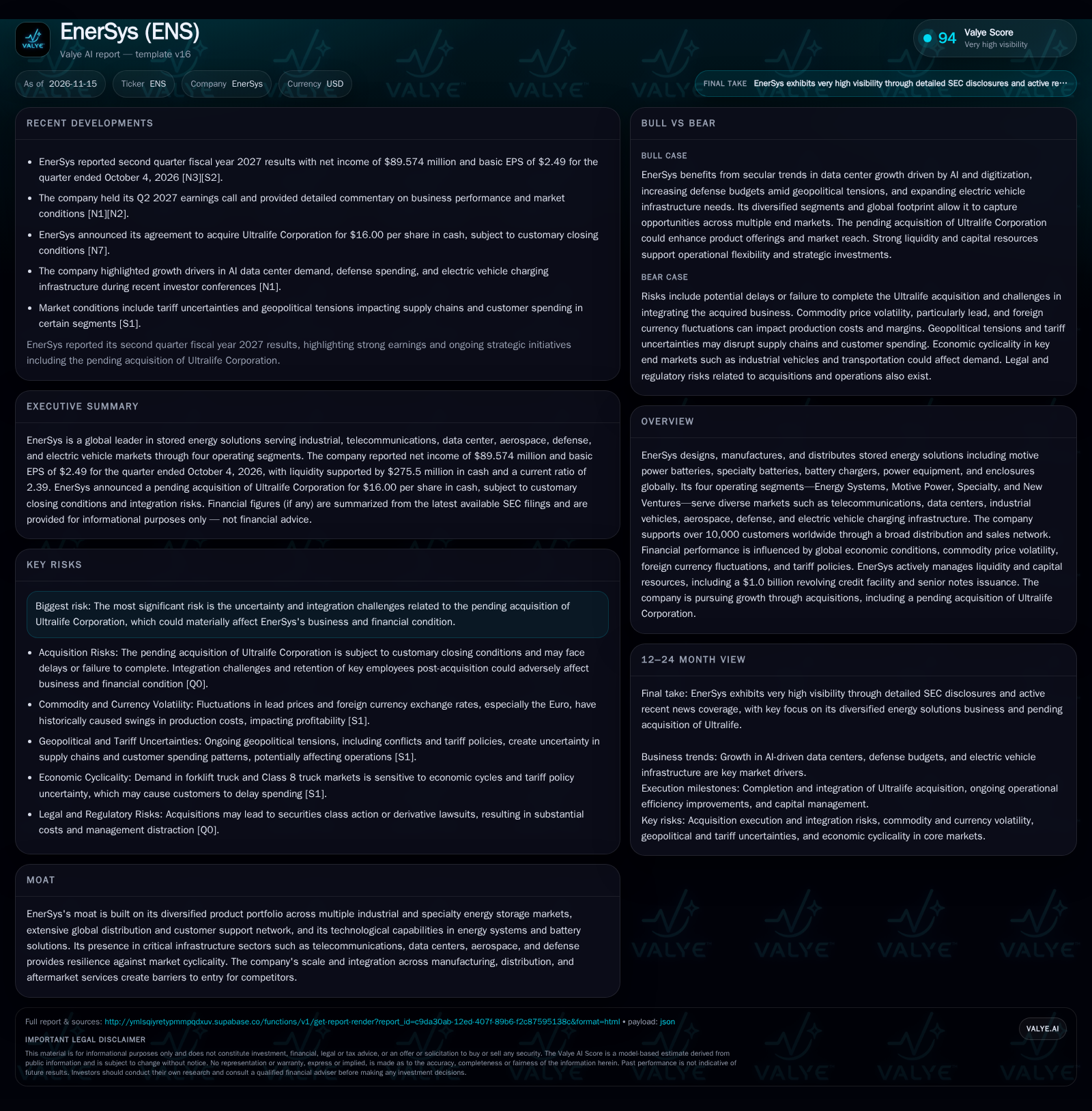
EnerSys reported net income of $89.574 million and basic EPS of $2.49 for the quarter ended October 4, 2026, underscoring continued operating performance [S2]. The company reported a current ratio of 2.39 for the period. [S2] [S1] A defining strategic development is the announced agreement to acquire Ultralife Corporation for $16.00 per share in cash, pending customary closing conditions and integration risks [N7]. These facts collectively position EnerSys for both organic and inorganic growth, while also introducing integration challenges and increased exposure to specialty battery markets.
The near-term prospects for EnerSys are also influenced by the interplay between organic growth initiatives and inorganic expansion through acquisitions. While the Ultralife deal offers scale and product diversification, it also requires significant management bandwidth and operational focus to avoid disruption. The timing of integration milestones and the ability to retain key talent will be critical to sustaining momentum. The company reported cash and liquidity metrics for the period; these figures do not by themselves establish operating runway, investment capacity, financial flexibility, or financing capacity.
EnerSys’s Revenue Model: Segment Mix, Cost Challenges, and Financial Leverage
EnerSys generates revenue across four segments: Energy Systems, Motive Power, Specialty, and New Ventures, each targeting distinct end markets such as telecommunications, data centers, industrial vehicles, aerospace, and defense [S1]. Revenue mix is influenced by market cycles—data center and communications demand are less cyclical, while motive power is sensitive to industrial activity and tariffs. The company’s cost base is heavily affected by commodity inputs (notably lead) and foreign exchange, especially the Euro, introducing margin volatility [S1].
Pricing power is conditional: EnerSys may be able to pass increased input costs to customers, particularly in mission-critical applications, but competitive intensity and contract terms can limit this ability. Fixed costs in manufacturing and R&D create operating leverage, so incremental volume growth—especially in higher-margin segments like Specialty—can drive outsized profit gains. Capital needs are significant for inventory, working capital, and M&A, as evidenced by the cash outlay for the Ultralife acquisition and ongoing management of a $1.0 billion revolver and senior notes [S1].
The company’s exposure to commodity price swings, particularly lead and other raw materials, introduces a layer of complexity in cost forecasting and margin stability. If EnerSys can enhance supply chain resilience through strategic sourcing or hedging strategies, it may mitigate some input cost volatility. Conversely, failure to pass costs onto customers in competitive segments could compress margins. Financial leverage amplifies these dynamics; while debt enables strategic acquisitions, excessive leverage could constrain flexibility during downturns or integration phases, emphasizing the importance of disciplined capital allocation and cash flow management.
Balancing Integration, Innovation, and Global Expansion to Strengthen Competitive Edges
EnerSys’s competitive position is anchored by its broad product portfolio, global distribution network, and presence in both mature and emerging energy storage markets [S1]. Its customer support infrastructure and aftermarket services create switching frictions, while scale in manufacturing and supply chain management drive cost advantages. However, rivalry is intense—especially from multinational battery manufacturers and energy solutions providers with advanced lithium and alternative chemistries.
The pending Ultralife acquisition could deepen EnerSys’s specialty battery capabilities, particularly in defense and high-reliability applications. This may create cross-selling opportunities and strengthen customer stickiness, but integration risks—ranging from cultural alignment to technology harmonization—could erode anticipated synergies. Continued innovation, particularly in batteries for AI data centers and EV infrastructure, will be required to maintain relevance and defend share against both established players and disruptive entrants.
EnerSys’s ability to innovate within its product portfolio is a key determinant of long-term competitiveness, especially as battery technologies evolve rapidly. The company must balance investment in incremental improvements to existing chemistries with potential shifts toward emerging technologies that may redefine market standards. Global expansion efforts also require navigating diverse regulatory environments and local market dynamics, which can affect pricing, distribution, and customer relationships. Effective integration of acquired entities like Ultralife must preserve innovation pipelines and cultural alignment to sustain competitive advantages in a fragmented and rapidly evolving industry.
Value Creation Potential Through Effective Integration and Growing Secular Demand
A favorable outcome could see EnerSys efficiently integrating Ultralife, realizing cost and revenue synergies, and leveraging its expanded specialty product set to win business in defense, aerospace, and critical infrastructure. If EnerSys capitalizes on AI-driven data center buildouts, rising defense budgets, and accelerating EV charging deployment, segment mix could shift toward higher-margin businesses, driving earnings growth and cash generation.
Confirmation would come from above-trend revenue and margin expansion in the Specialty and New Ventures segments, smooth post-acquisition reporting, and evidence of cross-selling or bundled solutions to new and existing customers. Additional signals would include market share gains in targeted verticals and successful cost containment despite commodity and currency pressures.
Maintaining Progress Despite Market Volatility and Integration Challenges
The most plausible path is that EnerSys maintains solid profitability and operational discipline, but integration of Ultralife proceeds at a measured pace, with incremental rather than transformative synergy realization. Core demand in data centers, defense, and telecom remains resilient, offsetting cyclical softness in industrial vehicles and transportation.
Margins fluctuate with lead prices and FX, but EnerSys’s pricing discipline and cost initiatives temper the impact. The company continues to invest in product development and operational efficiency, maintaining its competitive position but not dramatically expanding it. Confirmation would be continued mid-single-digit revenue growth, stable or modestly improving operating margins, and steady free cash flow generation, with no major integration setbacks disclosed.
Risks to Margins from Integration Errors and Economic Downturns
A negative scenario could emerge if the Ultralife acquisition faces significant integration hurdles—such as loss of key personnel, technology incompatibilities, or customer attrition—leading to delayed or unrealized synergies and unexpected costs. Concurrently, sharp commodity price spikes or adverse currency moves could compress margins, particularly if EnerSys is unable to pass through cost increases in competitive markets.
Further downside would result if macroeconomic or geopolitical shocks stall demand in core segments, or if regulatory or legal issues linked to acquisitions materialize. This would manifest in declining revenue, negative operating leverage, and pressure on liquidity, especially if working capital needs rise or debt service costs increase. Confirmation would include integration-related charges, margin declines outpacing peers, and negative revisions to forward guidance.
Key Developments Influencing EnerSys’s Path to Value Creation
Integration progress of Ultralife—timing, realized synergies, and any disclosed integration costs or setbacks.
Segment revenue and margin trends, particularly in Specialty and New Ventures, as leading indicators of mix shift and pricing power.
Gross margin evolution in relation to lead prices and FX movements; a useful metric would be the quarterly sensitivity disclosed to these inputs, if available.
Working capital efficiency, monitored via the company’s primary operating capital ratio to net sales, as a signal of asset intensity and operational discipline.
Customer retention and cross-selling metrics post-Ultralife acquisition, if disclosed, to assess the success of integration and expanded offerings.
Order backlog or awarded contracts in defense, data center, and EV infrastructure, as evidence of forward demand visibility (if disclosed).
Any legal or regulatory proceedings or disclosed acquisition-related litigation, which could signal unexpected costs or distractions.
Capital allocation updates—additional acquisitions, debt repayments, or changes to the revolving credit facility—that may affect potential financial flexibility.
Disclaimer: This is research-only, informational analysis and not investment advice. It may include AI-generated interpretation and general industry context. Always verify important details using primary sources.

Comments