
Solarius Capital Acquisition Corp.: Countdown to a Defining Business Combination in Asset and Wealth Management
With $177 million in trust and a management team steeped in asset management, Solarius Capital faces the high-stakes execution of a SPAC mandate—where target selection, deal structure, and shareholder dilution will determine value creation or loss.
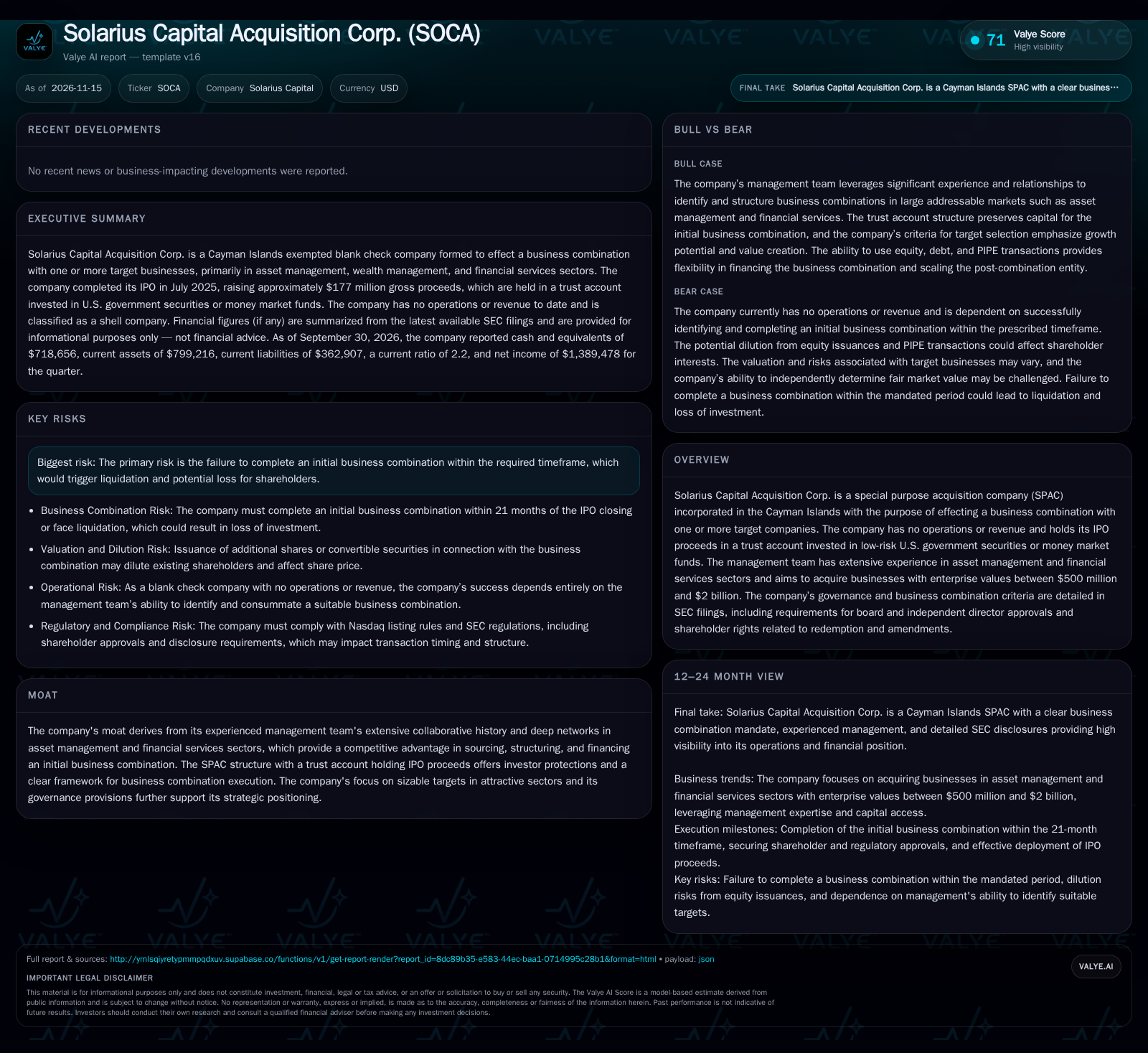
Solarius Capital Acquisition Corp. (SOCA) is a Cayman Islands SPAC with $177 million in trust, zero operations or revenue, and a mandate to acquire a business in asset management, wealth management, or financial services. The clock is ticking on its 21-month window to consummate a deal, with success hinging on the management team’s ability to identify, structure, and finance a transaction in a crowded SPAC market. Shareholder dilution, valuation discipline, and deal execution are the core variables that will drive outcomes for investors. [S2]
Solarius Capital Acquisition Corp. stands at the classic SPAC crossroads: flush with $177 million in trust and guided by an experienced asset management team, it has no operations, no revenue, and a single, high-stakes mandate—to acquire and merge with a business in the financial services sector. With less than a year remaining in its 21-month window, the company’s fate hinges entirely on its ability to identify and execute a business combination that delivers value without excessive dilution. In a market crowded with SPAC capital and rising competition for quality targets, Solarius’s strategic decisions in the coming months will determine whether its structure creates value for shareholders or leads to a costly liquidation. [S2]
Solarius’s Present Position: A Shell With Capital and a Tight Deadline
As of September 30, 2026, Solarius Capital Acquisition Corp. reported cash and equivalents of $718,656, current assets of $799,216, and current liabilities of $362,907, with a current ratio of 2.2 and a cash ratio of 1.98. These figures reflect the administrative operations of a SPAC, not an operating business. The company’s trust account—holding the $177 million raised in its July 2025 IPO and concurrent private placement—remains restricted for use only in the event of a business combination or liquidation. No revenue has been generated, and the company’s net income of $1,389,478 for the September quarter is attributable to interest income on trust investments, not business activity. The core fact shaping the investment case is that Solarius must complete a business combination within 21 months of the IPO (by April 2027) or liquidate, returning trust proceeds to shareholders. [S2]
SPAC Economics: How Value Is Created or Destroyed
Solarius’s economics hinge on a binary outcome: either it successfully merges with a target and transforms into an operating company, or it fails to do so and liquidates. Until a deal is consummated, the only income comes from interest on the trust’s low-yield investments. The capital structure—units comprising shares and warrants—offers upside leverage if a strong deal is executed, but introduces dilution risk from warrant exercise and potential equity or PIPE financing. The economics of the eventual business combination will depend on the deal’s purchase price, the mix of cash, equity, and debt consideration, and the quality of the acquired company’s own business model (e.g., fee-based revenues, recurring AUM, margin profile). Operating leverage and capital needs post-merger will be dictated by the target’s scale and capital intensity: asset-light wealth managers may require less incremental capital than fintech lenders or specialty finance companies. If the acquired company is already profitable and growing, the combined entity could benefit from public market access and acquisition currency. If not, the risk of post-merger underperformance and further dilution rises.
The Race for Financial Services Targets in a Crowded SPAC Field
Solarius is one of many SPACs targeting asset management, wealth management, and broader financial services businesses. Its management team’s deep sector experience and relationships could provide a sourcing edge, but competition is intense: strategic acquirers, private equity firms, and numerous other SPACs are bidding for similar targets. The most attractive companies—those with sticky AUM, scalable platforms, or differentiated technology—tend to command high valuations. The SPAC’s ability to offer a quick, public-market path for targets can be a selling point, but is counterbalanced by the complexity of shareholder redemptions, regulatory scrutiny, and market skepticism toward SPAC-sponsored deals. Solarius’s governance provisions—requiring independent director and shareholder approval—may reassure some investors but could slow execution. Ultimately, the company’s competitive position will be determined by its ability to identify a willing and suitable target, negotiate a fair price, and structure a transaction that survives due diligence and market reception.
What Success Looks Like: Sourcing and Closing a High-Quality Acquisition
In the best-case scenario, Solarius leverages its management network to source a high-growth, profitable asset or wealth management platform with a defensible market position and recurring revenue. The deal is structured with an optimal balance of cash and equity, minimizing dilution but providing the target with adequate growth capital. Shareholder redemptions are modest, and any required PIPE financing is secured on favorable terms. The post-merger company demonstrates operating leverage and earnings growth, attracting institutional investors and supporting a re-rating of the shares. Confirmation of this scenario would come from a deal announcement featuring a recognized, high-quality target, clear disclosure of valuation and consideration mix, limited redemptions, and positive market reaction to the transaction terms.
Most Likely Outcome: Competitive Pressures and Dilution Shape the Deal
The most plausible scenario is that Solarius identifies a viable, but not top-tier, target in the asset or wealth management space—potentially a regional player or a niche financial platform. The deal is completed with a significant equity component, and PIPE investors are brought in to backstop redemptions, resulting in moderate to high dilution for public shareholders. The target brings steady but unremarkable growth, and the combined entity faces the usual integration and execution risks. Share price performance is mixed, tracking the quality of the target and the level of dilution. Confirmation of this scenario would be a deal announcement with a credible, but not market-leading, target, significant PIPE participation, and a share price that trades near or below the $10 trust value post-announcement.
Deal Failure, Liquidation, or Value-Destructive Transaction
The adverse scenario centers on Solarius either failing to secure a business combination within the allotted timeframe or pursuing a deal that is rejected by shareholders or regulators. Alternatively, the company could announce a transaction with a low-quality or overvalued target, prompting massive redemptions, failed PIPE fundraising, and a collapse in share price. In such cases, the SPAC would be forced to liquidate, returning trust proceeds (minus expenses) to shareholders, or close a value-destructive merger that erodes public shareholder value through extreme dilution or post-merger underperformance. Confirmation of this scenario would be continued absence of a deal as the deadline approaches, a failed shareholder vote, or a post-announcement trading price well below trust value with persistent negative sentiment.
Milestones and Metrics That Will Determine Solarius’s Outcome
Announcement of a definitive business combination agreement, with clear disclosure of target identity, sector, and transaction terms.
The level of public shareholder redemptions at the time of deal announcement and closing; high redemption rates would signal skepticism and could impair deal economics.
PIPE financing commitments—size, terms, and investor quality—if disclosed, as these will reveal market confidence in the transaction.
Valuation multiples relative to peer asset and wealth management companies; a useful metric would be deal EV/AUM, EV/revenue, or EV/EBITDA, if disclosed.
Timing of regulatory and shareholder approvals, and any delays or complications in the de-SPAC process.
Post-announcement share price performance relative to trust value, indicating market sentiment toward the proposed deal.
Management and sponsor alignment post-merger, including lock-up agreements, rollover equity, and ongoing board participation, if disclosed.
Progress toward the 21-month deadline (April 2027) without a completed deal; the closer to expiry, the higher the risk of forced liquidation.
Disclaimer: This is research-only, informational analysis and not investment advice. It may include AI-generated interpretation and general industry context. Always verify important details using primary sources.

Comments