
DarioHealth’s Next Act: Product Expansion, Margin Pressure, and the Stakes of Financial Discipline
DarioHealth is advancing its digital health platform with new women’s health and sleep programs set for launch, while contending with ongoing net losses and the critical challenge of financial covenant compliance. As the company seeks to diversify revenue streams and narrow its losses, operational discipline and strategic execution will determine whether it can translate product breadth into sustainable economics.
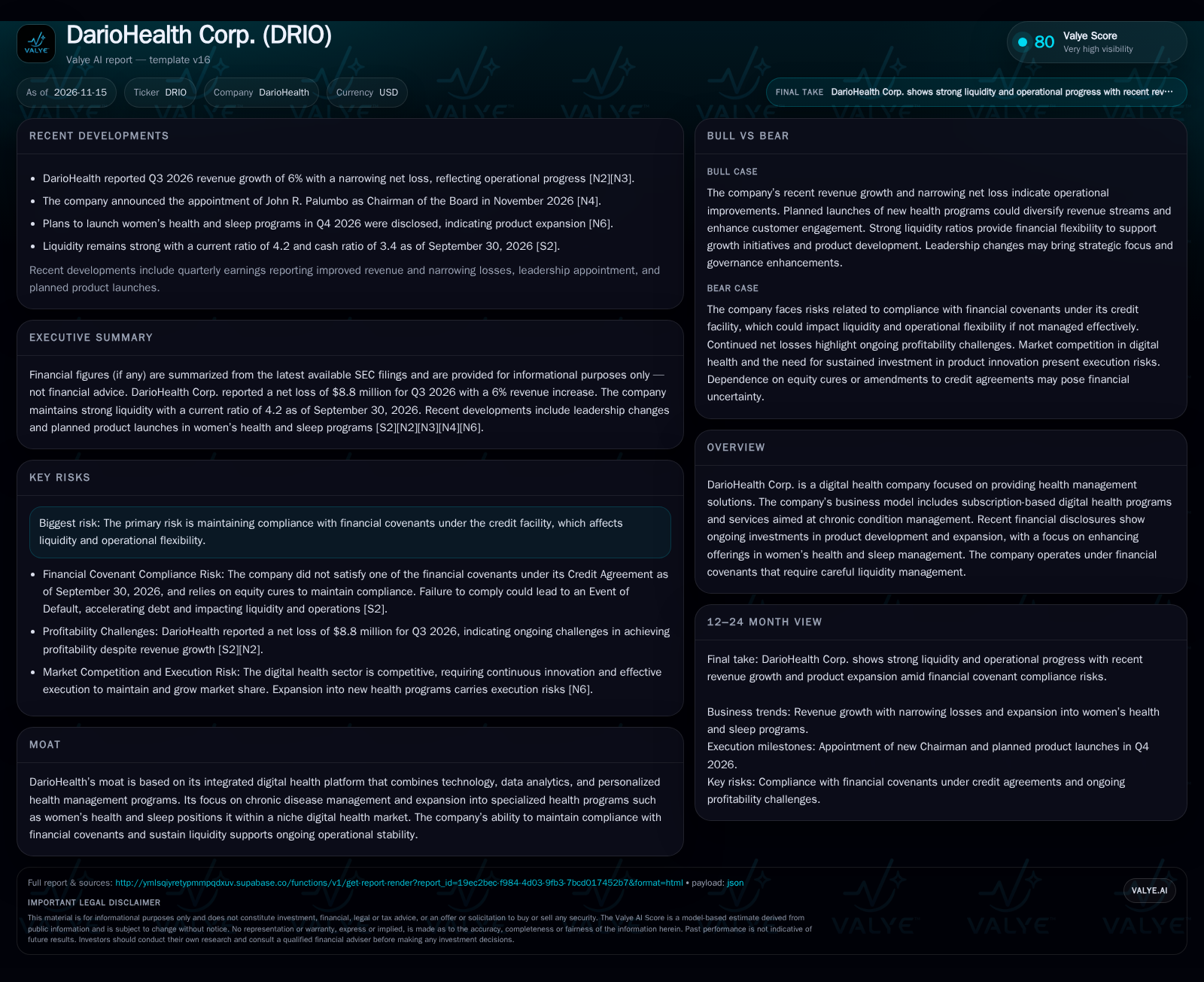
DarioHealth reported a 6% year-over-year revenue increase and a narrowed Q3 2026 net loss. The company maintains a reported current ratio of 4.2 and plans to launch women’s health and sleep programs in Q4 2026. Strategic product expansion and leadership changes are key levers for the company’s next phase.[S2] [N2] [N3] [N4] [N6]
DarioHealth Corp., a digital health platform company, is at a pivotal juncture as it shifts from core chronic condition management into adjacent verticals like women’s health and sleep. While Q3 2026 results showed a 6% revenue increase and a narrowing net loss, the company remains unprofitable and must vigilantly monitor compliance with financial covenants attached to its credit agreement. The upcoming product launches and board-level leadership changes could catalyze new growth, but execution risks are heightened by persistent margin pressure and the need for disciplined capital management.
Recent Financial and Strategic Developments Reshape DarioHealth’s Risk Profile
The company reported a current ratio of 4.2 for the period. [S2] [N2] [N3] [N6] Palumbo as Chairman in November 2026 suggests a potential shift in board oversight and strategic direction.[N4]
How Revenue Mix, Fixed Costs, and Product Expansion May Shape Economics
DarioHealth’s core business is built around subscription-based digital health programs for chronic condition management, a model typically characterized by recurring revenue and the potential for high gross margins if customer retention is strong and customer acquisition costs (CAC) are controlled. However, the company remains loss-making, suggesting that current scale does not yet provide sufficient operating leverage to cover fixed costs, including ongoing R&D, sales, and administrative expenses.[S2]
The planned entry into women’s health and sleep programs could provide new revenue streams and improve customer lifetime value if cross-sell and up-sell rates are high. These verticals are attractive in digital health due to large addressable populations and employers’ growing interest in comprehensive wellness. However, expansion efforts often entail upfront investment in product development, regulatory clearance (if applicable), and marketing. If new programs fail to achieve sufficient adoption, the added costs could delay the path to profitability.
The company reported cash and liquidity metrics for the period; these figures do not by themselves establish operating runway, investment capacity, financial flexibility, or financing capacity. DarioHealth’s long-term economics will depend on its ability to grow recurring revenue faster than fixed costs and to eventually achieve positive unit economics in new verticals.
Differentiation in a Crowded Digital Health Market: Opportunities and Threats
DarioHealth operates in a highly competitive digital health ecosystem, facing rivals ranging from pure-play chronic disease management platforms to diversified virtual care and wellness providers. The company’s differentiation historically stems from an integrated approach combining connected devices, personalized digital interventions, and data analytics for chronic condition management.
Expansion into women’s health and sleep exposes DarioHealth to new competitor sets, including specialized women’s wellness platforms, sleep monitoring apps, and broader telehealth offerings. The ability to offer a unified platform experience and leverage data across conditions could provide switching-cost benefits and cross-sell opportunities, but only if the user experience, outcomes, and employer or payer value propositions are demonstrably superior.
Counterforces include the rapid pace of innovation in digital health, the risk of commoditization as new entrants emerge, and the challenge of demonstrating clinical efficacy and cost savings to enterprise customers. If competitors achieve faster adoption in the new verticals or offer more attractive pricing or integrations, DarioHealth may struggle to capture share despite its breadth.
If Product Expansion Unlocks Adoption and Margin Leverage
The most favorable scenario for DarioHealth is that its Q4 2026 launches in women’s health and sleep are well received by employers, payers, and end users, driving accelerated adoption and higher per-customer revenue. If the company can demonstrate improved outcomes or engagement—especially in under-addressed segments like sleep—this could provide a competitive edge and enable pricing power.
Strong uptake in new programs would likely improve gross margin mix, as digital health solutions can scale efficiently once developed. If cross-selling to existing chronic care clients proves successful, customer acquisition costs could decrease as wallet share rises. Operating leverage would then become visible as revenue growth outpaces incremental fixed costs, leading to further narrowing of net losses or a potential inflection to profitability.
Evidence that would confirm this scenario includes above-consensus revenue growth in subsequent quarters, higher gross margins, and positive commentary from enterprise customers or channel partners regarding the new offerings. Early renewal or expansion contracts in the new verticals would also be a bullish signal.
What Steady Execution with Measured Adoption Would Mean
The most plausible outcome is that DarioHealth’s new programs provide incremental revenue growth but do not immediately transform the economics of the business. Adoption rates in women’s health and sleep may be moderate, with the company needing several quarters to refine offerings, build clinical evidence, and achieve meaningful enterprise traction.
Under this scenario, recurring revenue from core chronic care programs continues to grow at a mid-single-digit pace, with net losses narrowing gradually as operating efficiencies are realized.
Confirmation would come from steady revenue growth, continued narrowing of losses, and no further breaches or reliance on equity cures for covenant compliance. Conversely, signs of stagnating adoption in new verticals, persistent cash burn, or further covenant stress would challenge the sustainability of this trajectory.
How Covenant Pressure and Execution Risks Could Derail Progress
A negative scenario would involve weak adoption of the new women’s health and sleep programs, resulting in disappointing revenue contribution and a cost structure that remains too high relative to growth. If the company is unable to build material traction in new verticals, fixed costs from R&D and commercial expansion could keep net losses elevated.
More critically, if profitability improvements stall and recurring cash burn persists, DarioHealth could again breach financial covenants attached to its credit agreement. Reliance on equity cures or amendments may not be sustainable, particularly if market conditions deteriorate or investor appetite wanes. A covenant breach could trigger an event of default, leading to accelerated debt repayment or operational restrictions that limit flexibility for further investment.
Confirmation of this scenario would include flat or declining revenue, widening losses, repeat covenant breaches, or the need to raise additional dilutive capital on unfavorable terms.
Milestones and Metrics That Will Define DarioHealth’s Next Chapter
Adoption rates and revenue contribution from newly launched women’s health and sleep programs—if disclosed, these figures will reveal whether expansion efforts are gaining commercial traction.
Gross margin trends, particularly as new programs scale. Improvement would suggest operating leverage and successful monetization of product investments.
Churn rates or customer retention in both legacy and new verticals, as higher retention would support recurring revenue growth and lower CAC.
Compliance with financial covenants and any reliance on equity cures, amendments, or waivers. Persistent issues here would signal elevated risk.
Enterprise contract wins, renewals, or expansions, especially involving new verticals—these would validate the cross-sell thesis and product-market fit.
Board and management commentary on strategic priorities and capital allocation, which may shift following the appointment of a new Chairman.
Any changes in competitor offerings or market share dynamics in chronic care, women’s health, or sleep, which could affect DarioHealth’s growth outlook.
Disclaimer: This is research-only, informational analysis and not investment advice. It may include AI-generated interpretation and general industry context. Always verify important details using primary sources.

Comments