
X-Energy: Liquidity Strength Meets the Realities of First-of-a-Kind Nuclear Deployment
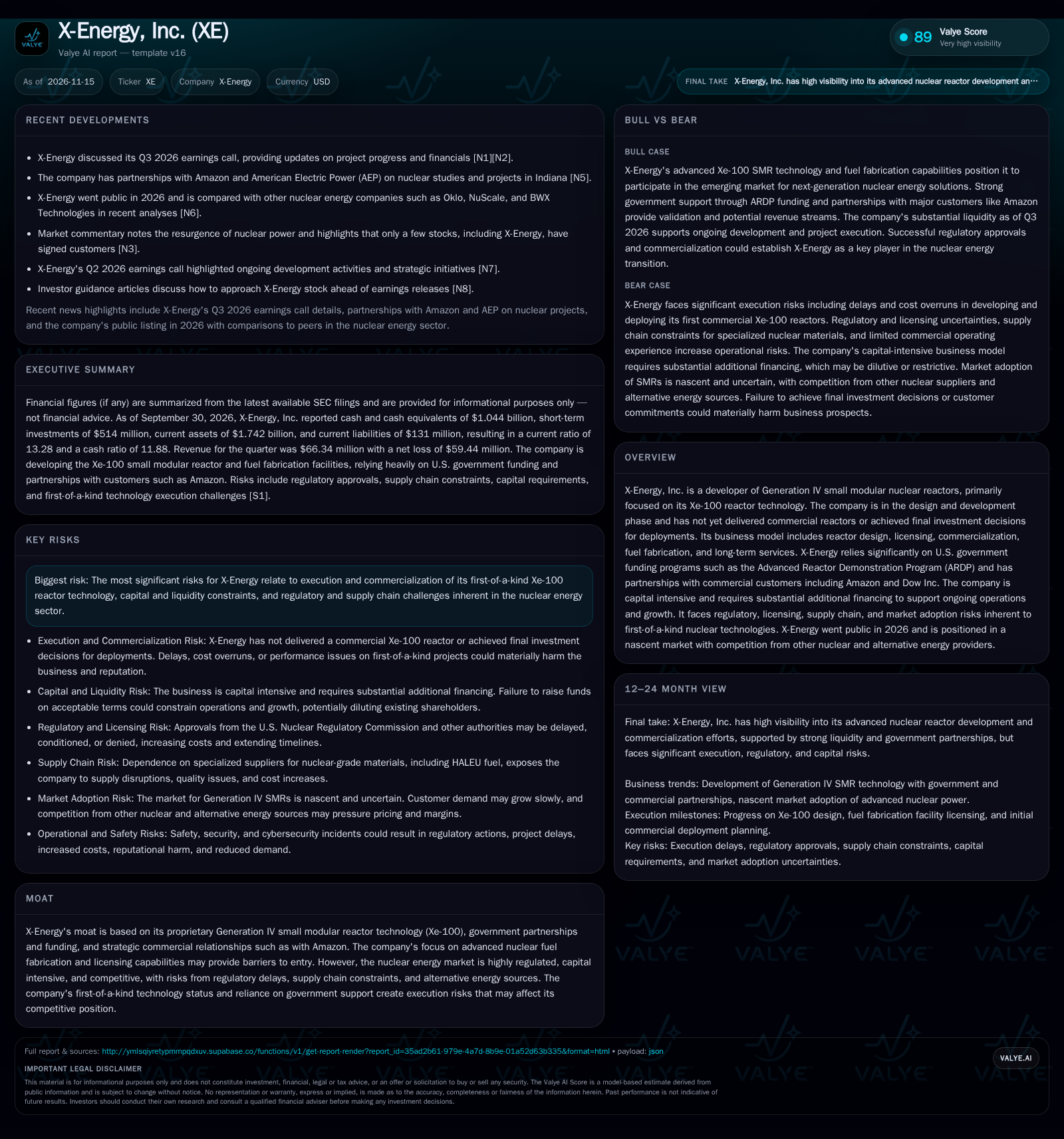
X-Energy holds over $1.5 billion in liquidity and works with partners like Amazon, yet has not achieved a final investment decision or delivered a commercial reactor.
X-Energy holds over $1.5 billion in liquidity and works with partners like Amazon, yet has not achieved a final investment decision or delivered a commercial reactor. The company’s future hinges on overcoming first-of-a-kind project risks, regulatory hurdles, and the uncertain pace of SMR market adoption. Its capital-intensive model and reliance on government funding create both opportunity and vulnerability as it seeks to commercialize the Xe-100.
X-Energy, Inc. is positioning itself at the forefront of the next wave of nuclear innovation, with its Xe-100 small modular reactor (SMR) targeting a market eager for low-carbon baseload power. The stakes are high: success could transform X-Energy into a foundational player in 21st-century energy infrastructure, but the pathway is fraught with financing needs, market uncertainty, and execution risk.
Liquidity, Partnerships, and the Absence of Commercial Deployments
As of September 30, 2026, X-Energy reported $1.044 billion in cash and cash equivalents and $514 million in short-term investments, supporting a current ratio of 13.28 and a cash ratio of 11.88 [S1]. The company reported cash and liquidity metrics for the period; these figures do not by themselves establish operating runway, investment capacity, financial flexibility, or financing capacity. However, the company recorded a $59.44 million net loss on $66.34 million in revenue for the quarter, with revenue still mainly derived from government cost-share agreements rather than commercial product sales or licensing [S1]. X-Energy has not yet achieved a final investment decision or delivered a Xe-100 reactor to any customer. Its customer and partnership roster includes Amazon, Dow Inc., and a non-binding joint development agreement with Centrica, alongside a project study with American Electric Power (AEP) in Indiana [N5]. The company remains in the design and development phase for both its reactor and fuel fabrication business lines, with first commercial deployment not expected before the early 2030s and subject to significant uncertainty [S1].
The SMR Business Model: Capital Intensity, Deferred Revenue, and Long-Term Service Potential
X-Energy’s business model is structurally capital intensive, combining nuclear reactor design, licensing, and commercialization with vertically integrated fuel fabrication and anticipated long-term operations and service contracts. In the short term, revenue is tied to milestone-based government contracts and cost-share agreements, resulting in lumpy and unpredictable inflows with no recurring commercial revenue as of the latest filings [S1]. The path to meaningful commercial revenue depends on regulatory approval, customer commitment, and final investment decisions for Xe-100 deployments, all of which are still pending.
If X-Energy succeeds in commercializing the Xe-100, future economics could shift toward a mix of upfront reactor sales or project development fees, recurring revenue from long-term service agreements, and ongoing fuel supply contracts. The extent of operating leverage would depend on the company’s ability to standardize reactor modules, achieve economies of scale in fuel fabrication, and secure a pipeline of projects. However, initial unit economics for first-of-a-kind deployments are likely to be unfavorable due to high fixed costs for regulatory compliance, project management, and supply chain development. The need for substantial additional capital – either through equity, debt, or further government support – is an inherent feature of the business, with dilution or restrictive covenants a likely consequence [S1].
Potential Differentiators and Headwinds in a Crowded Advanced Nuclear Field
X-Energy’s competitive position hinges on its proprietary Generation IV Xe-100 SMR technology, fuel fabrication capabilities, and a web of government and commercial partnerships. In principle, the company could benefit from early-mover advantages if it achieves regulatory approval and successful demonstration ahead of peers. Advanced fuel technology and vertically integrated supply could provide barriers to entry, especially given the complexity and regulatory scrutiny of nuclear-grade materials.
However, these potential moats are counterbalanced by formidable industry headwinds. X-Energy faces competition from both incumbent nuclear vendors (e.g., established U.S. and international reactor suppliers) and a new wave of SMR developers such as Oklo, NuScale, and BWX Technologies [N6]. Alternative energy sources—including renewables and storage—are also aggressively scaling and may capture a portion of the grid decarbonization agenda. Regulatory risk, supply chain fragility (notably around HALEU fuel), and reliance on government support further limit sustainable competitive advantage. Finally, the absence of commercial deployments means customer switching costs, retention, and recurring revenue mechanics remain unproven.
What Success Would Look Like: Regulatory Wins, Project Execution, and Market Adoption
In a favorable scenario, X-Energy achieves timely NRC licensing for both the Xe-100 reactor and its Oak Ridge fuel fabrication facility, enabling the company to secure binding customer commitments and reach final investment decisions on one or more commercial projects. Successful project execution—on time and on budget—demonstrates technical credibility, while partnerships with major corporates such as Amazon and Dow Inc. translate into repeatable commercial reference sites.
The upside case would be further confirmed by the conversion of non-binding agreements (like that with Centrica) into firm contracts, the announcement of multi-year service and fuel supply agreements, and evidence of project pipeline growth. Public policy momentum for decarbonization and continued government funding would reinforce the market opportunity. Evidence to falsify this scenario would include persistent regulatory delays, cost overruns, failure to secure customer commitments, or a broader loss of political support for advanced nuclear deployment.
Expected Trajectory: Prolonged Development, Episodic Funding, and Uncertain Commercialization
The most plausible near-term scenario for X-Energy is a protracted development phase marked by continued reliance on government contracts and episodic capital raises to bridge working capital needs. Regulatory approvals for the Xe-100 and fuel facilities may proceed incrementally, but are likely to encounter delays and iterative feedback from the NRC, slowing time to market. Commercial traction may materialize gradually, with initial projects focused on demonstration or pilot deployments rather than large-scale rollouts.
The company’s financials are likely to remain volatile, with recurring net losses and cash burn offset by its existing liquidity and the prospect of further government support. Confirmation of this scenario would come from ongoing but slow progress on regulatory filings, limited movement from non-binding to binding customer agreements, and the absence of near-term revenue inflection from commercial projects. Falsifying this trajectory would require either a rapid breakthrough on licensing and customer commitments or a material adverse event such as a regulatory setback or loss of government funding.
Where Things Could Go Wrong: Regulatory, Capital, or Supply Chain Failure
In the adverse case, X-Energy encounters significant regulatory or technical hurdles—such as NRC rejection, extended delays, or safety concerns—that prevent timely commercialization of the Xe-100. Cost overruns, project execution failures, or setbacks in fuel fabrication facility licensing could erode confidence among government backers and commercial partners alike. In this scenario, the company’s substantial cash reserves are depleted before meaningful commercial revenue is achieved, forcing dilutive capital raises or strategic retrenchment.
Market adoption of SMRs remains tepid, with alternative energy sources capturing customer demand and policymakers shifting focus away from nuclear. Confirmation would come from missed regulatory milestones, withdrawal or downsizing of government support, failed customer negotiations, or the emergence of supply chain bottlenecks—particularly for HALEU fuel—that cannot be resolved at scale. Evidence against the downside would be sustained project progress, renewal of government programs, or successful navigation of first-of-a-kind risks.
Upcoming Milestones to Gauge X-Energy’s Progress Toward Commercialization
Progress on NRC licensing and regulatory milestones for both the Xe-100 reactor and Oak Ridge fuel fabrication facility—timing and outcomes will be critical.
Conversion of non-binding customer agreements (such as with Centrica) into binding contracts with defined financial commitments.
Movement from milestone-based government funding to commercial revenue from reactor sales, licensing, or technology fees—if disclosed.
Updates on project execution, including cost, schedule, and performance of demonstration or pilot deployments.
Trends in cash burn and additional capital raises—magnitude, terms, and impact on shareholder dilution.
Supply chain developments, especially regarding HALEU fuel sourcing and fabrication capacity.
Resolution or remediation of the identified material weakness in internal control over financial reporting—if disclosed.
Disclaimer: This is research-only, informational analysis and not investment advice. It may include AI-generated interpretation and general industry context. Always verify important details using primary sources.

Comments