
Aureus Greenway: Golf Club Operator at a Crossroads of Capital Strength and Structural Headwinds
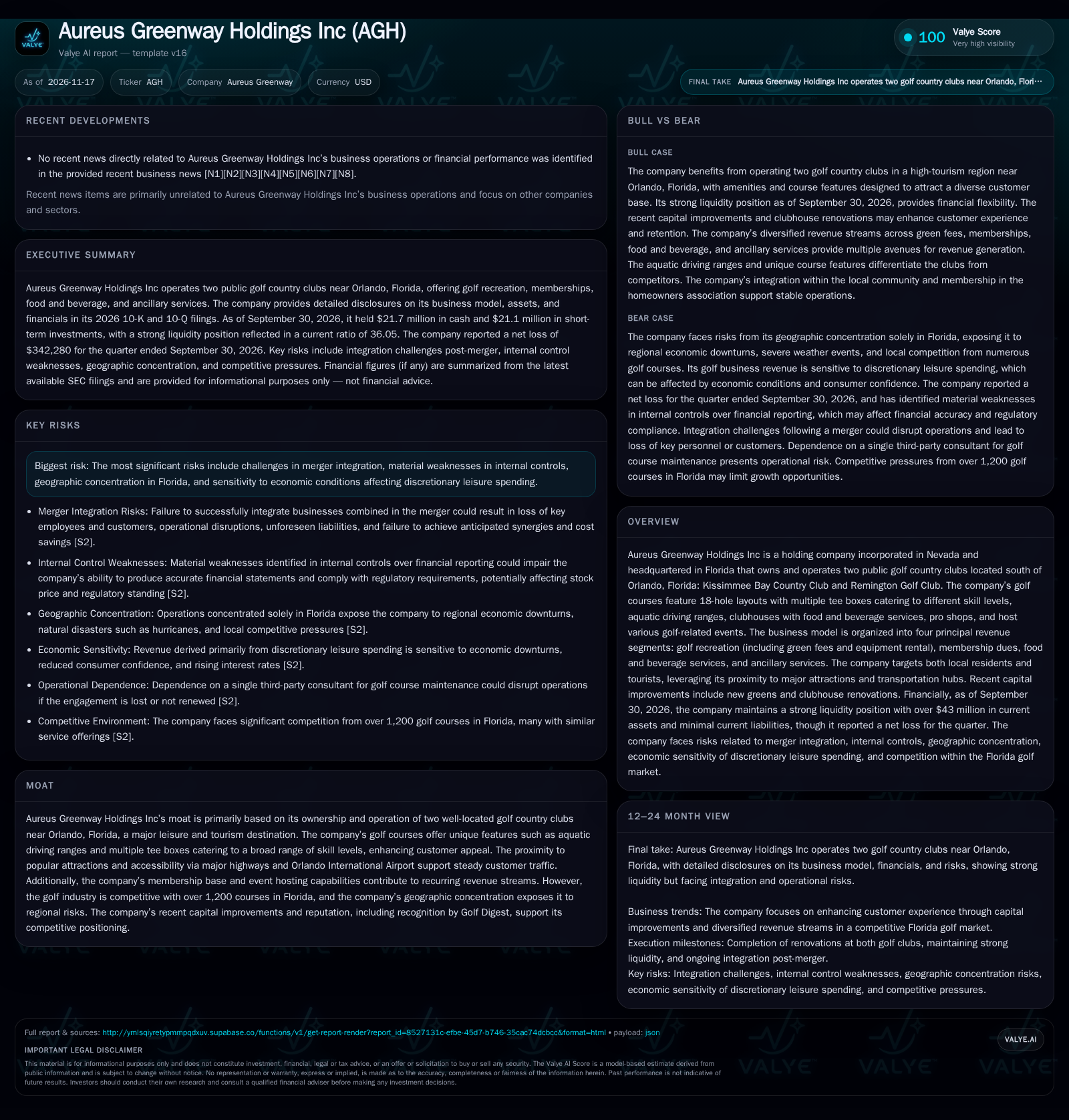
Aureus Greenway Holdings Inc owns and operates two public golf clubs near Orlando, Florida, boasting significant liquidity and recent property upgrades. Yet, the company’s reliance on green fees, exposure to local economic cycles, and material internal-control risks leave its business model exposed to shifting leisure demand and operational disruptions.
Aureus Greenway operates two public country clubs in a high-tourism area near Orlando, targeting both locals and tourists with golf, membership, and event services. [S1] [S2]
Aureus Greenway Holdings Inc stands as a microcosm of the modern public golf operator: asset-rich, strategically located near a major tourist hub, and diversified across memberships, events, and food service—but still heavily reliant on traditional green fees. Despite a fortress-like liquidity position and recent investments in course and clubhouse upgrades, the company’s core golf revenue is shrinking, and its exposure to Florida’s economic and weather cycles, combined with persistent internal-control issues, puts its long-term competitive standing in question. Whether Aureus Greenway can pivot to more resilient revenue streams and operational stability will determine if its balance sheet strength translates into sustainable value.
Recent Performance and Financial Posture: Liquidity Amid Core Revenue Erosion
The company reported cash and liquidity metrics for the period; these figures do not by themselves establish operating runway, investment capacity, financial flexibility, or financing capacity. However, the company reported a net loss of $342,280 for the quarter, and its core green fee revenue (64% of gross revenue) declined about 11% year over year in 2025. This decline in the main revenue driver signals deeper demand or pricing challenges. Meanwhile, recent capital improvements, including new greens at Remington and clubhouse renovations at Kissimmee Bay, reflect efforts to enhance the customer experience, but their financial impact remains uncertain. [S1] [S2]
How Revenue Streams and Cost Structures Shape Club Economics
Aureus Greenway’s business model is anchored in four main revenue streams: green fees (including equipment rental and retail), membership dues, food and beverage, and ancillary services/events. Green fees are the dominant contributor, making the business highly sensitive to fluctuations in golf play volume, pricing, and local tourism. Memberships provide more predictable cash flow, but the reported member base is modest—100 at Kissimmee Bay and 30 at Remington as of December 2025—limiting recurring revenue stabilization. Food, beverage, and event services likely offer higher margins but are volume-dependent and subject to local competition.
The company’s cost base features a mix of fixed and variable elements: property maintenance, staffing, and utilities are largely fixed, while food, beverage, and retail costs vary with sales. The use of aquatic driving ranges with reusable floater balls may lower recurring supply costs and provide a modest operational edge. Notably, Aureus Greenway avoids inventory risk in its pro shops by selling golf clubs only on a prepaid custom-order basis. Capital needs are episodic—driven by renovations and course upgrades—while ongoing maintenance is outsourced to a single third-party consultant, introducing concentrated operational risk. Operating leverage is moderate: higher utilization can drive incremental margin, but fixed costs limit flexibility when traffic softens.
Competitive Landscape: Differentiation and Structural Disadvantages in a Saturated Market
Aureus Greenway operates in one of the most crowded golf markets in the U.S., with over 1,200 competing courses in Florida alone. Its two properties benefit from proximity to Orlando International Airport and Walt Disney World, providing access to both tourists and local residents. Differentiators such as aquatic driving ranges and recent property upgrades may increase appeal, but these features are relatively easy to replicate and do not guarantee pricing power or customer loyalty.
The club’s integration within a homeowners association offers community ties but also imposes certain restrictions and easements, which could limit future development. Given the scale of competition and lack of a unique, defensible offering, Aureus Greenway’s ability to outcompete peers likely depends on sustained course quality, event programming, and targeted marketing. The company’s modest membership base and reliance on green fees suggest limited switching costs and a low barrier for customers to sample alternatives.
Unlocking Value: What a Successful Pivot to Experience-Driven Growth Would Look Like
The most attractive upside scenario for Aureus Greenway involves leveraging its substantial liquidity and recent capital improvements to reposition its clubs as destination venues for both tourists and high-frequency local golfers. If the renovations translate into higher customer satisfaction, increased event bookings, and improved membership retention or growth, the company could see stabilization—or even growth—in non-green fee revenue streams. Enhanced food and beverage offerings, expanded event hosting (e.g., weddings, corporate outings), and creative golf experiences could diversify the revenue base and improve margins.
Evidence that would confirm this trajectory includes: a rebound in green fee volume or yield, a rising membership count, stronger event and F&B revenues, and improved gross margin. If Aureus Greenway can also address its internal control weaknesses and demonstrate consistent operational execution, the market could reward its strategic repositioning.
Status Quo: Navigating Flat Demand and Incremental Improvements
The most plausible outcome is a continuation of current trends: green fee revenue remains under pressure due to intense local competition and the cyclical nature of discretionary leisure spending, while incremental gains from renovations and amenities partially offset declines. Membership and event bookings may see modest growth, but not enough to fundamentally shift the revenue mix.
Confirmation of this scenario would be ongoing net losses, stable or slow-growing non-green fee revenue, and only marginal improvements in membership or event bookings. If the company fails to materially improve its revenue mix or address internal control weaknesses, it could remain a structurally challenged operator despite its liquidity.
Adverse Developments: When Concentration and Execution Risks Compound
The downside scenario is characterized by a further decline in green fee revenue, exacerbated by local economic weakness, severe weather events, or loss of the key maintenance consultant. Failure to resolve internal control weaknesses could result in regulatory penalties or eroded stakeholder confidence. If capital improvements do not drive increased traffic or if competitive dynamics force further price cuts, both top-line and margin erosion could accelerate.
Evidence supporting this scenario would include continued or accelerating net losses, cash burn exceeding projections, deterioration in course condition or customer satisfaction (if disclosed), and negative swings in working capital. A shock event—such as hurricane damage or the abrupt loss of the maintenance consultant—would further stress the business.
Testing Aureus Greenway’s Thesis: What Will Reveal the Real Trajectory?
Green fee volume and yield trends by club—any reversal of the recent 11% year-over-year decline would suggest stabilization or improvement. [S1]
Membership count evolution at both Kissimmee Bay and Remington—rising numbers would indicate successful customer retention and recurring revenue growth. [S1]
Food, beverage, and event revenue as a share of total—higher contributions could confirm effective diversification away from green fee dependence (if disclosed).
Gross margin changes—expansion would suggest operating leverage from higher utilization or successful cost management (if disclosed).
Resolution of material weaknesses in internal controls—a clean audit or regulatory statement would reduce operational risk. [S2]
Customer satisfaction and course condition metrics—improved ratings or lower complaint rates would support the impact of recent capital improvements (if disclosed).
Retention or replacement of the third-party maintenance consultant—continued engagement reduces operational disruption risk. [S2]
Cash burn rate and liquidity buffer—monitoring whether cash balances remain stable or begin to erode will be critical given ongoing net losses. [S2]
Disclaimer: This is research-only, informational analysis and not investment advice. It may include AI-generated interpretation and general industry context. Always verify important details using primary sources.

Comments