
Firefly Neuroscience: AI-Driven Brain Health Diagnostics and the Stakes of Commercialization
Firefly Neuroscience is advancing AI-enabled EEG diagnostics, forging research partnerships, and building a multi-modal brain health platform. The company’s recent revenue and liquidity figures signal the stakes of scaling from academic validation to broader commercial adoption in a competitive neurodiagnostics landscape.
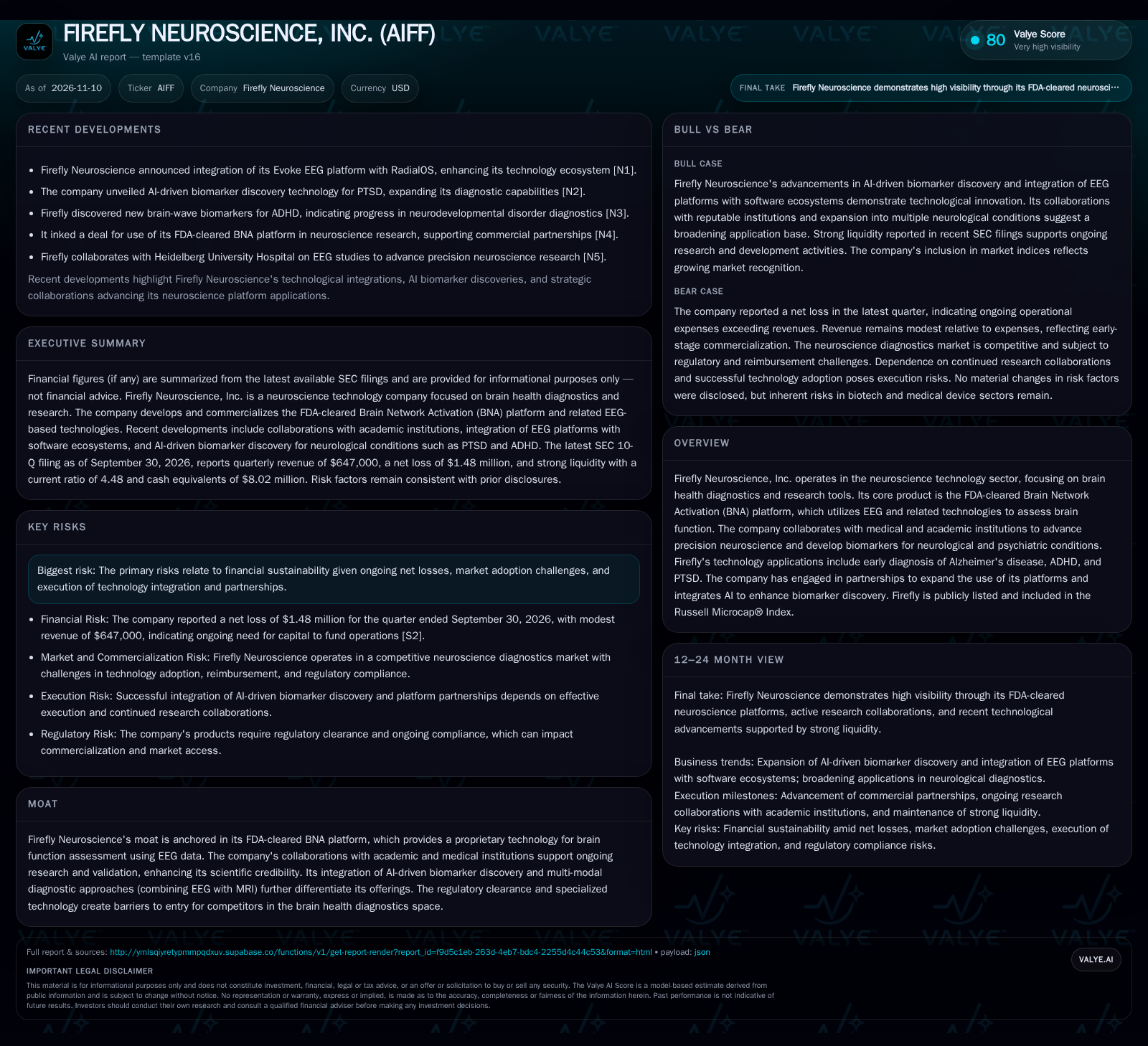
Firefly Neuroscience combines FDA-cleared EEG technology, AI-based biomarker discovery, and academic partnerships to target neurological and psychiatric diagnostics. Success will hinge on execution in commercial partnerships, market adoption, and regulatory navigation as the company expands its platform’s clinical and research footprint. [S2] [N1] [N2] [N3] [N4] [N5]
Firefly Neuroscience stands at the intersection of AI, EEG diagnostics, and collaborative neuroscience research. With a portfolio anchored by its FDA-cleared Brain Network Activation (BNA) platform, the company is pushing into AI-driven biomarker discovery and multi-modal diagnostics aimed at conditions like PTSD, ADHD, and Alzheimer’s disease. Recent financials highlight the duality of reported liquidity position and persistent net losses, setting the stage for a crucial phase where commercial execution and market adoption will determine whether Firefly can turn scientific innovation into a scalable, sustainable business.
Recent Results Highlight Innovation, Partnerships, and the Commercialization Challenge
Firefly Neuroscience reported $647,000 in revenue and a net loss of $1.48 million for the quarter ended September 30, 2026, with cash and equivalents of $8.02 million and a current ratio of 4.48 [S2]. The company reported cash and liquidity metrics for the period; these figures do not by themselves establish operating runway, investment capacity, financial flexibility, or financing capacity.
The company continues to expand its technology platform, recently integrating its Evoke EEG system with RadialOS and unveiling AI-driven biomarker discovery capabilities for PTSD and ADHD [N1] [N2] [N3]. These developments signal an intent to enhance both the breadth and depth of its brain health solutions.
Firefly’s collaborations with research institutions, most notably Heidelberg University Hospital, and its inclusion in the Russell Microcap® Index further establish its presence and credibility in the neuroscience diagnostics field [N5] [N6].
Beyond headline financials, a deeper understanding of Firefly’s innovation pipeline and partnership dynamics is essential. The integration of Evoke EEG with RadialOS, for example, suggests a strategic focus on creating a seamless user experience and data interoperability, which can be critical for adoption in clinical environments where workflow efficiency matters. Similarly, AI-driven biomarker discovery initiatives reflect a broader industry trend toward leveraging machine learning for nuanced pattern recognition in brain signals, potentially enabling earlier and more precise diagnostics. However, translating these technical advancements into commercial traction requires not only scientific validation but also effective stakeholder engagement including clinicians, payers, and regulatory bodies.
Revenue Streams, Cost Structure, and the Stakes of Platform Expansion
Firefly’s business model centers on commercializing its FDA-cleared BNA (Brain Network Activation) platform and related EEG-based technologies, targeting both clinical diagnostics and research applications. Revenue is currently modest relative to expenses, reflecting early-stage commercialization and the high fixed costs associated with R&D, regulatory compliance, and platform development [S2].
The economics of neurodiagnostics platforms often rely on a mix of direct device/software sales, recurring revenue from SaaS analytics, and service contracts with research or clinical partners. If Firefly can transition its technology to a subscription or usage-based model, it could improve revenue visibility and gross margins, but this model is not yet established in the reported facts.
Operating leverage will depend on scaling commercial partnerships and broadening adoption beyond research collaborations. The capital-intensive nature of clinical validation, regulatory submissions, and ongoing product development means that Firefly’s path to profitability likely requires sustained revenue growth and/or strategic partnerships to offset fixed costs.
The transition from research-driven revenue to a sustainable commercial model often involves overcoming several economic hurdles. For Firefly, the high fixed costs in R&D and regulatory activities imply that scaling revenue without proportional increases in expenses is critical to improving profitability. Furthermore, the potential shift toward subscription or usage-based revenue models could align incentives better with customer value, but such models demand robust service delivery infrastructure and ongoing product updates to justify recurring fees. Additionally, the company’s ability to negotiate favorable reimbursement codes and integrate with existing clinical IT systems will materially impact its cost structure and revenue realization, underscoring the importance of strategic partnerships and market access efforts.
Positioning in a Fragmented Neurodiagnostics Landscape
Firefly’s FDA-cleared BNA platform provides a proprietary entry point in the brain health diagnostics market, where competition includes traditional EEG vendors, advanced neuroimaging firms, and emerging AI diagnostics startups. The integration of AI for biomarker discovery and the combination of EEG with volumetric MRI suggest a strategy to differentiate through multi-modal, data-driven diagnostics [N2] [N7].
Academic collaborations add scientific credibility and facilitate validation, but also expose the company to competition from institutionally developed solutions and larger medtech incumbents with more established commercial channels.
Barriers to entry in this space include regulatory clearance, clinical validation, and the complexity of integrating multi-modal data. However, customer switching costs in diagnostics remain moderate unless workflow integration, payer coverage, or network effects (e.g., large-scale normative datasets) can be established. Firefly’s partnerships and platform integrations may help, but widespread adoption will depend on demonstrating superior clinical utility and cost-effectiveness.
In a fragmented neurodiagnostics market, differentiation is often achieved through a combination of proprietary technology, clinical validation, and ecosystem integration. Firefly’s multi-modal approach, combining EEG with volumetric MRI and AI analytics, may create a defensible niche by offering richer diagnostic insights than single-modality competitors. However, the competitive advantage will depend on the platform’s ease of integration into clinical workflows and its ability to demonstrate incremental value in patient outcomes or cost savings. Additionally, the company faces the challenge of building or accessing large normative datasets to enhance AI model accuracy and generalizability, which could serve as a significant barrier to entry for others and a moat for Firefly if successfully executed.
AI-Driven Biomarker Adoption Spurs Clinical and Commercial Momentum
A favorable outcome for Firefly would involve its AI-driven biomarker discovery gaining traction in both research and clinical settings, leading to expanded use of its EEG-based platforms for early diagnosis and monitoring of conditions like PTSD, ADHD, and Alzheimer’s. This could drive a shift from project-based research revenue to recurring clinical diagnostics revenue as hospitals and clinics adopt the technology in routine workflows.
Evidence that would support this scenario includes multi-center validation studies demonstrating clear clinical utility, new commercial agreements for platform deployment in hospital networks, and a rising share of revenue from recurring sources (if disclosed). Additional regulatory clearances for new indications or geographies would further strengthen the commercial case.
A virtuous cycle could emerge if successful clinical integration prompts payer coverage, fueling both adoption and pricing power. Confirmation would come from reported growth in contracted clinical sites, increased average revenue per customer, and improved gross margins.
Incremental Progress Anchored in Research Partnerships and Platform Enhancements
The most plausible near-term trajectory is continued revenue growth primarily from research collaborations and selective commercial deployments, with technology enhancements (such as RadialOS integration and new AI biomarkers) broadening the platform’s appeal but not yet driving mass clinical adoption.
Progress is likely to be measured by new research contracts, additional academic partnerships, and incremental increases in revenue per deployment.
Confirmation of this scenario would be additional partnership announcements, moderate revenue growth, and sustained or improved liquidity without a step-change in clinical adoption. Falsification would come from stagnating partnership activity or a sharp increase in cash burn without corresponding revenue gains.
Execution Risks and Slow Market Uptake Prolong the Path to Scale
A negative scenario would involve slower-than-expected adoption of Firefly’s platforms, either due to technical integration challenges, limited clinical validation, or competitive pressure from larger firms and alternative diagnostic modalities. Prolonged reliance on research revenue without conversion to broader clinical adoption would constrain growth and erode the company’s liquidity buffer.
Potential confirming evidence would include declining or flat revenue, a shrinking pipeline of new research collaborations, delays in product or regulatory milestones, and an accelerating net loss. If external capital becomes harder to access, the company could face pressure to scale back R&D or seek strategic alternatives.
This scenario would be exacerbated if payers or clinicians remain unconvinced of incremental utility versus established diagnostics, or if regulatory or reimbursement barriers prove insurmountable for new indications.
Milestones That Will Shape Firefly Neuroscience’s Commercial Trajectory
Trends in revenue mix between research collaborations and clinical/commercial deployments—if disclosed—would clarify the path to sustainable growth.
Number of new academic or hospital partnerships signed each quarter, providing a proxy for adoption momentum.
Progress on additional regulatory clearances for new indications or international markets, which would expand addressable opportunity.
Clinical validation studies published in peer-reviewed journals, especially those demonstrating clear diagnostic or prognostic benefit over standard of care.
Recurring revenue metrics (e.g., revenue from SaaS analytics or multi-year contracts) would help test the potential for operating leverage.
Updates on payer coverage or reimbursement status for key diagnostic indications, as this will be critical for clinical adoption.
Customer retention and expansion rates, if disclosed, would indicate satisfaction and potential for upsell within existing accounts.
Disclaimer: This is research-only, informational analysis and not investment advice. It may include AI-generated interpretation and general industry context. Always verify important details using primary sources.

Comments