
Juniata Valley Financial: Profitability, Liquidity, and the Stakes of Regional Banking Execution
Juniata Valley Financial Corp’s sustained quarterly profitability and substantial cash holdings position it as a stable regional banking operator. The company’s ability to manage credit risk, navigate interest rate cycles, and leverage local relationships will determine how it balances earnings resilience against inherent sector vulnerabilities.
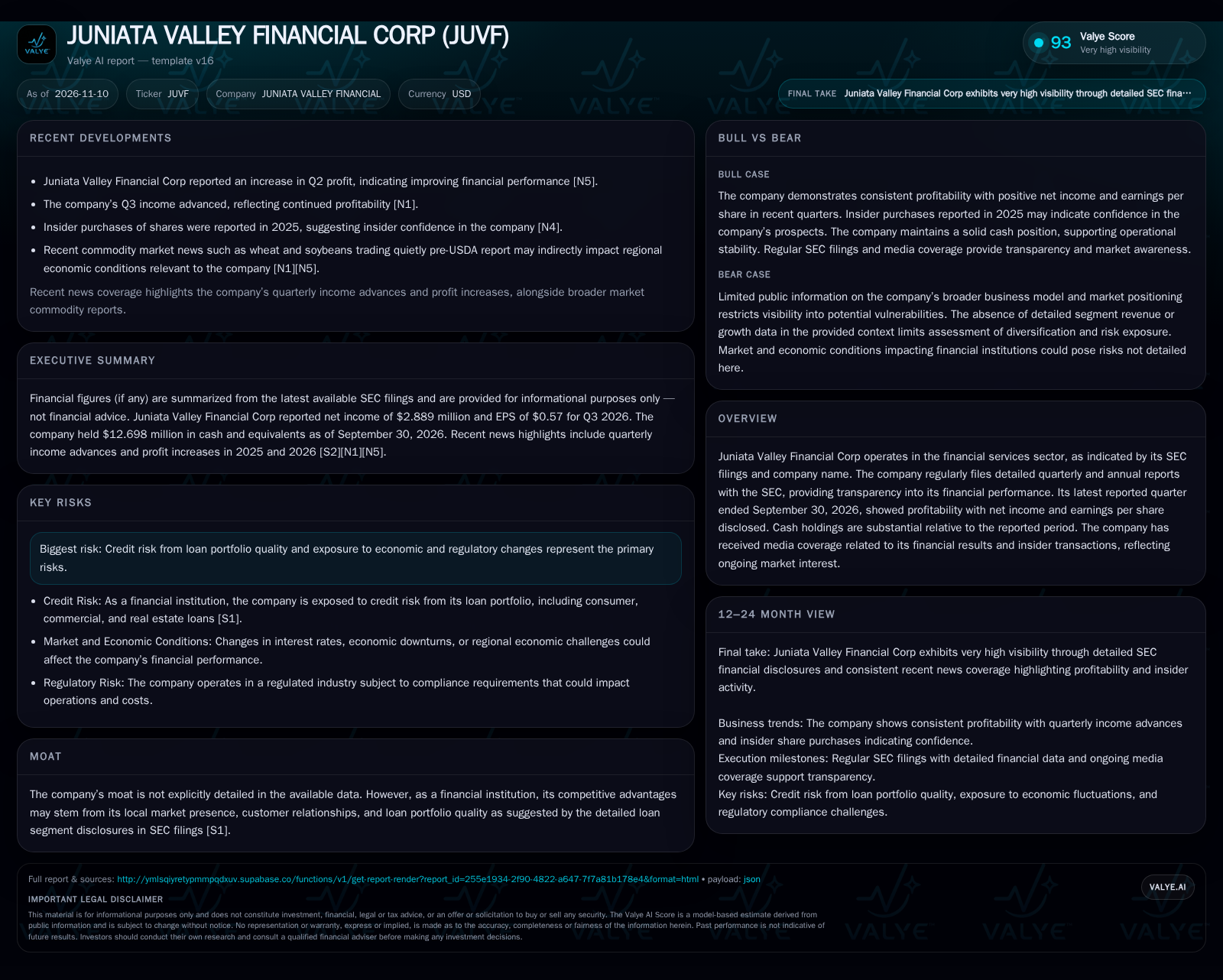
Juniata Valley Financial Corp reported $2.89 million in net income and $0.57 EPS for Q3 2026, with $12.7 million in cash as of September 30, 2026. The bank’s future performance will hinge on credit quality, interest rate management, and its capacity to grow or defend its local market share in a competitive and regulated landscape. [S2]
Juniata Valley Financial Corp’s most recent quarter underscores a pattern of steady profitability, with $2.89 million in net income and basic/diluted EPS of $0.57. Yet, as a regional financial institution, Juniata Valley’s prospects remain tightly bound to its ability to manage credit risk, respond to shifting interest rates, and maintain its footing in a competitive, regulated sector. The ultimate question is whether its risk management and local market strengths can consistently translate into durable shareholder value.
Profitability, Cash Holdings, and Insider Activity: The Current Landscape
Juniata Valley Financial Corp reported net income of $2,889,000 and earnings per share of $0.57 for the third quarter of 2026, indicating continued quarterly profitability [S2]. As of September 30, 2026, the company held $12,698,000 in cash and cash equivalents [S2]. Additionally, insider share purchases in 2025 suggest some degree of internal confidence in future prospects. These facts matter because they collectively point to operational stability, near-term potential financial flexibility, and a potentially supportive management posture. However, they do not by themselves reveal the underlying quality of earnings, loan book health, or the sustainability of returns in a shifting economic environment.
Beyond headline profitability and cash balances, a deeper examination of earnings quality would consider the composition and sustainability of revenue streams. For instance, reliance on one-time gains or volatile trading income could mask underlying operational challenges. Similarly, the nature of cash holdings—whether primarily liquid and unencumbered or tied to regulatory reserves—affects the bank’s true potential financial flexibility. Insider transactions, while potentially signaling confidence, require contextualization against broader market conditions and insider incentives, as such activity can be influenced by factors unrelated to fundamental outlooks.
How Juniata Valley Makes Money—and Where the Levers Lie
As a regional financial institution, Juniata Valley Financial’s core revenue streams likely derive from net interest income on loans and investments, with non-interest income from fees, service charges, and potentially wealth management or ancillary services. The bank’s profitability is driven by the spread between interest earned on assets (primarily loans and securities) and interest paid on liabilities (deposits and borrowings). Fixed costs include branch operations, regulatory compliance, and corporate overhead, while variable costs are tied to loan origination, servicing, and deposit acquisition.
Operating leverage can be meaningful: incremental loan growth or deposit inflows may improve margins if fixed costs are well contained. However, rising interest rates can compress net interest margins if asset yields lag deposit repricing, while credit losses can quickly erode earnings. The capital intensity is moderate relative to other industries but high within financial services, as regulatory capital requirements constrain leverage and dictate minimum equity buffers.
Interest rate cycles play a pivotal role in shaping net interest margins, especially for regional banks with limited hedging capabilities. When rates rise rapidly, deposit costs may increase faster than asset yields if loan repricing lags, compressing margins temporarily. Conversely, a declining rate environment can pressure asset yields while deposit costs remain sticky. The bank’s ability to manage this timing mismatch through asset-liability management strategies, such as adjusting loan product mix or deposit pricing, is critical. Additionally, non-interest income diversification can mitigate margin pressure but often requires investment in capabilities that may strain cost structures.
Local Market Focus: Advantages and Pressures in Community Banking
Juniata Valley Financial’s competitive positioning is primarily anchored in its local market presence and established customer relationships—a classic strength of community banks. This can confer advantages in customer retention, local knowledge for underwriting, and the ability to tailor services. Competitors include other community banks, credit unions, and regional/national banks that may offer digital convenience or broader product suites.
However, community bank moats are inherently vulnerable to technology-driven disintermediation, rising customer expectations for digital services, and price competition from larger players. The quality of the loan portfolio and the ability to source low-cost core deposits are critical differentiators. A significant counterforce is the potential for economic downturns or regional shocks to disproportionately impact smaller, less diversified banks. Regulatory costs and compliance burdens also weigh more heavily on smaller institutions.
The local market focus offers both a moat and a constraint. Deep community ties enable tailored underwriting that can reduce credit losses by leveraging nuanced local knowledge. However, geographic concentration inherently limits diversification, making the bank susceptible to region-specific economic downturns or industry shocks. Moreover, the competitive landscape increasingly favors institutions that can offer seamless digital experiences; failure to invest adequately in technology risks customer attrition. Balancing the cost of technological upgrades against the benefits of customer retention and acquisition is a strategic challenge that can materially impact long-term viability.
If Credit Quality Holds and Local Lending Expands, Earnings Could Compound
The most favorable outcome for Juniata Valley Financial would unfold if the bank continues to grow its loan portfolio with high-quality credits, maintains low delinquency and charge-off rates, and expands its deposit base without resorting to expensive funding.
Evidence that would confirm this trajectory includes sustained low non-performing asset ratios (if disclosed), consistent growth in core deposits, stable or improving net interest margin, and minimal credit losses over several quarters. Additional insider buying, positive commentary on loan demand, and increased fee income from ancillary services would further bolster the upside case.
Stable Returns Amid Interest Rate and Regulatory Headwinds
The most plausible scenario is one of continued modest profitability, with periodic fluctuations driven by interest rate movements, loan demand, and regulatory costs. The company is likely to maintain operational stability—delivering positive net income and preserving its cash position—while navigating the typical pressures of a regional banking environment.
Confirmation of this scenario would come from quarterly earnings that remain consistent with recent performance, manageable credit costs, and the absence of major swings in deposit or loan balances. If disclosed, stable net interest margin and a steady efficiency ratio (costs as a percentage of revenue) would reinforce the thesis. Any modest increase in non-interest income or prudent expense control would be positive but not transformative.
Credit Deterioration or Funding Shocks Could Erode Value
A negative scenario would likely be triggered by a deterioration in credit quality—such as rising non-performing loans or unexpected charge-offs—leading to higher loan loss provisions and depressed earnings. Alternatively, a spike in funding costs (due to deposit outflows or competitive repricing) could compress net interest margins and disrupt profitability.
Evidence of downside risk would include a sharp increase in non-performing loans (if disclosed), declining net interest margin, or a notable reduction in cash and equivalents. Regulatory actions, negative surprises in compliance costs, or loss of key customer relationships could also amplify downside pressure.Insider transaction activity was reported in the cited source; this activity does not by itself establish insider confidence.
What Will Determine Juniata Valley’s Long-Term Banking Value?
Quarterly trends in net interest margin, if disclosed, would help gauge the company’s ability to navigate changing rate environments.
Loan portfolio quality metrics, such as non-performing asset ratio and charge-off rates, would be critical to validate credit risk management.
Core deposit growth or retention rates, if available, would indicate the strength of local franchise and funding stability.
Efficiency ratio movements would reveal whether cost discipline is supporting profitability.
Any material changes in insider buying or selling activity could serve as a sentiment indicator for management’s outlook.
Disclosures on regulatory capital ratios, if provided, would clarify balance sheet resilience and ability to absorb shocks.
Expansion into new products or markets, or digital banking initiatives, would test the company’s ability to adapt to competitive threats.
Disclaimer: This is research-only, informational analysis and not investment advice. It may include AI-generated interpretation and general industry context. Always verify important details using primary sources.

Comments