
Autonomix Medical: The Stakes and Scenarios of Nerve-Targeted Sensing Platform Commercialization
Autonomix Medical is pursuing a novel transvascular neural sensing system as its entry point into the nerve-targeted device market, leveraging clinical proof-of-concept and expanding IP. The company faces a high-stakes sequence of regulatory, technical, and financial hurdles that will determine whether its platform becomes a new standard in pain management and beyond—or remains an unproven innovation.
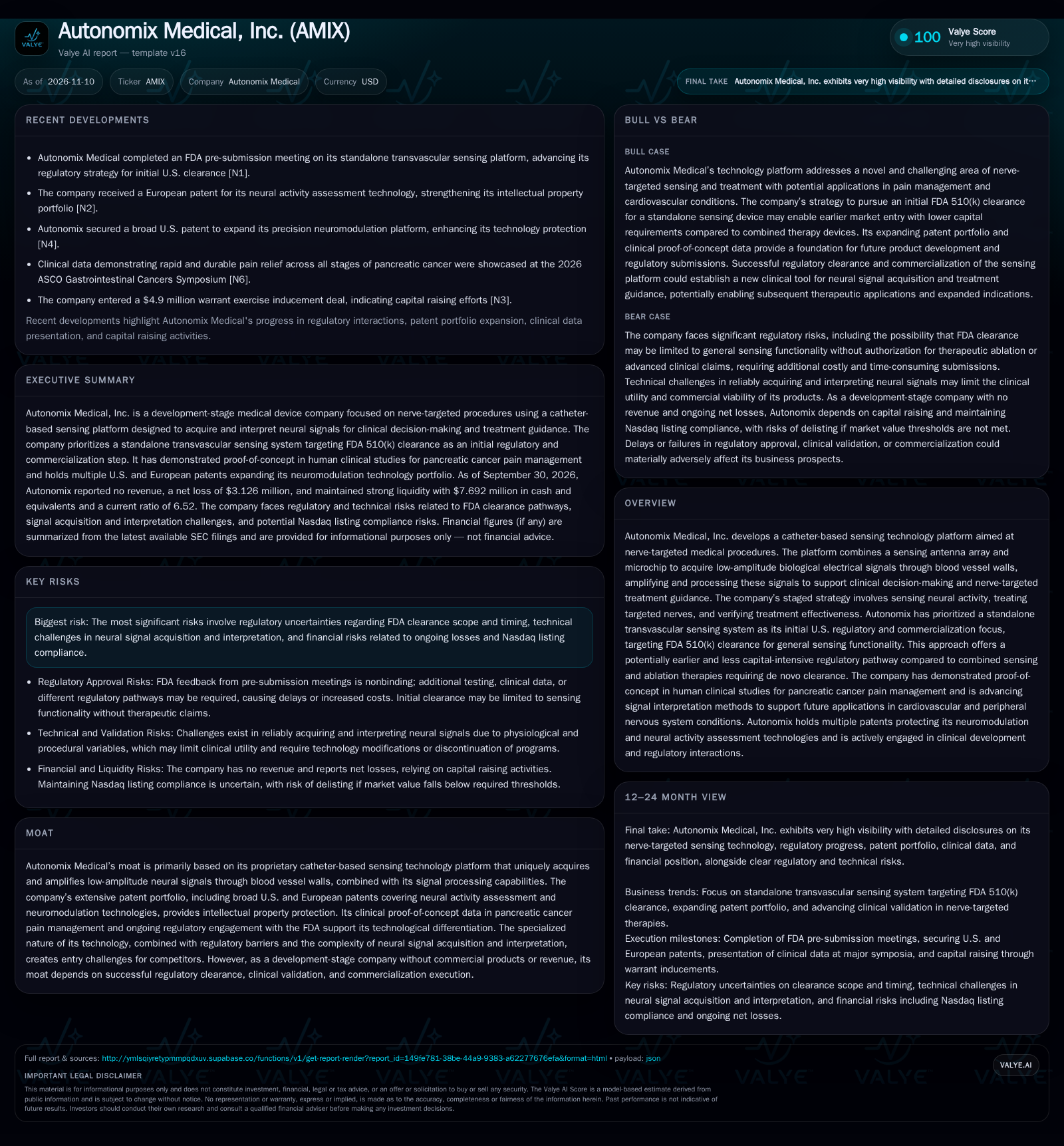
Autonomix Medical is a development-stage medtech company focused on a catheter-based system for sensing neural activity through blood vessel walls. The next inflection points hinge on regulatory feedback, clinical validation, and the company’s ability to convert technology into a reimbursable and adopted product.[S2] [N1] [N2] [N3] [N4] [N6]
Autonomix Medical, Inc. is at a pivotal juncture as it seeks to establish a new category in nerve-targeted medical procedures with its catheter-based neural sensing platform. The company’s initial focus on a standalone sensing device—rather than a combined therapy system—reflects a calculated effort to accelerate regulatory clearance and reduce capital intensity. Backed by fresh clinical data and a growing patent estate, Autonomix’s future now hinges on its ability to navigate FDA requirements, overcome technical signal interpretation challenges, and ultimately translate its technology into a commercially viable product in pain management and beyond. The stakes are high: early success could unlock a platform opportunity, while setbacks could leave the technology stranded in development.[S2] [N1] [N2] [N3] [N4] [N6]
Recent Progress and Remaining Hurdles: Where Autonomix Stands in Late 2026
Autonomix Medical’s most significant recent developments include the completion of an FDA pre-submission meeting for its flagship standalone transvascular neural sensing platform, the presentation of compelling clinical data in pancreatic cancer pain at the 2026 ASCO GI Cancers Symposium, and the addition of U.S. and European patents broadening its neuromodulation technology estate.[N1] [N2] [N4] [N6] These advances provide a foundation for regulatory engagement and intellectual property protection, both essential for a first-mover in a novel device category.
On the financial front, the company reported a net loss of $3.126 million for the September 2026 quarter, with no revenue recorded and $7.692 million in cash following a $4.9 million warrant exercise inducement deal.[S2] [N3] This capital position supports near-term operations but underscores the ongoing dependence on external funding and the urgency of achieving regulatory and commercial milestones.
The company’s Nasdaq listing remains at risk if its market value falls below $5 million for 30 consecutive business days, adding another layer of near-term uncertainty.[S2]
How Platform-Driven Device Economics Could Work for Autonomix
Autonomix’s business model is predicated on the commercialization of a proprietary catheter-based neural sensing platform, with the initial product targeting FDA 510(k) clearance for general sensing functionality. If cleared, the platform could be sold as capital equipment to hospitals or interventional suites, with possible recurring revenues from disposable catheters or software modules, depending on final commercial mechanics. At this stage, the company has disclosed no revenue or pricing structure, leaving unit economics hypothetical.[S2]
The strategic choice to prioritize a standalone sensing system—rather than a combined sensing and ablation therapy—reflects a desire to enter the market via a lower-cost, faster regulatory pathway. This approach typically involves less upfront clinical trial expense and a potentially larger initial installed base, but may also limit early revenue per procedure if the product is confined to a diagnostic or guidance role.
Future economic upside could be substantial if Autonomix can layer on therapeutic capabilities (e.g., ablation, neuromodulation) as supplemental modules or next-generation devices, since these would command higher ASPs and potentially recurring procedure-based revenue. However, these expansions require de novo regulatory clearance, additional clinical trials, and robust health-economic validation to secure reimbursement.
Operating leverage is likely to be high if the sensing platform achieves meaningful adoption: fixed R&D and regulatory costs will dominate the early P&L, but variable costs for disposables and incremental software are typically low relative to price in advanced device business models. The capital intensity of initial commercialization—salesforce, clinical education, and post-market surveillance—remains a gating factor, especially in the absence of early revenue.
Defensibility in a Nascent Field: IP, Technical Complexity, and Clinical Proof
Autonomix’s competitive position is anchored by its proprietary approach to neural signal acquisition via blood vessel walls, a technical feat that is not widely replicated in the medtech landscape. The company’s expanding U.S. and European patent portfolio provides some degree of IP protection, particularly for core methods of neural activity assessment and catheter-based neuromodulation.[N2] [N4]
However, the true defensibility of Autonomix’s position will rest on its ability to consistently acquire clinically meaningful signals and to demonstrate that these signals improve procedural outcomes or enable new interventions. The field is characterized by rapid innovation and significant technical hurdles—especially when translating neural signals into actionable intraoperative guidance or treatment triggers.
Competition could emerge from established neuromodulation device manufacturers, advanced electrophysiology firms, or new entrants leveraging alternative sensing modalities (e.g., high-resolution imaging, AI-driven data interpretation). Barriers to entry exist in both regulatory complexity and the need for robust clinical data, but these also represent hurdles for Autonomix itself.
Switching frictions may be moderate if Autonomix’s platform is approved and adopted, as training, workflow integration, and physician familiarity can create stickiness. However, in the absence of reimbursement or clear clinical superiority, hospitals and clinicians may be slow to displace entrenched pain management or ablation workflows.
What Success Looks Like: Early Clearance, Adoption, and the Expansion Pathway
In a favorable scenario, Autonomix secures FDA 510(k) clearance for its standalone sensing device with claims that are broad enough to support real-world clinical adoption—potentially as a guidance tool for nerve-targeted interventions or as a diagnostic adjunct in pain management.[S2] [N1] Rapid follow-on adoption would likely require robust clinical data demonstrating not just technical feasibility, but also improved outcomes, workflow efficiency, or cost savings.
The company’s recent proof-of-concept data in pancreatic cancer pain management, showing rapid and durable relief, could serve as a pivotal commercial entry point if corroborated in larger studies and translated into label claims or reimbursement support.[N6] Early hospital placements might drive recurring demand for disposable catheters and foster physician champions.
A successful initial launch could also establish the platform’s credibility, enabling Autonomix to pursue the more ambitious—and lucrative—therapeutic applications (ablation, neuromodulation) as next steps, leveraging the same installed base and data-sharing infrastructure.
Evidence that would confirm this scenario includes: 1) positive FDA feedback on the 510(k) submission, 2) publication of larger-scale, peer-reviewed clinical studies demonstrating clinical and economic value, 3) early hospital adoption or pilot program announcements, and 4) progress toward reimbursement coding or favorable payer coverage.
Probable Trajectory: Iterative Regulatory Steps and Protracted Commercial Ramp
The most plausible near-term outcome is an incremental regulatory and commercial trajectory. Autonomix may achieve FDA clearance for its standalone sensing device, but with a narrow label limited to general sensing or research use, not yet supporting therapeutic claims or robust clinical adoption.[S2]
Technical challenges in reliably acquiring and interpreting neural signals may require further engineering, post-market studies, or even regulatory supplements before the platform can be broadly adopted. Early sales, if any, are likely to be limited to academic centers or high-volume specialty clinics engaged in research or pilot programs.
Financially, the company will likely continue to operate at a loss, requiring additional capital raises to fund ongoing R&D, regulatory submissions, and initial commercialization efforts. The risk of Nasdaq delisting could persist if market value remains volatile or depressed.
This scenario would be confirmed by: 1) FDA clearance with a limited label, 2) slow or research-centric initial adoption, 3) ongoing net losses and further capital raising, and 4) no immediate movement on reimbursement or broad clinical guidelines.
How the Thesis Could Break: Regulatory Barriers, Technical Setbacks, and Funding Gaps
The adverse case involves a confluence of regulatory, technical, and financial setbacks. The FDA may require additional clinical data or shift the pathway to a more onerous de novo or PMA process, delaying market entry and increasing costs.[S2] Alternatively, the device could be cleared only for a narrow research indication, providing little commercial value.
Technical difficulties in consistent signal acquisition or interpretation—especially in real-world, variable clinical environments—could undermine the platform’s utility, leading to negative trial results or tepid physician adoption. If the company is unable to demonstrate clear clinical or economic benefits, payers may deny reimbursement, stifling market uptake.
Financially, persistent net losses, lack of product revenue, or a market cap drop below Nasdaq’s continued listing threshold could force restructuring, delisting, or distressed fundraising.[S2]
This scenario would be confirmed by: 1) regulatory rejections or major delays, 2) negative or inconclusive clinical study results, 3) failure to secure additional funding, and 4) public warning of Nasdaq delisting or loss of key personnel.
Milestones That Will Determine Whether Autonomix’s Platform Can Break Through
FDA review outcome and label breadth for the standalone sensing device—whether claims support clinical adoption beyond research use.
Publication of peer-reviewed, multi-center clinical data confirming the platform’s efficacy and utility in real-world settings, if disclosed.
Announcement of initial hospital placements, pilot programs, or commercial partnerships that signal clinical traction.
Progress toward reimbursement—such as CPT code applications, payer policy updates, or inclusion in clinical guidelines.
Cash runway updates and disclosure of additional capital raises or financing events, especially if operating losses continue.
Nasdaq listing status and any SEC communications regarding market value compliance.
Clinical or technical feedback from early users—evidence of signal quality, workflow integration, and procedural impact, if disclosed.
Expansion of the IP portfolio or defense of existing patents in the face of competitive or legal challenges.
Disclaimer: This is research-only, informational analysis and not investment advice. It may include AI-generated interpretation and general industry context. Always verify important details using primary sources.

Comments