
Uwharrie Capital Corp: Financial Stability and the Strategic Unknowns of a Quiet Operator
Uwharrie Capital Corp reports strong cash reserves and ongoing profitability, but the absence of disclosed sector, business model, or growth strategy leaves the company’s sustainable value creation open to interpretation.
Investors face a classic trade-off: visible financial stability against opaque business fundamentals. [S1] [S2]
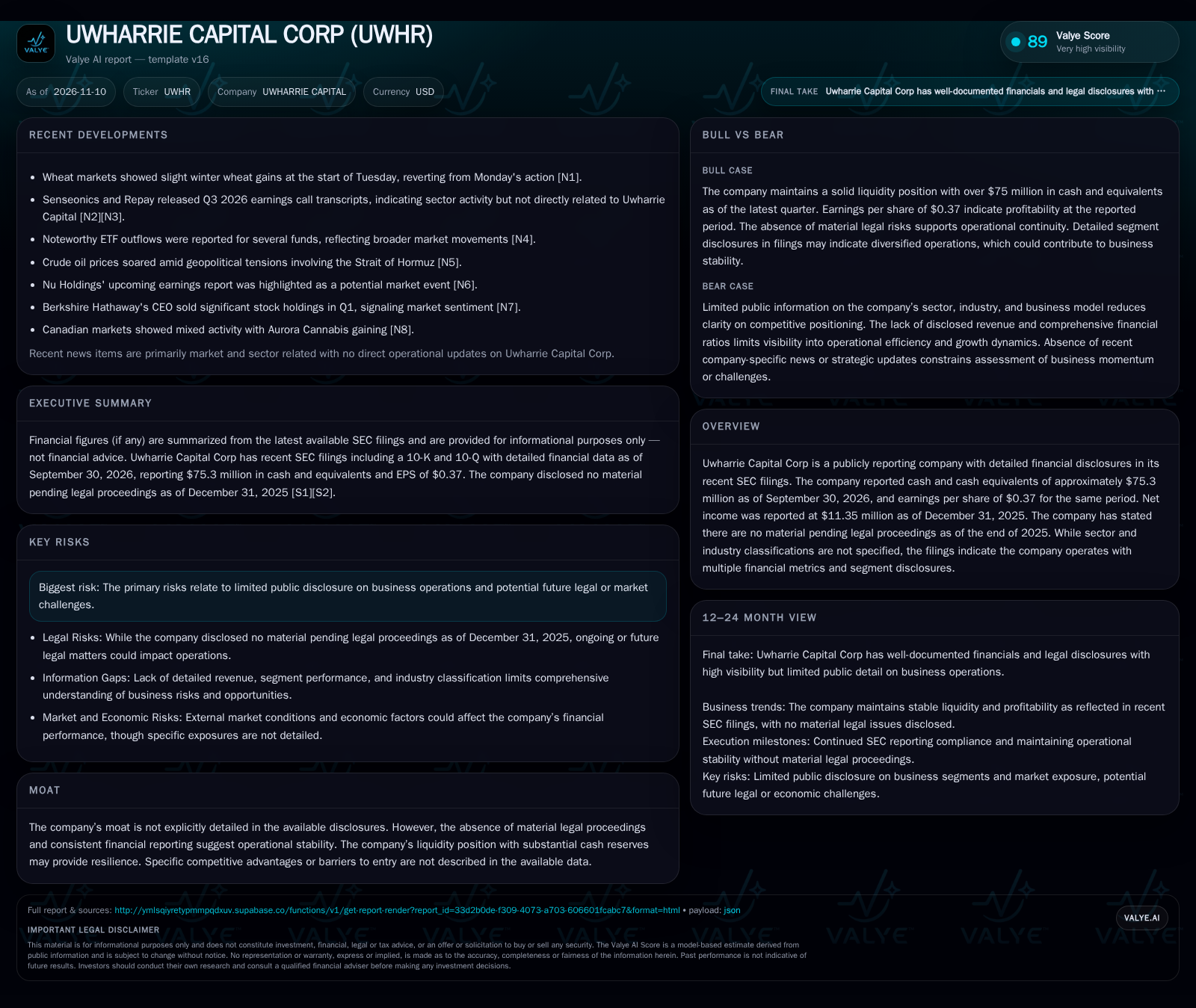
Uwharrie Capital Corp presents a paradox for investors: the company is transparent in its financial reporting and legal disclosures, yet opaque in virtually all aspects of its business model, sector, and operational strategy. With over $75 million in cash and recent profitability, Uwharrie demonstrates financial stability. However, the absence of public details on revenue sources, market focus, or competitive advantages makes it difficult to evaluate whether this stability is durable or opportunistic. The core question is whether the current balance-sheet strength reflects a resilient underlying franchise or simply a snapshot of short-term discipline.
Recent Financial Disclosures Point to Stability, but Business Details Remain Sparse
As of September 30, 2026, Uwharrie Capital Corp reported cash and cash equivalents of $75.3 million, a substantial figure for a company of unspecified sector or scale. This liquidity is paired with basic and diluted earnings per share of $0.37 for the most recent quarter, and net income of $11.35 million for the full year 2025. No material pending legal proceedings are disclosed as of December 31, 2025, indicating a clean legal slate. However, the company provides no explicit information on its industry, revenue mix, or operational segments, and recent news coverage offers no material updates on strategy or operations. [S1] [S2]
How Uwharrie Might Make Money: Scenarios in the Absence of Public Business Model Details
With no disclosed industry or segment information, the underlying economic engine of Uwharrie Capital Corp remains ambiguous. The available financials—steady earnings and substantial cash—suggest either a capital-light, potentially fee-based model (such as financial services, asset management, or specialized lending) or a company benefiting from a one-time liquidity event. If Uwharrie operates as a bank or a diversified financial holding company (typical for 'Capital Corp' entities), its revenues could stem from net interest margins, fees, and potentially asset management, with profitability tied to spread management, credit quality, and operating leverage. Conversely, if it is an investment holding company, income may be more volatile, depending on asset sales or investment returns. The lack of revenue and expense breakdowns makes it impossible to distinguish between recurring operational profits and nonrecurring windfalls. Capital needs and fixed versus variable cost structures are similarly opaque, limiting insight into the company’s sensitivity to economic cycles or margin pressures.
The ambiguity surrounding Uwharrie’s business model invites consideration of the company’s capital allocation priorities and risk profile. If the firm operates primarily through fee-based revenue streams, its capital deployment would likely focus on scaling client relationships and technology investments to enhance service efficiency and capture higher margins. Conversely, if the company’s earnings are driven by interest income or investment returns, capital allocation might prioritize asset quality management and liquidity buffers to withstand credit cycles or market volatility. The interplay between fixed and variable costs would also shape operational leverage and sensitivity to volume fluctuations, influencing earnings stability under different economic conditions. Understanding these dynamics would be critical to assessing whether Uwharrie’s profitability can be sustained or improved in varying macroeconomic environments.
Assessing Competitive Moat Without Industry Disclosure: What Could Confer Advantage?
The absence of public sector or industry data makes direct comparison to peers or competitors impossible. If Uwharrie is a regional financial institution, it could benefit from local brand recognition, entrenched customer relationships, and regulatory barriers. Alternatively, if it is a holding company or operates in a niche market, its moat could stem from unique asset exposure or specialized expertise. However, without evidence of recurring revenue, proprietary technology, or contractual customer lock-in, any competitive advantage remains speculative. The company’s clean legal record and consistent reporting suggest operational discipline, but the durability of its position is unproven without context on competitors, substitutes, or switching frictions.
Evaluating potential competitive advantages without industry context requires examining structural factors that generally confer defensibility across sectors. For example, regulatory barriers can limit new entrants if Uwharrie operates in a highly regulated financial segment, effectively protecting market share. Alternatively, if the company manages unique or hard-to-replicate assets, such as specialized loan portfolios or proprietary investment strategies, these could create entry barriers for competitors. Customer stickiness, driven by long-term contracts or integrated service offerings, would further enhance resilience against competitive pressures. However, absent evidence of innovation, scale economies, or network effects, the company may face commoditization risks, especially if operating in a fragmented or highly competitive market. These considerations underscore the importance of future disclosures to clarify Uwharrie’s strategic positioning and competitive moat.
What Could Drive Sustainable Value: Pathways to Enduring Profitability
The most bullish scenario is that Uwharrie’s current financial strength reflects a scalable, recurring, and defensible business model—such as a profitable niche lender, a fee-driven financial services provider, or a specialist asset manager. Upside would be confirmed by future disclosures of growing recurring revenue, expanding margins, or new strategic initiatives, as well as evidence of customer retention and product differentiation. Additional clues would include segment reporting that reveals diversified income streams and updates on organic or inorganic growth strategies.
Sustainable value creation would also depend on Uwharrie’s ability to adapt to evolving market conditions and regulatory landscapes. For instance, a business model anchored in recurring fees or interest income would benefit from proactive risk management and diversification across client segments or geographies to mitigate concentration risks. Additionally, operational scalability through technology adoption or process optimization could improve margins and support growth without commensurate increases in fixed costs. Strategic initiatives such as targeted acquisitions or partnerships might expand the company’s product offerings or market reach, further enhancing competitive positioning. The realization of these pathways would be contingent on effective governance, capital discipline, and transparent communication with investors to build confidence in the company’s long-term trajectory.
Sustained Caution and Operational Discipline, but Opaqueness Keeps Valuation in Check
The most plausible near-term scenario is that Uwharrie continues to operate with financial prudence, maintaining positive earnings and a strong reported cash balance, but without visible catalysts for rapid growth or margin expansion. In this scenario, the company’s value is anchored by balance-sheet stability rather than market leadership or innovation. This would be confirmed by continued profitability, absence of legal or regulatory setbacks, and ongoing compliance with SEC reporting. However, without additional transparency, the market may discount the stock due to uncertainty about the durability and drivers of earnings. The thesis would be challenged if future filings reveal declining margins, one-off gains driving profits, or lack of reinvestment in the core business.
Opaque Operations Could Mask Risks: What If Current Profits Are Not Sustainable?
A negative scenario emerges if Uwharrie’s recent profitability is driven by nonrecurring events—such as asset sales, investment windfalls, or one-time cost reductions—rather than core business strength. The absence of revenue details and segment disclosures raises the risk that underlying operations may not be generating sustainable cash flows. Confirmation of this downside would include sudden drops in profitability, new legal or regulatory disclosures, or restatements of prior results.
Evidence That Will Clarify Uwharrie’s Franchise Quality and Strategic Trajectory
Disclosure of revenue composition and segment performance—if provided—would illuminate the drivers of earnings and potential growth levers.
Any new information on sector or industry classification would help benchmark Uwharrie against relevant peers.
Updates on sources and uses of cash, including capital allocation decisions, would clarify whether liquidity is being deployed for growth, returned to shareholders, or held defensively.
Future filings that detail recurring versus nonrecurring income streams would help distinguish core profitability from one-off events.
Evidence of customer concentration, retention rates, or long-term contracts—if disclosed—would support or challenge the case for business durability.
Announcements of strategic initiatives, acquisitions, or divestitures would signal management’s growth ambitions or risk appetite.
Material changes in legal, regulatory, or compliance disclosures could signal emerging risks or operational disruptions.
A useful metric would be net interest margin or fee income ratio, if Uwharrie operates in financial services, to assess sensitivity to market cycles.
Disclaimer: This is research-only, informational analysis and not investment advice. It may include AI-generated interpretation and general industry context. Always verify important details using primary sources.

Comments