
Upstream Bio’s Verekitug: Clinical Differentiation, Liquidity, and the Stakes of Phase 3 Execution in Severe Respiratory Disease
Upstream Bio advances verekitug, a highly potent TSLP receptor antagonist, through late-stage clinical development in severe asthma, CRSwNP, and COPD.
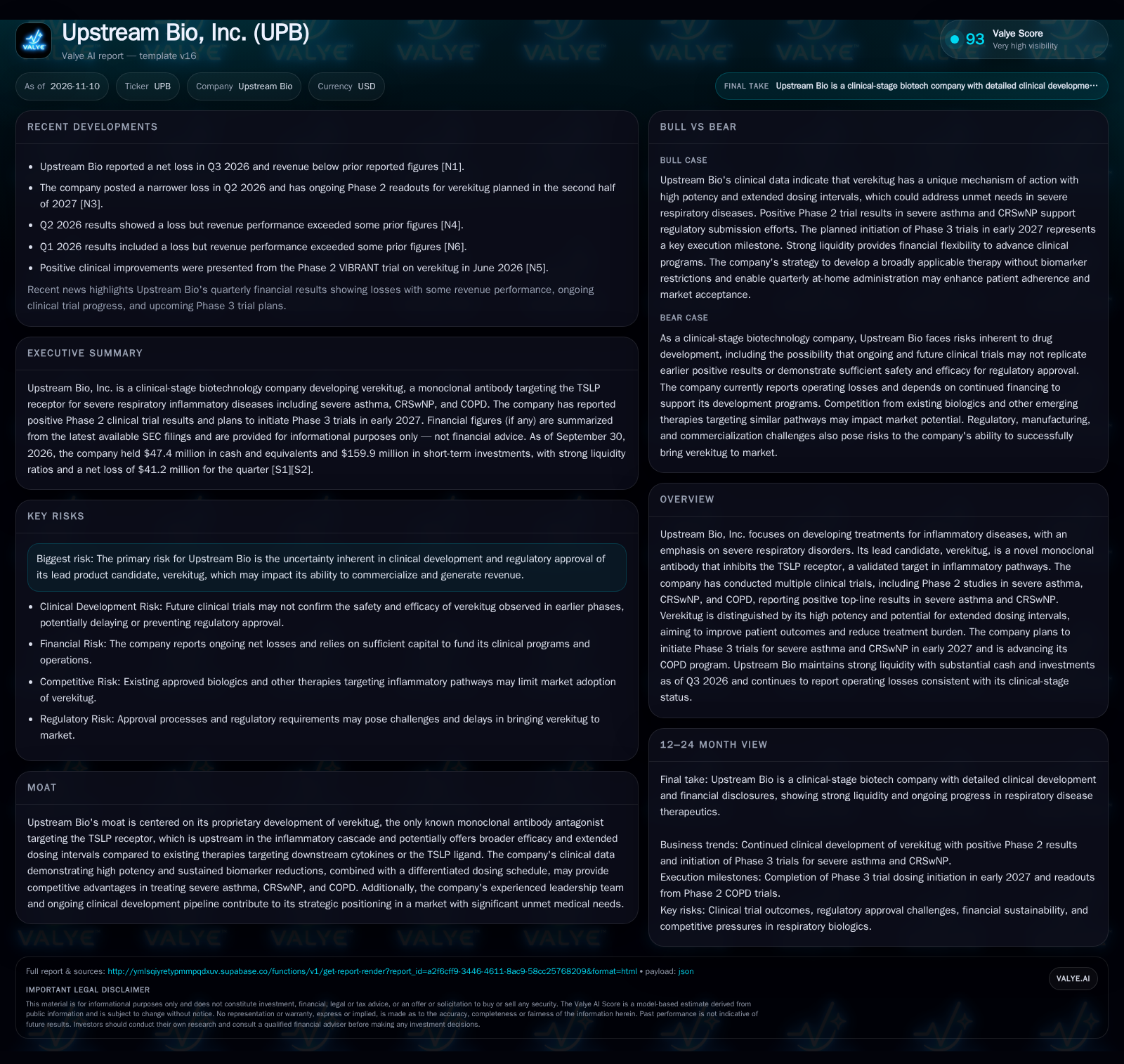
Upstream Bio has reported positive Phase 2 data for verekitug—its TSLP receptor-targeting antibody—in severe asthma and CRSwNP, and maintains reported liquidity position as of Q3 2026. With extended dosing intervals and a differentiated mechanism, the company is positioned for Phase 3 trials in 2027, but faces the usual clinical, regulatory, and competitive risks of a single-asset, pre-commercial biotech. The next major inflection points hinge on successful pivotal trial execution and the ability to demonstrate commercial value versus established biologics. [S1] [S2]
Upstream Bio, Inc. is positioning itself as a differentiated player in the competitive landscape of severe respiratory disease therapeutics with its lead monoclonal antibody, verekitug. Recent positive Phase 2 results in severe asthma and chronic rhinosinusitis with nasal polyps (CRSwNP) have set the stage for pivotal Phase 3 trials planned for 2027. [S1] [S2]
Recent Clinical Milestones and Financial Snapshot Define the 2026 Inflection Point
Upstream Bio recently reported positive top-line results from its Phase 2 trials of verekitug in both severe asthma (February 2026) and CRSwNP (September 2025), supporting the rationale for advancing to Phase 3 trials, which are set to begin in early 2027. The company is also running a Phase 2 trial in COPD and a long-term extension study, further expanding the clinical dataset. On the financial front, as of September 30, 2026, Upstream reported $47.4 million in cash and equivalents, $159.9 million in short-term investments, and current liabilities of $11.96 million, yielding a current ratio of 20.45. [S1] [S2]
How Verekitug Could Reshape the Economics of Respiratory Biologics
Upstream Bio’s business model is that of a classic clinical-stage biotech: investing heavily in R&D to advance a single, highly differentiated asset through trials, with the expectation of major value creation at regulatory approval or via a partnership/acquisition. Verekitug’s potential for quarterly (24-week) dosing and its biomarker-unrestricted profile could enable broader patient eligibility and reduced treatment burden compared to existing biologics, which often require more frequent dosing and may be limited to biomarker-defined subpopulations.
If approved, pricing dynamics would likely reflect current benchmarks for respiratory biologics, which often command annual prices in the mid-to-high five figures per patient in the U.S. However, the commercial success of verekitug would depend on demonstrating superior efficacy, safety, and convenience—especially given payer scrutiny and the presence of entrenched competitors. The company’s current cost structure is dominated by R&D and G&A expenses, with no product revenue, meaning operating leverage would only materialize post-approval or through licensing. While current reported liquidity position, additional capital would likely be required for commercialization unless a partnership or acquisition is secured.
From a pricing and reimbursement perspective, the absence of biomarker restrictions broadens the potential patient population but also raises payer concerns about cost-effectiveness across heterogeneous groups. Payers may require robust pharmacoeconomic evidence demonstrating that broader eligibility does not dilute overall treatment value. This dynamic could pressure Upstream Bio to invest in health economics and outcomes research (HEOR) early in the commercial lifecycle to substantiate claims of value. Additionally, the company may need to consider innovative contracting models, such as outcomes-based agreements, to mitigate payer risk and facilitate market access in a competitive biologics environment.
Differentiation in a Crowded Biologic Landscape: Upstream’s Moat and Its Limits
Upstream Bio’s core competitive advantage rests on verekitug’s unique mechanism: it is the only known clinical-stage antibody targeting the TSLP receptor, in contrast to existing therapies such as tezepelumab which target the TSLP ligand. This upstream inhibition theoretically offers broader suppression of inflammatory cascades. Clinical data suggest verekitug is approximately 300-fold more potent than tezepelumab, with the possibility for extended, at-home dosing intervals, which could be a meaningful convenience advantage for patients and providers. [S1]
However, the field is crowded with established biologics targeting IL-5, IL-4/IL-13, IgE, and the TSLP ligand, each with substantial clinical, payer, and prescriber inertia. Upstream’s ability to convert mechanistic and dosing advantages into meaningful clinical and commercial differentiation will depend on robust Phase 3 results, real-world outcomes, and head-to-head data if available. The absence of biomarker restrictions could expand the addressable market, but also places greater emphasis on demonstrating safety and efficacy across heterogeneous patient populations.
The mechanistic distinction of targeting the TSLP receptor rather than the ligand may confer theoretical advantages in blocking downstream signaling pathways more comprehensively. However, this hypothesis must be validated in clinical outcomes, as the complexity of inflammatory cascades in respiratory diseases often leads to compensatory mechanisms that can attenuate therapeutic effects. Moreover, the competitive landscape includes not only direct TSLP ligand inhibitors but also a multitude of biologics targeting parallel pathways, which have established safety and efficacy profiles. Upstream Bio’s challenge will be to demonstrate that receptor blockade translates into clinically meaningful improvements beyond incremental benefits, which will be critical for payer and prescriber adoption in a crowded market.
Another strategic consideration is the potential for combination therapy with existing biologics or small molecules. If verekitug’s safety profile supports co-administration, it could be positioned as part of a multi-modal treatment regimen for patients with refractory disease. This approach, however, introduces complexity in clinical trial design and regulatory approval pathways, as well as challenges in pricing and reimbursement negotiations. The company would need to generate evidence of additive or synergistic effects to justify combination use, which may extend development timelines and increase capital requirements. Conversely, failure to demonstrate clear differentiation or combination benefits could limit market penetration and reinforce incumbent biologics’ dominance.
If Verekitug’s Efficacy, Safety, and Convenience Are Confirmed in Phase 3
The best-case scenario for Upstream Bio is that Phase 3 trials in severe asthma and CRSwNP replicate or exceed the efficacy and safety signals observed in Phase 2. If verekitug delivers meaningful clinical improvements—with rapid, sustained biomarker reductions, a favorable safety profile, and successful quarterly at-home dosing—it could attract strong prescriber and payer interest, especially for patients inadequately controlled by or ineligible for existing biologics. Upstream’s large potential market (severe asthma alone affects millions globally) and the absence of biomarker restrictions could drive broad adoption.
Confirmation of these advantages—especially in head-to-head or real-world comparative settings—would support premium pricing, rapid uptake, and potentially attract acquisition or partnership interest from larger pharma companies seeking respiratory franchise expansion. Evidence supporting this scenario would include robust Phase 3 data, favorable regulatory feedback, and early commercial partnerships or licensing agreements.
Progression Through Pivotal Trials, but a Competitive and Capital-Intensive Road Ahead
If Phase 3 results are consistent with Phase 2—showing efficacy and safety but not dramatically outperforming existing biologics—verekitug could still secure regulatory approval and a modest commercial launch, especially in patient subgroups with unmet needs or for those seeking less frequent dosing.
However, given the entrenched biologic landscape, commercial ramp may be gradual, with payer adoption and prescriber education required to drive uptake. The company may need to seek additional funding or a commercial partner to support launch and post-market studies. Evidence confirming this scenario would include on-time trial enrollment, clear regulatory guidance, and continued financial discipline. Falsification would come from delayed trial timelines, unexpected safety signals, or inability to secure additional funding.
Clinical Setbacks, Funding Pressure, and Competitive Overhang
In a downside scenario, Phase 3 trials could fail to replicate earlier efficacy or safety signals, or reveal unexpected adverse events, undermining the case for regulatory approval. Even with positive data, if verekitug’s differentiation is not clinically or commercially meaningful versus incumbent biologics, payers may restrict access or demand substantial discounts, limiting revenue potential.
Given its single-asset focus and ongoing operating losses, any delay or setback in clinical development would likely force Upstream to seek dilutive financing, restructure, or potentially halt development. Additional risks include manufacturing or supply chain issues, as well as regulatory delays.
Testing the Thesis: What Will Determine Verekitug’s Impact and Upstream Bio’s Trajectory?
Completion and top-line readouts from Phase 3 trials in severe asthma and CRSwNP—timing, results, and regulatory feedback will be pivotal.
Enrollment speed, retention rates, and adverse event profiles in ongoing and upcoming pivotal trials—if disclosed, these will indicate operational execution and safety.
Quarterly cash burn and updated runway projections, especially as Phase 3 costs ramp—would help test financial sustainability.
Updates on partnership, licensing, or acquisition discussions—any announced deal could validate commercial value and reduce funding risk.
Payer and prescriber feedback on verekitug’s clinical profile and dosing advantages—if disclosed, this would clarify adoption barriers or tailwinds.
Comparative data (head-to-head or indirect) versus existing biologics—would clarify true clinical and economic differentiation.
Manufacturing scale-up progress and any supply chain or CMC (chemistry, manufacturing, and controls) issues—if disclosed, would affect launch readiness.
Disclaimer: This is research-only, informational analysis and not investment advice. It may include AI-generated interpretation and general industry context. Always verify important details using primary sources.

Comments