
Olema Pharmaceuticals: Pivotal Phase 3 Stakes, Capital Position, and the Endocrine Therapy Opportunity in Metastatic Breast Cancer
With pivotal Phase 3 trials for palazestrant underway and reported liquidity position reported, Olema Pharmaceuticals stands at a critical inflection point. The company’s differentiated oral CERAN/SERD candidate targets a multi-billion-dollar market, but clinical and regulatory outcomes—plus future funding needs—will define its ability to compete in a crowded landscape.
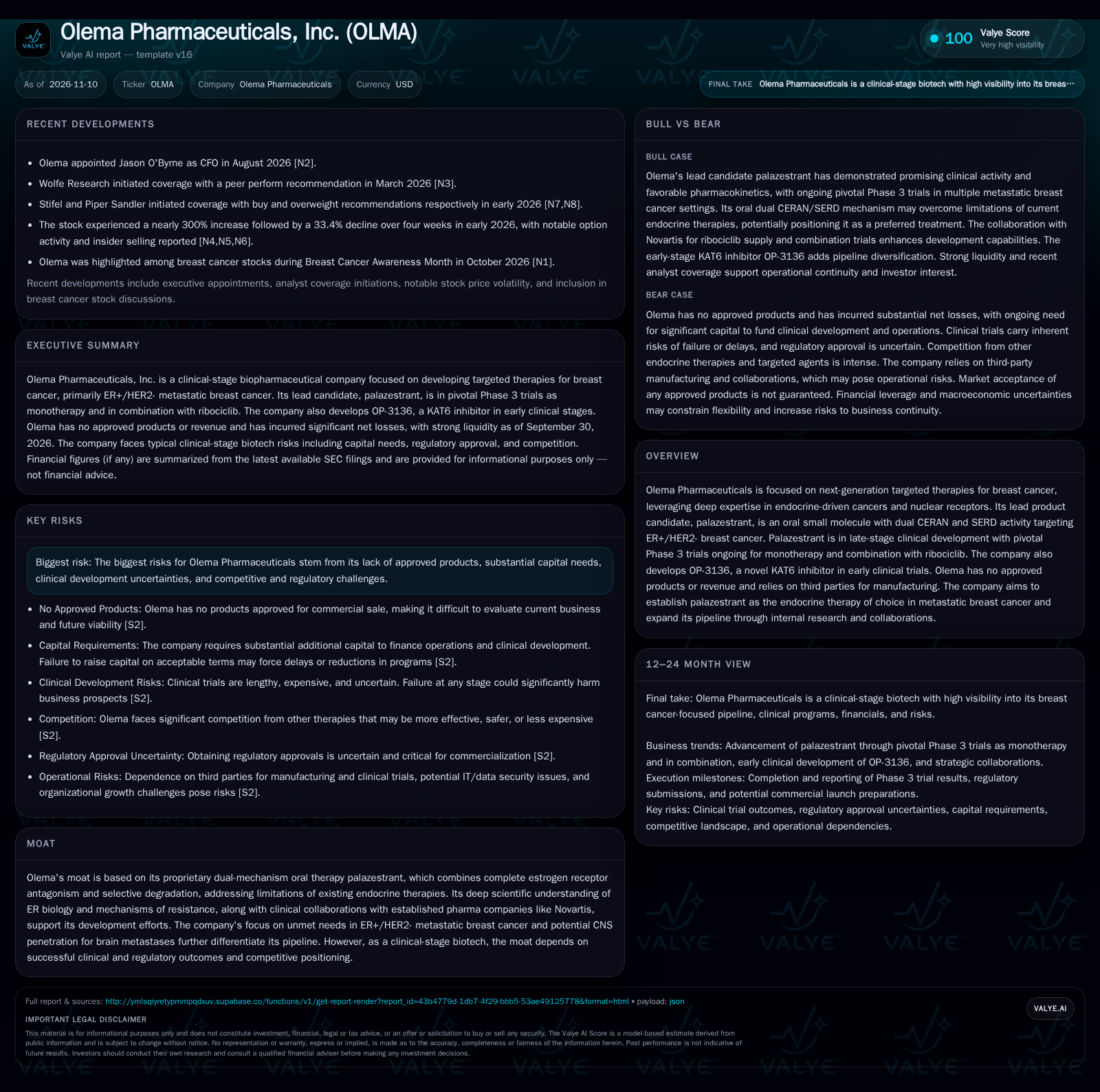
Olema Pharmaceuticals is advancing palazestrant, an oral dual-mechanism endocrine therapy, through pivotal Phase 3 trials for ER+/HER2- metastatic breast cancer, targeting both second/third-line and first-line settings. The company reported a net loss of $73.6 million for the quarter ending September 30, 2026, but held $413.7 million in cash and short-term investments, giving it reported liquidity position. With no approved products or revenue, Olema’s prospects hinge on clinical trial outcomes, regulatory approval, and future funding—amid intense competition from both established and emerging therapies. Analyst coverage has increased, but execution and differentiation remain central to the investment case. [S1] [S2] [N2] [N3] [N7] [N8]
Olema Pharmaceuticals, a clinical-stage biotech focused on endocrine-driven breast cancer, is rapidly approaching a decisive moment. With its lead asset, palazestrant, in late-stage Phase 3 trials targeting the lucrative ER+/HER2- metastatic breast cancer market, the company is seeking to position itself as a new standard in endocrine therapy. However, with no products approved and persistent operating losses, Olema’s future hinges on pivotal trial outcomes, the ability to secure additional capital, and successful navigation of a landscape crowded with both established and next-generation competitors. The coming 12–24 months will reveal whether its differentiated science can translate into commercial relevance and sustained investor confidence.
Olema’s Current Position: Pivotal Trials, Reported Liquidity Position, and Unproven Commercialization
Olema Pharmaceuticals is advancing its lead drug candidate, palazestrant (OP-1250), through two pivotal Phase 3 trials—one as monotherapy (OPERA-01) and another in combination with Novartis’ ribociclib (OPERA-02)—for ER+/HER2- metastatic breast cancer. The monotherapy trial began in November 2023, with top-line results expected in fall 2026, a key catalyst that could define the company’s near-term trajectory. [S1]
The company reported cash and liquidity metrics for the period; these figures do not by themselves establish operating runway, investment capacity, financial flexibility, or financing capacity. [S2]
Olema has no approved products or revenue from product sales, and its entire business model depends on successful clinical development, regulatory approval, and eventual commercialization of its pipeline. The company has also initiated a Phase 1 trial for its second program, OP-3136, a KAT6 inhibitor, signaling early pipeline diversification but not near-term revenue. [S1] [S2]
Decoding Olema’s Business Model: High-Risk R&D, Future Revenue Leverage, and Capital Demands
Olema’s economics are typical of a clinical-stage biotech: substantial upfront investment in R&D and clinical trials, with the promise of high-margin revenue if and when products reach the market. The company’s cost base is dominated by R&D, with minimal commercial infrastructure, and it outsources manufacturing rather than investing in fixed production assets. This keeps fixed operating leverage relatively low outside of R&D, but exposes Olema to variable costs and potential supply chain risks.
If palazestrant achieves approval, the economics could shift rapidly. Oral targeted therapies in oncology, especially those serving large indications like ER+/HER2- metastatic breast cancer, can command premium pricing and rapid uptake if differentiation is clinically meaningful. The company estimates the addressable market for palazestrant at up to $5 billion in second/third-line and $10 billion in first-line settings in the US and EU. [S1] However, commercial success would require significant investment in sales, marketing, and post-approval studies—costs that would scale only after regulatory milestones.
However, continued negative cash flow and the absence of product revenue mean that further equity or partnership financing is likely if trial results are positive and the company moves toward commercialization. [S2]
Competitive Dynamics: Differentiation Versus a Crowded Endocrine Therapy Field
Olema’s core bet is that palazestrant’s dual mechanism—combining complete estrogen receptor antagonism with selective degradation—will offer superior efficacy or resistance benefits over existing endocrine therapies, including fulvestrant, aromatase inhibitors, and emerging oral SERDs. The company’s clinical focus is on ER+/HER2- metastatic breast cancer, a large and competitive space where multiple next-generation agents are in development and some are already approved.
Potential advantages for Olema include the oral administration of palazestrant, the possibility of overcoming resistance mechanisms, and the opportunity to demonstrate CNS penetration for patients with brain metastases. These features, if clinically validated, could support both initial uptake and longer-term market share. [S1]
However, the landscape is highly competitive. Multiple large pharmaceutical companies and innovative biotechs are advancing oral SERDs, CERANs, and other targeted agents, some of which may have head starts in development or broader commercial infrastructure. The Novartis partnership for ribociclib supply in the combination trial provides Olema with credibility and a potential commercial ally, but does not eliminate the risks of being outpaced or out-marketed by larger players.
How Palazestrant Could Become a New Standard: Clinical Differentiation and Strategic Leverage
In a favorable scenario, palazestrant demonstrates statistically and clinically meaningful superiority over current endocrine therapies in both pivotal trials, with a safety profile that supports use across lines of metastatic disease. If the combination with ribociclib also shows clear benefit, Olema could position palazestrant as the backbone of ER+ metastatic breast cancer treatment.
Strong Phase 3 data would likely accelerate regulatory review and attract partnership or acquisition interest, especially given the size of the addressable market and the oral, dual-mechanism profile. Commercialization, either independently or via a larger partner, could result in rapid revenue ramp, high gross margins, and expansion into additional indications, including brain metastases.
Evidence that would support this scenario includes positive top-line Phase 3 results (OPERA-01 and OPERA-02), strong differentiation on efficacy or CNS activity, and rapid movement toward regulatory submissions. Early signals of payer acceptance or guideline inclusion would further validate the upside case.
Most Plausible Trajectory: Incremental Progress, Funding Needs, and Gradual Validation
The most likely outcome is that palazestrant yields positive but not transformative results in Phase 3—demonstrating non-inferiority or modest superiority to current therapies, supporting approval in at least one line of metastatic breast cancer. This would enable Olema to pursue regulatory submissions and potentially launch in a subset of the addressable market, but would not guarantee rapid or dominant adoption.
Under this scenario, Olema would need to raise additional capital to support commercial build-out or seek a strategic partnership to offset launch costs. Uptake would depend on payer dynamics, physician acceptance, and the pace of competitive launches. The early-stage pipeline (OP-3136) would remain a secondary, longer-term value lever.
This path would be confirmed by Phase 3 results that meet but do not dramatically exceed endpoints, regulatory engagement progressing as expected, and Olema securing additional financing or partnership arrangements without significant shareholder dilution.
What Could Go Wrong: Clinical Setbacks, Funding Gaps, and Competitive Displacement
The primary risk is that palazestrant fails to meet its primary endpoints in one or both pivotal trials, or reveals an unfavorable safety or tolerability profile relative to competitors. This would severely limit Olema’s ability to pursue regulatory approval, likely precipitating a sharp decline in valuation and forcing a retrenchment to earlier-stage pipeline assets.
Even with positive data, if competitors bring superior agents to market first or Olema is unable to differentiate on efficacy, CNS activity, or convenience, payers and clinicians may default to more established or better-supported therapies. Given Olema’s lack of revenue and ongoing losses, any delay or setback could exhaust its liquidity, necessitating dilutive financings or restructuring.
Confirmation of this scenario would include negative or equivocal Phase 3 results, regulatory setbacks, inability to secure new financing, or rapid competitor advances that erode Olema’s potential market share.
Milestones and Data Points to Clarify Olema’s Trajectory in Breast Cancer Therapeutics
Top-line results from the OPERA-01 Phase 3 monotherapy trial for palazestrant, expected in fall 2026, will be the most decisive catalyst. [S1]
Progress and interim data (if disclosed) from the OPERA-02 Phase 3 combination trial with ribociclib, including safety and efficacy signals. [S1]
Updates on the enrollment and early clinical data from the Phase 1 study of OP-3136, Olema’s KAT6 inhibitor, as a test of pipeline potential. [S1]
Cash burn rate and updated liquidity projections in subsequent SEC filings, especially as Phase 3 trials progress and commercial planning begins. [S2]
Announcements of new clinical collaborations, licensing deals, or commercial partnerships that could expand resources or reduce funding risk.
Competitive trial readouts from other oral SERDs, CERANs, or novel endocrine therapies that may reset the competitive bar.
Any regulatory feedback or engagement milestones—such as acceptance for review or fast-track designation—that would accelerate or delay timelines.
Analyst and market commentary around trial catalysts, financing, and the competitive landscape, especially following major data releases. [N2] [N3] [N7] [N8]
Disclaimer: This is research-only, informational analysis and not investment advice. It may include AI-generated interpretation and general industry context. Always verify important details using primary sources.

Comments