
Advanced Oxygen Technologies: Concentration, Constraints, and the Realities of Microcap Operations
The company’s fate will likely hinge on its ability to diversify, stabilize cash flows, and overcome the structural limitations of its business model.
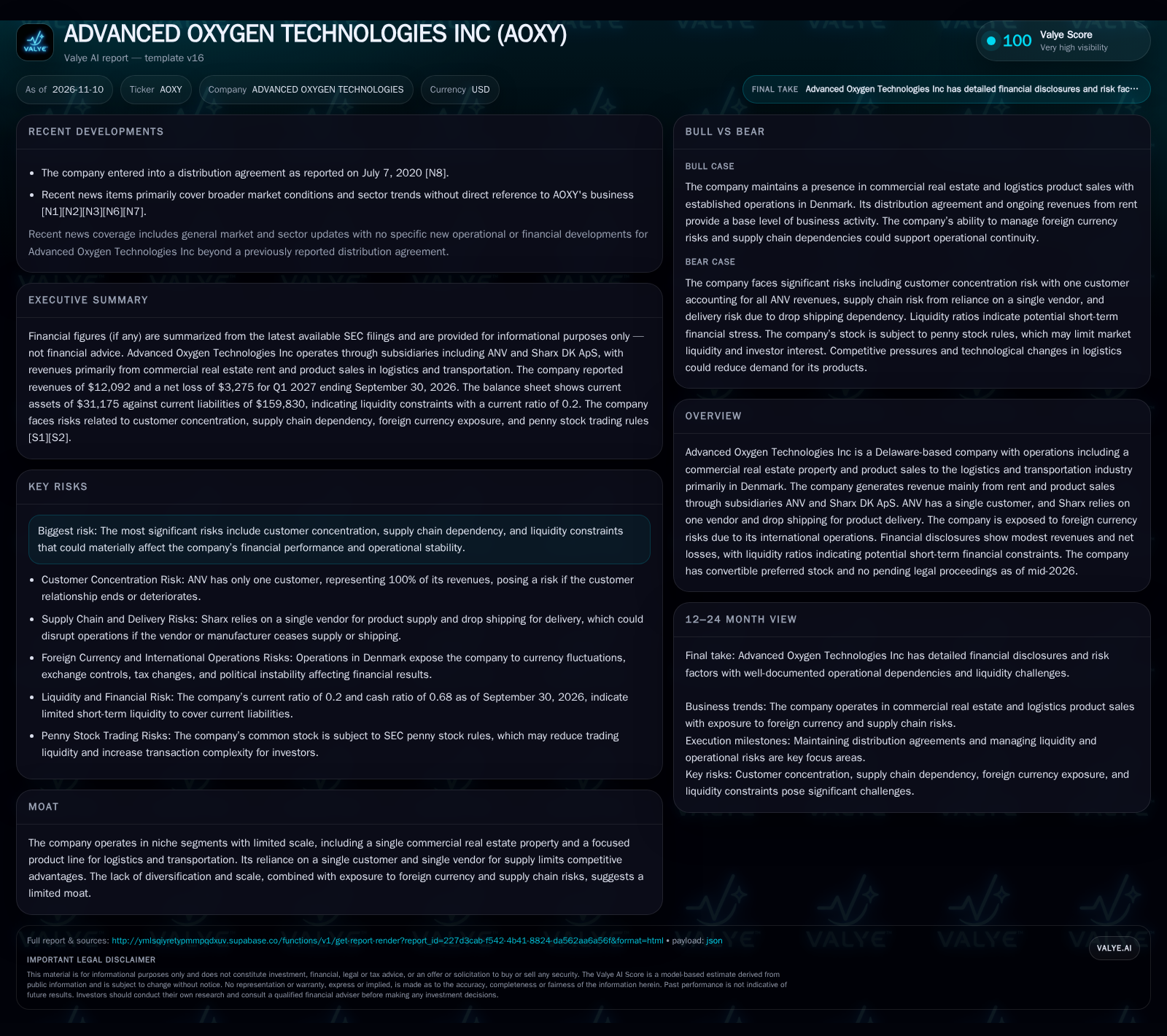
Advanced Oxygen Technologies Inc. reported $12,092 in Q3 2026 revenues, primarily from a single foreign real estate customer, and a net loss of $3,275. The investment thesis rests on whether AOXY can diversify revenues, secure more robust supply arrangements, and manage its exposure to customer, vendor, and currency risks. [S2]
For AOXY, the path forward will require not only shoring up balance sheet health but also addressing the existential risks of customer and supplier dependency, all within the constraints of penny stock trading rules and volatile international currency environments. The company’s prospects hinge on its capacity to diversify and stabilize its fragile business model in the face of acute structural limitations. [S2]
Material Facts: Concentration, Cash Constraints, and Operational Fragility
Advanced Oxygen Technologies reported total revenues of $12,092 for the quarter ended September 30, 2026, nearly all of which derived from rent on a single commercial property held by its ANV subsidiary. The company posted a net loss of $3,275 for the period. Its balance sheet is highly constrained, with current assets of $31,175 versus current liabilities of $159,830, yielding a current ratio of 0.2. This suggests the company may face acute challenges meeting near-term obligations. Operationally, ANV has only one customer, while the Sharx business is entirely dependent on a single vendor for logistics product supply, with fulfillment via drop shipping. The company’s foreign operations (primarily Denmark) expose it to currency and political risks. [S2]
How the Business Model Limits Scale and Margin Potential
AOXY’s economics are defined by extreme concentration and limited revenue streams. The real estate segment is entirely reliant on a single tenant, meaning rent is essentially binary—either it is collected or lost entirely. This lack of diversification eliminates any operational buffer or pricing power. The logistics product business, conducted through Sharx DK ApS, appears to function as a reseller or distributor. Because Sharx relies on one vendor and uses drop shipping, its cost structure is likely variable, with low gross margins typical of low-volume, third-party fulfillment models. Such models often lack meaningful operating leverage: fixed costs are minimal, but so are the prospects for substantial margin expansion unless sales volumes increase dramatically or the company secures more favorable supply terms.
The company reported cash and liquidity metrics for the period; these figures do not by themselves establish operating runway, investment capacity, financial flexibility, or financing capacity. With penny stock status constraining access to public markets and a history of accumulated deficits, AOXY is likely to face ongoing challenges funding growth or even maintaining operations absent significant operational improvements or capital infusions.
The interplay between AOXY’s concentrated revenue sources and its cost structure further complicates scalability. Because a large portion of revenue is fixed through rent, any loss of the single tenant would not only eliminate that income stream but also leave fixed property maintenance and administrative costs largely unchanged, pressuring margins further. Conversely, the logistics segment’s variable cost model tied to drop shipping limits fixed overhead but also caps profitability unless volume thresholds are met. In this context, achieving economies of scale is challenging without a significant increase in order volume or diversification of product offerings. Moreover, the absence of backward integration or proprietary supply agreements restricts the company’s ability to negotiate better input costs, which would otherwise improve gross margins.
Structural Disadvantages in Fragmented, Competitive Markets
AOXY’s competitive position is weak by industry standards. In commercial real estate, diversification of tenants and properties is a key risk mitigant; AOXY has neither. In logistics and transportation product sales, barriers to entry are low, and the company competes against both domestic and international players with greater scale, product breadth, and established supply chains. Sharx’s dependence on a single vendor and drop shipping model further weakens its position, as it cannot easily negotiate better terms or differentiate on fulfillment reliability.
Potential substitutes abound: logistics customers can source similar products from numerous alternative suppliers, often with better pricing, faster delivery, or more robust after-sales support. AOXY’s lack of proprietary technology or exclusive distribution rights limits its ability to defend share or command premium pricing. The penny stock status may also deter potential business partners or large customers, further entrenching its marginal position.
AOXY’s structural disadvantages are compounded by the dynamics of customer and vendor bargaining power inherent in fragmented markets. With a single tenant and sole vendor, the company is vulnerable to adverse contract renegotiations or abrupt terminations, which could drastically affect revenue and operational continuity. Additionally, the lack of differentiation in product offerings or service levels means AOXY competes primarily on price and availability, areas where larger competitors with scale advantages excel. This dynamic diminishes AOXY’s pricing power and exposes it to margin compression. The company’s limited brand recognition and financial visibility, exacerbated by penny stock status, may also hinder efforts to attract new customers or suppliers, perpetuating a cycle of dependency and fragility.
What a Turnaround Would Require: New Customers, Supply Security, and Revenue Diversification
A plausible upside scenario hinges on AOXY securing new customers for both its real estate and logistics segments. For ANV, signing additional tenants or expanding its property portfolio would dilute current concentration risk and create a more stable revenue base. On the Sharx side, diversifying the vendor base and potentially bringing fulfillment in-house could improve margins, reduce supply risk, and allow for customer acquisition efforts targeting a broader segment of the Danish logistics market.
Confirmation of this scenario would require disclosed contracts with new tenants or customers, announcements of additional vendor relationships, or a meaningful increase in quarterly revenue. Improvements in the current ratio and a reduction in net losses would further validate a turnaround. Conversely, continued reliance on one customer or vendor, or persistent low revenues, would falsify the upside case.
Likeliest Outcome: Treading Water Amid Chronic Constraints
The most probable path is that AOXY continues to operate at minimal scale, with single-customer revenue streams and persistent liquidity constraints. The company may maintain its current rent and product sales levels but struggle to generate positive cash flow or finance expansion. Operational risks—such as loss of the sole tenant or vendor disruptions—remain ever-present, and the company’s penny stock status limits its access to capital and its ability to attract significant new business.
Evidence that would confirm this scenario includes continued reporting of minimal revenues, unchanged customer/vendor concentration, and persistent working capital deficits. Any deterioration in these metrics—such as a missed rent payment or vendor disruption—could precipitate a rapid decline, while modest improvements without structural change would still leave the company in a fragile state.
How Disruption Could Lead to Rapid Deterioration
The primary downside risk is the loss of the single tenant or the logistics vendor ceasing supply, either of which could eliminate virtually all company revenue overnight. With a current ratio of 0.2 and limited cash, AOXY could quickly face insolvency if a major revenue stream is disrupted or if currency volatility significantly erodes the value of foreign income. Additional risks include changes in Danish regulations, political instability, or disruptions in cross-border payments, any of which could further destabilize operations.
Downside confirmation would come from disclosed loss of the tenant or vendor, a sharp decline in quarterly revenues, or an increase in current liabilities without a corresponding capital infusion. Inability to secure alternative sources of revenue or funding would likely force restructuring, asset sales, or even bankruptcy proceedings.
Currency risk introduces an additional layer of financial volatility that could accelerate deterioration. Given AOXY’s Denmark-centric operations, fluctuations in exchange rates can unpredictably impact reported revenues and expenses when consolidated into the parent company’s reporting currency. A weakening of foreign currency relative to the reporting currency reduces the value of income streams and may increase the relative burden of fixed costs denominated in the parent currency. This risk is heightened by the company’s limited hedging capabilities, constrained capital resources, and lack of diversified revenue sources to offset localized currency impacts. Persistent currency headwinds could therefore exacerbate liquidity pressures and hasten insolvency risks if not managed effectively.
What Will Determine AOXY’s Fate: Concrete Tests for the Next Year
Any disclosure of new customer acquisition or tenant agreements, especially in the real estate segment, would signal progress in reducing concentration risk.
Announcements regarding the addition of new vendors or logistics product lines would help gauge Sharx’s ability to diversify supply and reduce operational vulnerability.
Quarterly revenue growth—if disclosed—would be a direct indicator of improved commercial traction and reduced fragility.
Evidence of successful renegotiation or extension of the single tenant’s lease would provide near-term revenue visibility.
Disclosures of supply disruptions, vendor relationship changes, or delivery delays in the logistics segment would test the resilience of Sharx’s business model.
Any regulatory or currency developments affecting cross-border operations in Denmark should be monitored for potential impact on cash flows and reported earnings.
If disclosed, gross margin trends in the logistics segment would shed light on potential improvements in purchasing power or operational efficiency.
Disclaimer: This is research-only, informational analysis and not investment advice. It may include AI-generated interpretation and general industry context. Always verify important details using primary sources.

Comments