
HF Foods Group: Distribution Expansion, Margin Pressure, and the Stakes of Specialized Foodservice Scale
As HF Foods Group grows its national reach and invests in automation, the company’s specialized focus on Asian restaurant customers confronts the realities of thin margins, persistent losses, and the operational risks of scaling in a hyper-competitive U.S. foodservice distribution market.
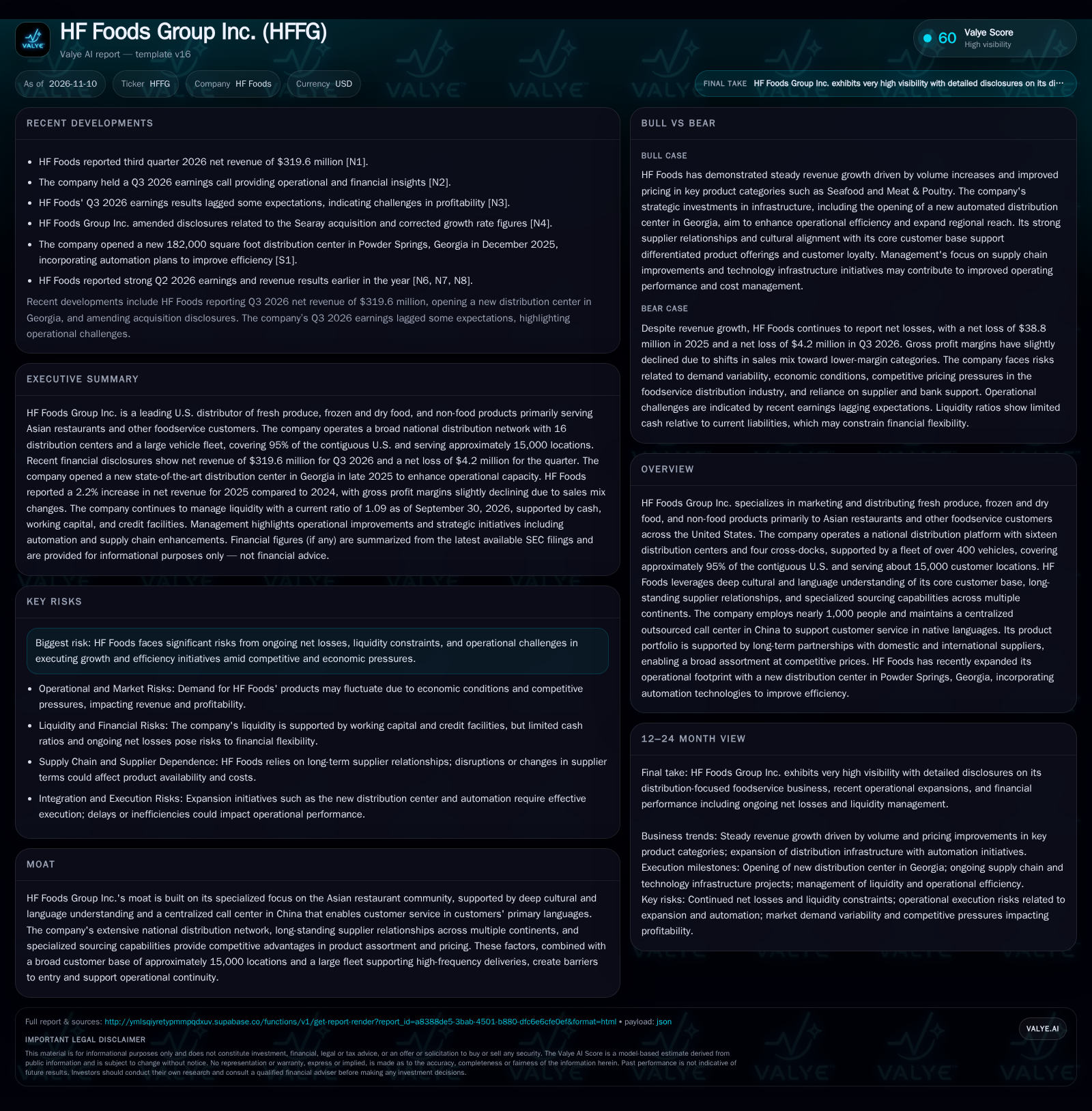
HF Foods Group reported Q3 2026 net revenue of $319.6 million and continues to expand its national distribution network, including a new automated facility in Georgia. Its business model leverages cultural alignment and supplier relationships to serve 15,000 customer locations, but the ability to translate scale and efficiency investments into sustainable profitability remains an open question. Execution on automation and sales mix improvement will be critical to altering the company’s economic trajectory. [N1] [S2]
HF Foods Group Inc. stands at a crossroads: its national logistics footprint and deep ties to Asian restaurant customers provide unique reach and relevance in the fragmented U.S. foodservice distribution sector. The company is pushing forward with automation and infrastructure—evidenced by its new Georgia distribution center—while reporting steady revenue growth. Yet, margin compression and ongoing net losses underscore the difficulty of translating scale and operational improvements into bottom-line gains. As HF Foods navigates a landscape shaped by intense competition and evolving customer needs, the effectiveness of its strategic initiatives will determine whether it can convert its distribution muscle and cultural alignment into lasting economic advantage.
Recent Performance and Expansion: What the Numbers Reveal
HF Foods Group reported net revenue of $319.6 million for the third quarter of 2026, but continued to post a net loss ($4.2 million in Q3 and $38.8 million for the full year 2025), highlighting ongoing profitability challenges despite top-line growth. The company’s 2025 net revenue rose 2.2% year-over-year, yet gross profit margins declined slightly as sales mix shifted toward lower-margin categories. Operationally, HF Foods opened a new 182,000 square foot distribution center in Powder Springs, Georgia in December 2025, featuring automation intended to improve efficiency and scale. The company reported cash and liquidity metrics for the period; these figures do not by themselves establish operating runway, investment capacity, financial flexibility, or financing capacity. These facts collectively signal a company investing heavily in infrastructure and technology while still struggling to convert scale into sustainable profitability. [N1] [S1] [S2]
Unit Economics and the Pursuit of Scale in Foodservice Distribution
HF Foods’ core business—sourcing and distributing fresh, frozen, and dry food products to Asian restaurants and foodservice outlets—operates on razor-thin margins typical of the broader food distribution sector. Revenue growth has been driven by both volume and pricing in categories like Seafood and Meat & Poultry, but cost of goods sold (COGS) remains high due to perishability, transportation, and labor intensity. The company’s gross margin pressure is exacerbated by a sales mix that has recently shifted toward lower-margin products, limiting the benefit of revenue gains on profitability.
Investments in automation and expanded facilities, such as the new Georgia center, are designed to reduce variable handling costs and increase throughput, potentially improving margins via operating leverage if fixed costs can be spread over rising volumes. However, capital expenditures and integration costs can weigh on near-term profitability, especially if volume growth or pricing power do not accelerate. The company’s reliance on supplier relationships and specialized sourcing may provide purchasing advantages, but these must offset both competitive pricing pressure and the high cost base inherent to national distribution. [S1] [S2]
Specialization Versus Scale: HF Foods’ Differentiation and Its Limits
HF Foods’ moat is rooted in its cultural and linguistic alignment with Asian restaurant customers—a segment often underserved by national broadline distributors. Its network of 16 distribution centers, long-term supplier relationships across continents, and a centralized call center in China enable tailored service and product assortment. These elements create switching frictions for customers who value language-congruent support and hard-to-source ingredients.
However, the U.S. foodservice distribution landscape is intensely competitive, with large national players (such as Sysco and US Foods) and regional specialists both able to exert pricing pressure and invest in technology. While HF Foods’ focus enables differentiation, it also narrows the addressable market and may limit economies of scale compared to broadline peers. Additionally, competitive encroachment into the Asian restaurant segment—especially as mainstream distributors pursue multicultural growth—could erode HF Foods’ customer retention and margin premium. The question is whether the company’s specialization and operational reach can deliver enough volume and loyalty to overcome structural cost and margin disadvantages.
How Automation and Sales Mix Optimization Could Unlock Margin Expansion
A favorable outcome for HF Foods would see automation and efficiency investments at the new Georgia distribution center materially lowering per-unit handling and logistics costs, driving operating leverage as volumes increase. If management successfully shifts the sales mix toward higher-margin product categories (such as premium seafood or proprietary branded goods) while leveraging supplier relationships for better terms, gross margins could stabilize or even expand. The company’s deep customer relationships and specialized sourcing may help defend pricing and capture incremental share as the Asian restaurant sector grows in the U.S.
Confirmation of this scenario would involve a sustained improvement in gross profit margins, a narrowing of net losses or transition to profitability, and evidence that automation is reducing variable costs. Additional signs would include volume growth outpacing industry averages and retention of major customer relationships. Falsification would occur if margin gains fail to materialize despite automation, or if sales mix shifts cannot offset competitive pricing and cost headwinds.
Incremental Gains Amid Persistent Margin Constraints
The most plausible trajectory is that HF Foods continues to grow revenue modestly, driven by organic volume growth and gradual expansion of its distribution footprint. Automation and operational improvements may yield incremental efficiency gains, but the benefit could be largely offset by competitive pricing, wage inflation, and ongoing sales mix pressure toward lower-margin categories. The company is likely to remain exposed to swings in restaurant demand and food input costs, with profitability showing only slow improvement—if at all.
This scenario would be confirmed by modest improvements in operating margins and reduced quarterly net losses, but without a decisive shift to sustained profitability. Falsification would be evident if losses widen, margin erosion accelerates, or if the company is forced to scale back investment due to liquidity constraints.
What Failure to Scale Profitably Could Mean for HF Foods
If automation and distribution investments fail to deliver the expected cost savings—or if competitive and macroeconomic pressures intensify—HF Foods could face continued or worsening net losses. A further decline in gross margins, whether from unfavorable sales mix, supplier cost increases, or customer churn, would threaten operating stability.
Confirmation of this adverse scenario would include persistent or increasing net losses, declining gross margins, negative operating cash flow, and potential reductions in capital spending or headcount. The scenario would be falsified if HF Foods demonstrates clear margin recovery, improved cash generation, or successful renegotiation of supplier and customer terms to restore profitability.
Milestones and Metrics That Will Define HF Foods’ Economic Trajectory
Gross profit margin trends, especially in the wake of automation and distribution center expansion, as a test of efficiency and sales mix improvement.
Quarterly net income and operating cash flow, to gauge progress toward or away from sustainable profitability.
Volume growth in core product categories (if disclosed), which would indicate whether customer acquisition and retention are advancing.
The impact of the new Georgia distribution center on logistics costs and service levels, as measured by internal KPIs or management commentary.
Customer retention rates and share of wallet among Asian restaurant clients, as a signal of competitive differentiation and switching friction.
Terms and stability of supplier relationships, particularly in the context of cost inflation or sourcing disruptions.
Evidence of successful sales mix shift toward higher-margin products, as indicated by segment disclosures or management guidance (if provided).
Disclaimer: This is research-only, informational analysis and not investment advice. It may include AI-generated interpretation and general industry context. Always verify important details using primary sources.

Comments