
MasterCraft Boat Holdings: Cyclicality, Dealer Leverage, and the Operating Stakes of Premium Recreation
Recent earnings outperformance highlights MasterCraft’s operational discipline, but the company remains exposed to interest-rate-driven demand swings, dealer network fragility, and the capital intensity of manufacturing expansion. Understanding how margin structure, channel health, and discretionary-spend cycles interact will determine whether current momentum is sustainable or at risk of reversal.
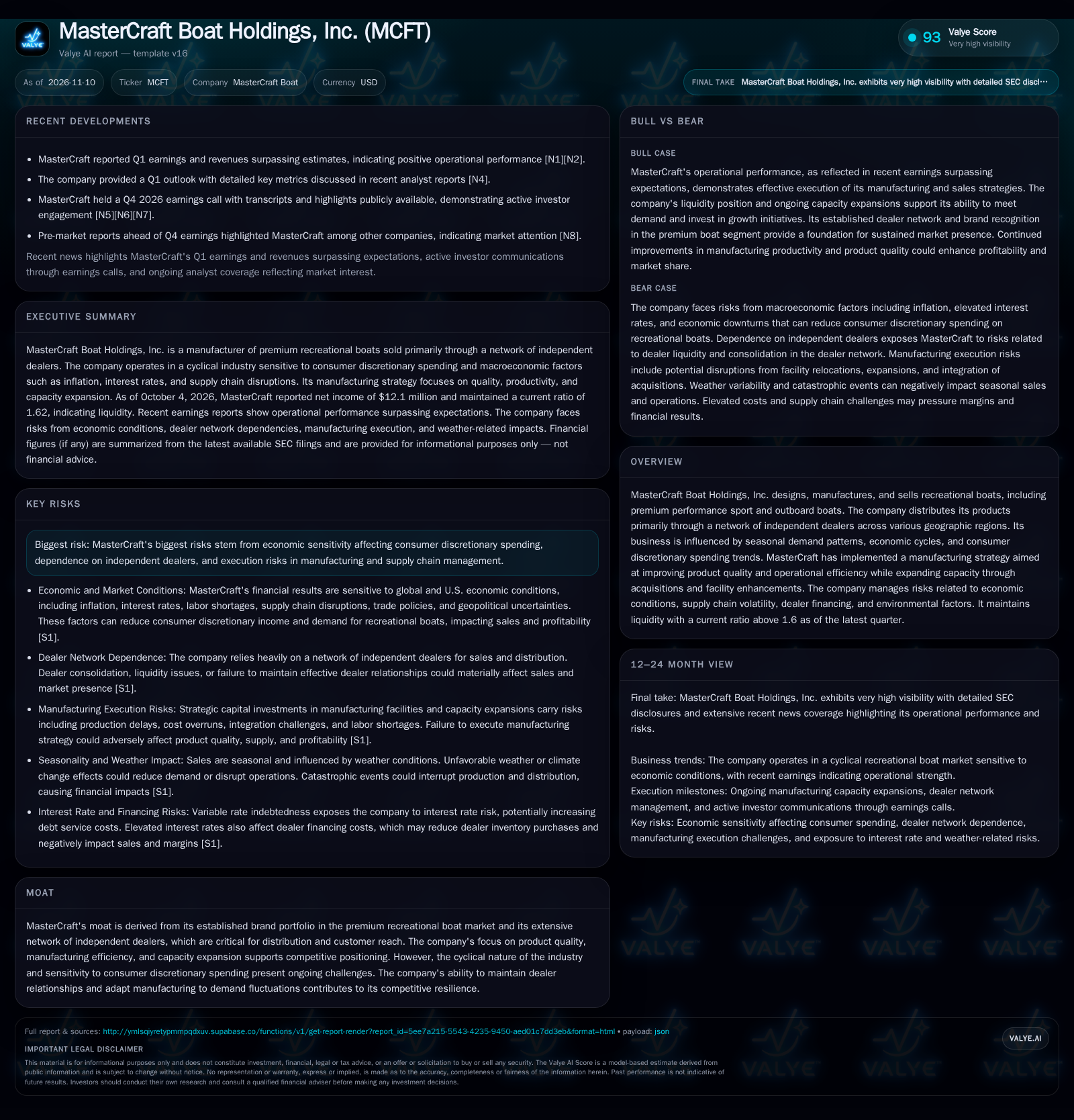
MasterCraft Boat Holdings exceeded earnings expectations in its latest quarter and maintains a cash reserve of $41.9 million, but its fortunes are tightly linked to economic cycles, dealer channel health, and continued manufacturing execution. The company’s strategic focus on premium product quality and dealer partnerships underpins its competitive position, yet persistent risks—from rising interest rates to potential dealer contraction—threaten both sales volume and margin resilience. Monitoring the interplay of consumer demand, dealer inventory dynamics, and cost control will be critical in gauging future performance.[S2] [N1] [N2]
With its latest quarterly earnings beating expectations and a respectable cash position, MasterCraft Boat Holdings finds itself at a crossroads shaped by both operational discipline and macroeconomic uncertainty. The company’s exposure to the discretionary recreational market, reliance on a dealer-driven sales model, and ongoing manufacturing investments create a business that can generate outsized returns during economic upswings—but also faces sharp reversals as consumer sentiment, rates, and dealer health fluctuate. The next phase for MasterCraft will test the resilience of its strategy as interest rates, supply chain conditions, and consumer spending patterns continue to evolve.
Earnings Beat and Liquidity Snapshot: What’s Changed for MasterCraft
MasterCraft Boat Holdings reported net income of $12.1 million and basic and diluted EPS of $0.5 for the quarter ended October 4, 2026, with both earnings and revenues surpassing analyst estimates according to recent news coverage.[S2] [N1] [N2] This operational outperformance comes amid a macro environment still pressured by elevated interest rates and inflation, both of which are explicitly cited as major risks for the company.[S1]
As of the latest quarter, MasterCraft maintained cash and cash equivalents of $41.9 million, a current ratio of 1.62, and a cash ratio of 0.42. [S2]
Recent earnings calls and analyst coverage have kept MasterCraft in the investor spotlight, with an emphasis on the company’s ability to execute its manufacturing and dealer strategies in a volatile environment.[N4] [N5] [N6] [N7]
How MasterCraft Makes Money: Pricing Power, Volume Volatility, and the Dealer Channel
MasterCraft’s core economics hinge on designing, manufacturing, and selling premium performance sport and outboard boats, largely through a network of independent dealers.[S1] Revenue is driven by a combination of unit volume, product mix (with higher-margin premium models likely contributing disproportionately to profitability), and pricing discipline. However, the company’s end-market—recreational boating—remains a classic discretionary spending category, with high sensitivity to consumer confidence, employment, and interest rates.
Fixed costs are significant, owing to three dedicated manufacturing facilities and ongoing investments in quality improvement and capacity expansion.[S1] This creates operating leverage that can amplify profits during demand upswings but also compress margins quickly if volumes decline. Variable costs, particularly raw materials and labor, are vulnerable to inflation and supply chain disruption.
The dealer model means most sales are wholesale to dealers, not direct to end consumers. This structure can smooth near-term revenue, but also introduces channel risk: dealers may reduce orders or struggle to finance inventory as rates rise, and MasterCraft may need to support dealers through incentives or extended terms during downturns. The capital intensity of manufacturing and the need to manage inventory through the channel create working capital demands, especially in the face of seasonality and weather-driven sales swings.
Assessing MasterCraft’s Defenses: Brand, Dealer Network, and the Threat of Substitution
MasterCraft’s competitive position rests on its established brand in the premium recreational boat segment and its extensive network of independent dealers, which provide geographic reach and local market knowledge.[S1] In the premium boat space, brand reputation, perceived product quality, and after-sales support are crucial differentiators. The company’s focus on manufacturing efficiency and product innovation may support margin stability and defend share against similarly positioned rivals.
However, the dealer network is a double-edged sword: while it extends reach, it also makes MasterCraft vulnerable to dealer consolidation or financial distress, especially in a high-rate environment. Competing categories include other premium boat manufacturers, mass-market boat brands, and to a lesser extent, adjacent leisure spending categories (e.g., RVs, vacation travel) that can substitute for boat purchases when consumer budgets tighten.
Technology substitution risk is modest, as the core recreational boating experience is not easily replaced by digital or alternative leisure products. Nonetheless, the company must continually invest in features, quality, and customer experience to maintain differentiation and pricing power.
What Could Drive a Sustained Upswing: Demand Resilience and Dealer Channel Strength
If consumer discretionary spending remains robust—despite macro headwinds—MasterCraft could see continued strong demand for premium boats, particularly if interest rates stabilize or decline. In this scenario, the company's investments in manufacturing quality and capacity could allow it to capture incremental share from weaker competitors or capitalize on product launches and upgrades.
Confirmation would come from further earnings beats, rising order backlogs (if disclosed), and commentary from both management and dealers indicating healthy retail sell-through and inventory turns. Expansion in dealer count or stability in dealer financial health would also support the thesis.
Falsification would be signaled by a reversal in sales momentum, rising dealer inventories, or evidence of discounting and incentives eroding pricing power. Sustained margin expansion and limited working capital build would reinforce the upside case.
Navigating Choppy Waters: Moderate Growth Amid Persistent Macro Risks
The most plausible scenario is one of moderate revenue and profit growth, punctuated by seasonal and cyclical volatility. MasterCraft’s operational discipline and manufacturing investments may allow it to hold or slightly grow share in the premium segment, but top-line gains are likely to be constrained by elevated interest rates and consumer uncertainty.
Confirmation would come from steady quarterly financials, stable dealer relationships, and manageable inventory levels. Continued emphasis on manufacturing efficiency and cost control would help offset input cost pressures.
A weakening of these trends—such as rising dealer distress, declining order rates, or margin compression—would indicate the base case is at risk. The company’s ability to adapt its production and support its dealer channel as conditions change will be critical.
How a Downturn Could Unfold: Dealer Contraction, Demand Shock, and Margin Squeeze
A sharper-than-expected pullback in consumer discretionary spending—driven by persistent inflation, further rate hikes, or an economic downturn—could trigger a rapid decline in dealer orders and retail demand. This would likely result in channel inventory build, price discounting, and pressure on both gross and operating margins.
Dealer consolidation or financial distress could force MasterCraft to provide additional support, increase incentives, or even lose distribution coverage in key markets. Manufacturing fixed costs would become a heavier burden if volumes fell, and the company might be forced to slow or defer capacity investments.
Confirmation of this scenario would include missed earnings, negative sales growth, rising working capital needs, and commentary about dealer network stress or inventory overhangs.
Milestones That Will Test MasterCraft’s Strategy and Channel Health
Quarterly changes in dealer inventory levels and retail sell-through rates, if disclosed, would provide early warning of demand shifts or channel oversupply.
Tracking gross margin trends and the extent of discounting or promotional activity will help gauge pricing power and cost pass-through ability.
Updates on dealer count, dealer financial health, and any signs of consolidation or attrition in the network are critical for understanding distribution risk.
Monitoring the company’s capital expenditure plans and execution on manufacturing expansions will signal whether investments are matched to demand realities.
Seasonal sales patterns—especially strength or weakness during the spring and summer peak—will reveal the impact of weather and discretionary spend trends.
Changes in working capital, particularly inventory and receivables, can indicate whether the company is managing production and dealer health effectively.
Management commentary on interest rate sensitivity, dealer financing costs, and macroeconomic outlook during earnings calls will be important for anticipating forward risk.
Disclaimer: This is research-only, informational analysis and not investment advice. It may include AI-generated interpretation and general industry context. Always verify important details using primary sources.

Comments