
Dominari Holdings: Integration Ambitions, Capital Return, and the Realities of Financial Services Diversification
Dominari Holdings has pivoted aggressively from biotechnology to a diversified financial services platform, reporting reported liquidity position, a substantial share buyback, and new leadership moves. The company's ability to integrate acquisitions and achieve profitability amid intense industry competition and execution risk will determine whether its multi-pronged strategy translates into durable value creation.
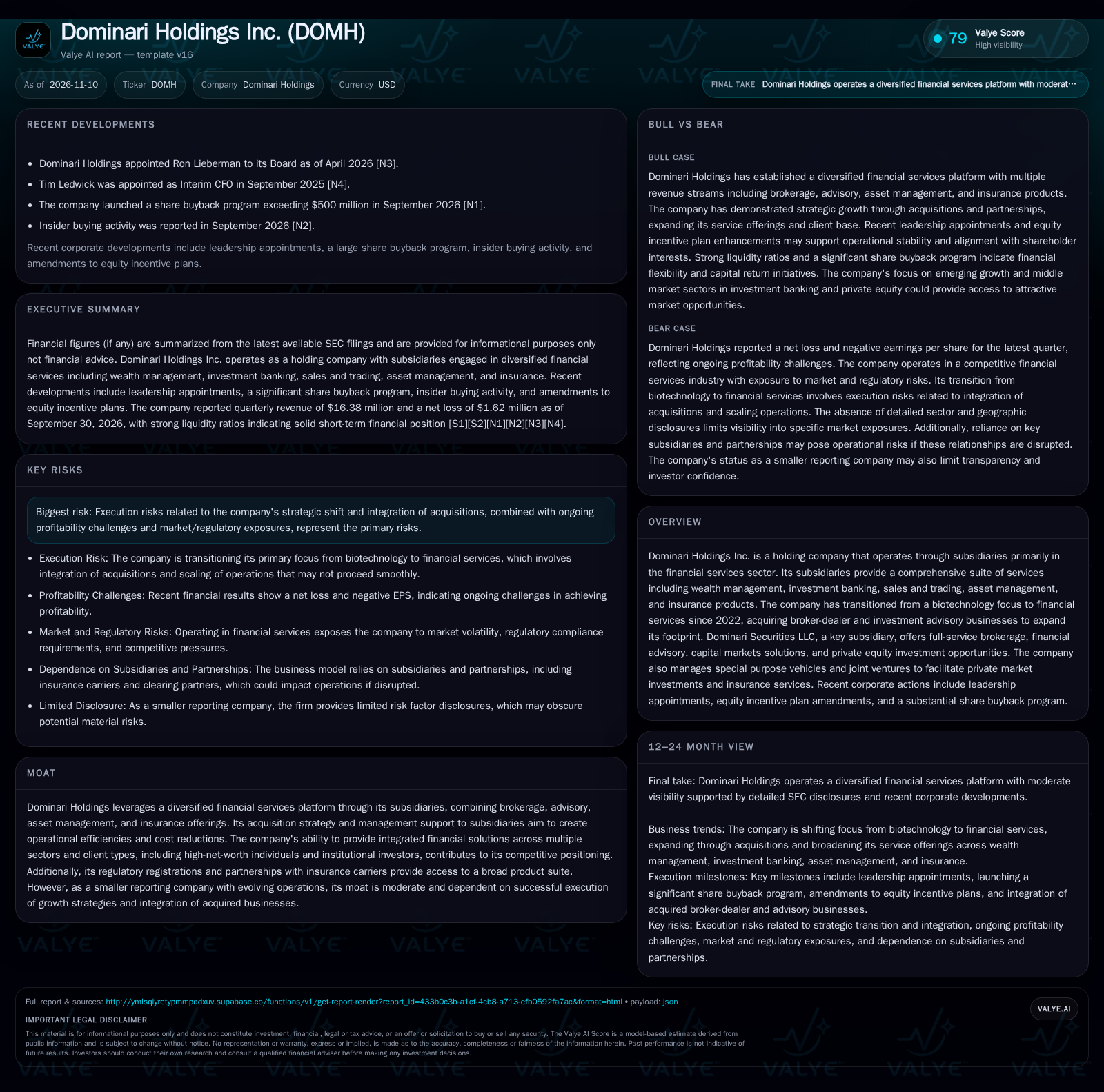
Dominari Holdings now operates as a multi-subsidiary financial services holding company, reporting $16.38 million in quarterly revenue and a net loss as of September 2026. The company has launched a $500+ million share buyback and maintains high liquidity ratios, while recent leadership changes reflect ongoing transformation. The central question is whether Dominari can effectively integrate acquisitions and scale its platform to achieve sustained profitability in a competitive sector. [S1] [S2] [N1] [N2] [N3] [N4]
Dominari Holdings has rapidly recast itself as a diversified financial services holding company, moving away from its biotech origins to assemble a suite of businesses spanning wealth management, investment banking, trading, asset management, and insurance. With recent quarterly revenue of $16.38 million but continued net losses, Dominari faces a familiar challenge for new entrants: translating platform breadth and capital strength into durable earnings.Insider transaction activity was reported in the cited source; this activity does not by itself establish insider confidence. [S1] [S2] [N1] [N2] [N3] [N4]
Dominari’s Recent Moves: Liquidity, Buybacks, and Leadership Shifts Signal a New Chapter
Dominari Holdings reported $16.38 million in revenue and a net loss of $1.62 million for the quarter ending September 30, 2026, with an EPS of -$0.08. The company’s cash and equivalents stood at $23.99 million, and liquidity ratios were notably high—current ratio at 27.54 and cash ratio at 9.41—indicating ample short-term resources. September 2026 saw the launch of a share buyback program exceeding $500 million and insider buying activity, while new leadership appointments included Tim Ledwick as Interim CFO and Ron Lieberman joining the Board. These facts highlight an ongoing transformation, with capital return initiatives and a refreshed management team supporting Dominari’s financial services pivot. The central issue is whether these moves can catalyze operating momentum and profitability in a competitive environment. [S2] [N1] [N2] [N3] [N4]
How Dominari’s Multi-Segment Platform Could Generate Earnings—And Where the Pressure Points Lie
Dominari’s revenue streams are diversified across brokerage, wealth management, investment banking, asset management, and insurance products, echoing the economic model of a traditional financial services conglomerate. Each segment tends to feature a mix of fee-based and spread-based income: wealth management and asset management often provide recurring fees tied to assets under management, while sales and trading generate transaction-based revenue that can be volatile. Investment banking revenues are typically episodic and hinge on deal flow, which is sensitive to market cycles.
The company’s insurance offerings, via direct agreements and joint ventures, add a layer of commission-based revenue but also introduce distribution and compliance costs. Integration of acquired broker-dealer and advisory businesses may offer some cost synergies and cross-sell potential, but also raises fixed costs and complexity. If Dominari can achieve scale in its core segments, operating leverage could enhance margins, as incremental revenue in established platforms often outpaces associated costs. However, the need to compete for talent, technology, and regulatory compliance creates ongoing cost pressure, making the path to sustainable profitability highly dependent on execution and successful integration. Capital needs are relatively modest outside of regulatory requirements and working capital, but expansion, acquisitions, and incentive programs could increase outlays.
Competitive Pressures and the Challenge of Differentiation in Financial Services
Dominari is entering a mature and highly competitive market, facing established players in wealth management, investment banking, and asset management. Incumbents benefit from scale, brand, technology infrastructure, and regulatory expertise. For new entrants, customer acquisition costs can be high, particularly in the high-net-worth and institutional segments. Switching costs in wealth management and advisory can be meaningful, but are often offset by relationship-driven churn and aggressive poaching by competitors.
Dominari’s broad product offering theoretically allows for cross-selling and integrated client solutions, which could drive client retention if executed well. However, the company’s relatively small scale and limited brand presence may constrain its ability to compete for marquee clients and deals. Technology adoption, digital client engagement, and regulatory compliance are table stakes; any failure to match industry standards could erode competitive standing. The insurance joint venture model provides access to a wider product suite, but also introduces partnership risk and potential revenue-sharing dilution. The company’s ability to carve out a defensible niche may depend on specialization in emerging growth and middle market sectors, or by leveraging agility and personalized service to counterbalance the scale of larger rivals.
If Integration Succeeds: The Pathway to Operating Leverage and Shareholder Value
A favorable scenario would see Dominari successfully integrating its acquisitions, achieving cross-segment synergies, and scaling its client base in both wealth and institutional channels. If fee-based revenue from wealth and asset management grows as a proportion of total income, revenue visibility and margin stability could improve. Effective cross-selling of insurance and alternative investments could deepen client relationships and increase wallet share.
The recently launched $500+ million share buyback, if completed at attractive valuations and supported by underlying earnings improvement, could amplify returns to shareholders. Confirmation of this scenario would include a sustained move to profitability, growth in assets under management, evidence of recurring fee income outpacing volatile trading or episodic banking revenues, and successful retention or acquisition of high-value clients. Further, positive operating leverage—where revenue growth outpaces expense growth—would be a key indicator that integration and scale benefits are materializing.
A Realistic Trajectory: Incremental Progress Tempered by Integration and Margin Challenges
The most plausible near-term outcome is that Dominari makes incremental progress in integrating its subsidiaries and expanding its client base, but continues to face margin pressure and episodic losses as it invests in talent, technology, and compliance. Revenue may grow modestly through organic and acquired channels, but the mix could remain volatile, with trading and investment banking subject to market conditions.
Profitability may remain elusive until the company achieves greater scale or operational efficiencies, especially given the competitive intensity and cost structure of the sector. Evidence supporting this scenario would include continued net losses or breakeven results despite revenue growth, a stable but not rapidly expanding asset base, and ongoing investments in infrastructure and personnel. If disclosed, metrics such as client retention rates, new client acquisition, and segment-level margins would help test whether Dominari is gradually building a more durable platform.
When Integration Stalls: Execution Missteps and the Risks of Platform Complexity
The adverse case centers on failed or delayed integration of acquisitions, leading to operational inefficiencies, client attrition, and persistent losses. If Dominari cannot harmonize systems, cultures, and client offerings across its various subsidiaries, it risks elevated costs and revenue leakage. Regulatory missteps or compliance failures could trigger fines or reputational damage, especially given the complex web of broker-dealer, advisory, asset management, and insurance activities.
In this scenario, cash outflows from ongoing losses, acquisition costs, or incentive programs could erode the company’s liquidity cushion, forcing capital raises or asset sales under less favorable terms. Confirmation would come from widening losses, declining cash balances, negative trends in client or asset retention (if disclosed), or regulatory actions. A stalled or abandoned share buyback, or insider selling, would also signal diminished confidence in the integration thesis.
What Will Determine Dominari’s Success as a Diversified Financial Services Platform?
Quarterly and annual trends in net income and EPS: A sustained move toward profitability would signal successful integration and cost control.
Growth in assets under management or advisory (if disclosed): Rising AUM would indicate traction in wealth and asset management segments.
Client acquisition and retention rates (if disclosed): Improved client metrics would validate the company’s ability to compete against established players.
Segment-level revenue and margin contributions: Disclosures on which business lines are driving growth or losses would clarify Dominari’s economic engine.
Completion rate and average price of the share buyback: Execution of the buyback at attractive valuations would confirm management’s capital allocation discipline.
Cash flow from operations and changes in cash/cash equivalents: Monitoring these figures would test whether liquidity remains robust as the company invests for growth.
Regulatory actions, compliance disclosures, or significant partnership changes: Any regulatory or operational disruptions could undermine the integration thesis.
Leadership stability and incentive plan outcomes: Retention of key executives and realization of performance-based compensation targets would support execution continuity.
Disclaimer: This is research-only, informational analysis and not investment advice. It may include AI-generated interpretation and general industry context. Always verify important details using primary sources.

Comments