
Cellectar Biosciences: Late-Stage Radioconjugate Ambitions and the Stakes of Regulatory, Commercial, and Dilution Pathways
Cellectar advances iopofosine I 131 toward potential approval in relapsed/refractory Waldenström Macroglobulinemia, supported by strong Phase 2 data, ample cash, and strategic isotope supply—but faces binary regulatory risk, future financing hurdles, and possible shareholder dilution if milestone warrants are triggered.
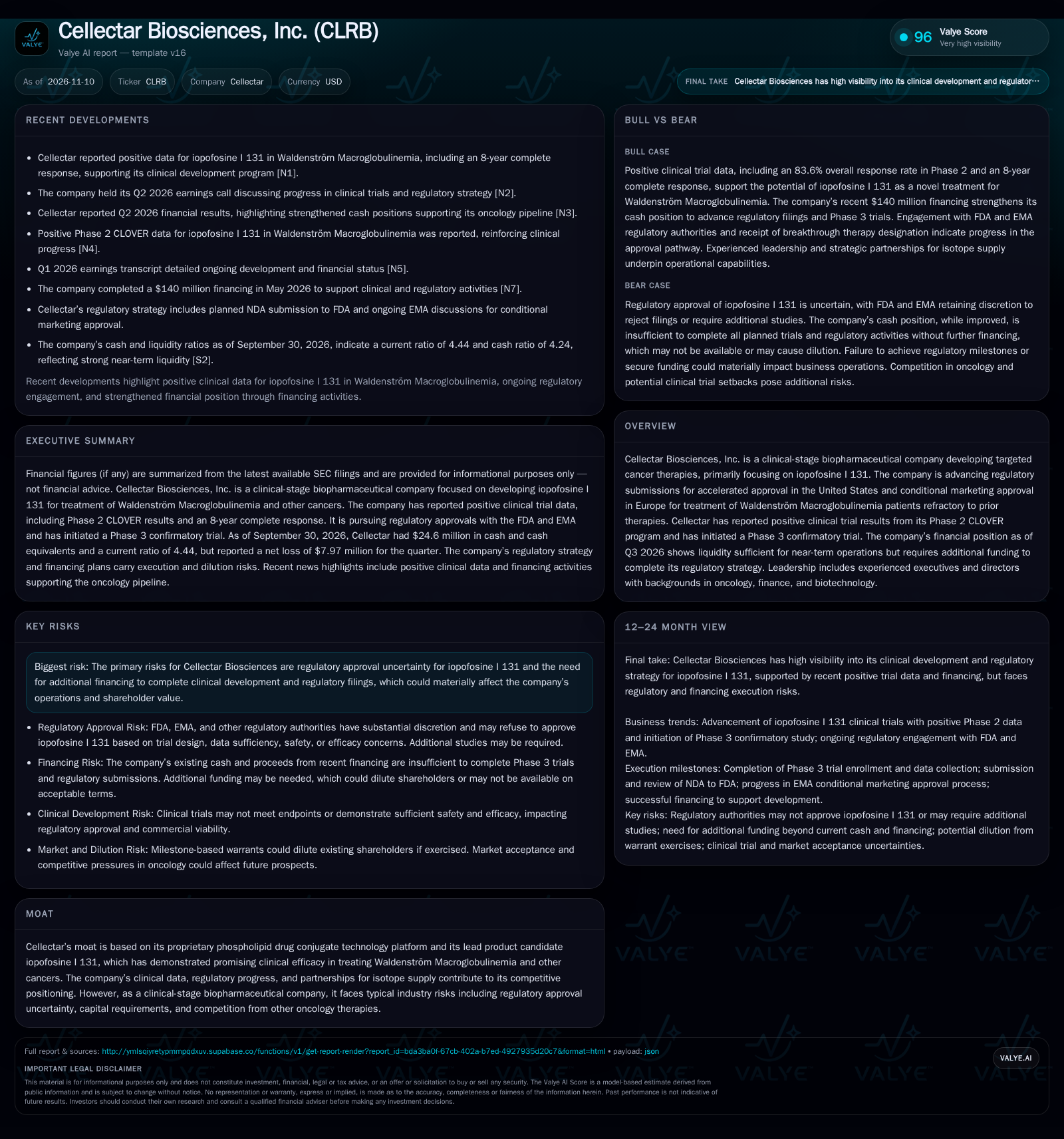
Cellectar is pushing iopofosine I 131 through late-stage clinical and regulatory milestones for Waldenström Macroglobulinemia, buoyed by positive efficacy data and a $24.6M reported cash balance. While its proprietary radioconjugate platform could carve out a differentiated niche, the company is exposed to classic biotech risks: binary regulatory outcomes, the need for additional capital, and dilution from milestone-driven warrants. The next 12-18 months hinge on regulatory feedback, Phase 3 trial initiation, and progress toward commercial readiness.
Cellectar Biosciences sits at a critical inflection point. Its lead candidate, iopofosine I 131, has delivered encouraging Phase 2 results in heavily pretreated Waldenström Macroglobulinemia, prompting regulatory engagement on both sides of the Atlantic and the launch of a Phase 3 confirmatory trial. The next 12-18 months will be defined by binary FDA/EMA decisions, financing execution, and Cellectar’s ability to carve out a defendable commercial position in the targeted radiopharmaceutical space.
Late-Stage Clinical and Regulatory Progress Defines the Near-Term Outlook
Cellectar’s lead asset, iopofosine I 131, posted an 83.6% overall response rate in Phase 2 for relapsed/refractory Waldenström Macroglobulinemia, including an 8-year complete response—a rare durability signal in this setting [N1] [S2]. The company is preparing to submit a New Drug Application to the FDA for accelerated approval and is in active discussions with the EMA regarding conditional marketing approval. However, net losses continue, and a recent milestone-based warrant program could add up to $105 million in new capital if exercised, at the cost of dilution to current shareholders [S2].
The Economics of Oncology Drug Development: Fixed Costs, Dilution, and Pivotal Value Creation
Cellectar’s business model is characteristic of clinical-stage biopharma: capital-intensive R&D, negative cash flow, and the prospect of a step-function value inflection tied to regulatory approval. The revenue model, if iopofosine I 131 is approved, would likely be a high-price, low-volume specialty oncology launch targeting patients who have failed two prior therapies, including BTK inhibitors. Margins in radiopharmaceuticals can be robust due to pricing power in rare diseases, but this is offset by complex manufacturing and logistics—particularly for short half-life isotopes. Cellectar’s long-term isotope supply deals may help de-risk production and distribution, but ultimate gross margins and commercial economics remain untested until launch.
[S2] The milestone-based warrants, if exercised, could provide substantial funding but would dilute current holders—underscoring the tradeoff between dilution and runway that defines the late-stage biotech financing playbook.
In addition to fixed R&D expenditures, Cellectar’s financial trajectory will be influenced by the scalability of its manufacturing processes. Radiopharmaceuticals require specialized facilities and logistics to manage short-lived isotopes, which can impose variable costs that scale with patient volume. If patient uptake grows faster than anticipated, operational leverage could improve, enhancing gross margins. Conversely, slower adoption or manufacturing inefficiencies could compress margins and necessitate further capital. Furthermore, reimbursement dynamics will critically affect net revenue; payers’ willingness to cover a high-cost, niche oncology therapy will depend on demonstrated cost-effectiveness and comparative clinical benefits versus existing treatments.
Differentiation in a Crowded Hematology Market: Platform, Efficacy, and Execution Risks
Cellectar’s competitive proposition rests on its proprietary phospholipid drug conjugate (PDC) platform, which aims to selectively deliver radiotherapy to malignant cells while sparing healthy tissue. This targeted approach, if clinically validated, could distinguish iopofosine I 131 from conventional chemotherapy, other radiotherapeutics, and newer cell therapies. However, the WM market is already served by multiple modalities, including BTK inhibitors, proteasome inhibitors, and monoclonal antibodies. Post-BTKi-refractory patients represent a high-need, niche segment, but competition for these late-line patients is likely to intensify as other targeted agents and radiopharmaceuticals advance.
Switching costs for oncologists are determined by efficacy, safety, and payer acceptance. The durability of response (as suggested by the 8-year CR) could be a differentiator, but broad adoption will depend on confirmatory Phase 3 data, regulatory labeling, and the ability to secure reimbursement in an increasingly cost-conscious oncology landscape. If iopofosine I 131’s platform proves adaptable to other hematologic or solid tumors, Cellectar could build a broader competitive moat—but this remains an unproven extension at present.
The competitive landscape for Waldenström Macroglobulinemia is evolving, with emerging therapies potentially altering treatment paradigms. Cellectar’s success will partly hinge on the timing of market entry relative to competitors’ launches and label expansions. If competitors secure earlier approvals or demonstrate superior efficacy or safety, Cellectar may face pricing pressure or limited market share. Additionally, the company’s ability to educate oncologists and payers about the unique benefits and logistics of a radioconjugate therapy will influence adoption rates. Strategic partnerships or collaborations could enhance market penetration by leveraging established commercial infrastructures or expanding indications, but these require careful negotiation to balance control, economics, and dilution.
How a Regulatory Win Could Unlock Value: Approval, Uptake, and Platform Leverage
If the FDA grants accelerated approval for iopofosine I 131 in relapsed/refractory WM, Cellectar could transition from a development-stage to a commercial-stage company, potentially capturing a first-mover advantage in this population. Uptake in the initial target segment could be rapid if the durability and depth of response seen in Phase 2 are confirmed in real-world use and/or Phase 3. Positive regulatory momentum may also facilitate EMA conditional approval, opening up the European market.
A successful launch could validate the PDC platform, positioning Cellectar for label expansions into additional indications or for business development activity (e.g., licensing, partnerships). The $105 million in potential warrant proceeds would provide firepower for commercial scaling or additional pipeline investment, albeit with dilution. Confirmation of this scenario would require regulatory approvals, strong initial launch metrics (patient starts, payor coverage), and evidence of platform extensibility beyond WM.
Navigating Binary Risk: Pivotal Trial, Funding Needs, and Gradual Progress
The most plausible outcome is that Cellectar spends the next 12-18 months advancing its Phase 3 trial, responding to regulatory feedback, and seeking additional capital to support ongoing development. NDA and CMA submissions may trigger review cycles, but approval is not guaranteed and may require further clinical data. Cash burn continues, with periodic dilutive financings likely as pivotal data and regulatory milestones approach.
In this scenario, Cellectar maintains operational continuity and preserves optionality, but value creation is gradual and remains highly sensitive to clinical and regulatory outcomes. Confirmation of this pathway would be continued enrollment in Phase 3, maintenance of adequate cash runway, and incremental regulatory progress without major clinical or financial setbacks.
Where the Thesis Breaks: Regulatory Setbacks, Financing Strain, and Shareholder Dilution
The primary risk is regulatory delay or rejection—if the FDA or EMA require additional studies or do not find the current data sufficient for approval, timelines and costs could escalate sharply. In a scenario where pivotal trial enrollment lags or safety/efficacy signals deteriorate, Cellectar could face a funding crunch before reaching value-creating milestones.
If new capital cannot be raised on favorable terms, or if milestone-based warrants are triggered at depressed share prices, existing shareholders could see significant dilution or the company could be forced into strategic alternatives under duress. Evidence of this scenario would include negative regulatory feedback, poor enrollment or trial discontinuation, and/or distressed financings.
Milestones and Metrics That Will Determine Cellectar’s Pivotal Value
Regulatory progress on NDA submission, acceptance, and review timelines for iopofosine I 131 in WM.
Initiation and pace of enrollment for the Phase 3 confirmatory trial in WM.
Cash burn rate and updated cash runway disclosures in subsequent quarterly filings.
Milestone-based warrant triggers: achievement of clinical, regulatory, or share price milestones that could result in warrant exercise and dilution.
Updates on EMA conditional marketing application and feedback from European regulators.
Real-world evidence of clinical benefit or safety signals—if disclosed—following any compassionate use or expanded access programs.
Partnership, licensing, or M&A activity that could supplement capital needs or validate the platform.
Disclaimer: This is research-only, informational analysis and not investment advice. It may include AI-generated interpretation and general industry context. Always verify important details using primary sources.

Comments