
T. Rowe Price Active Crypto ETF: The Stakes and Levers of Active Management in a New Crypto ETF Format
T. Rowe Price’s actively managed crypto ETF (TKNZ) brings an institutional approach to digital assets, leveraging model-driven selection and brand credibility.
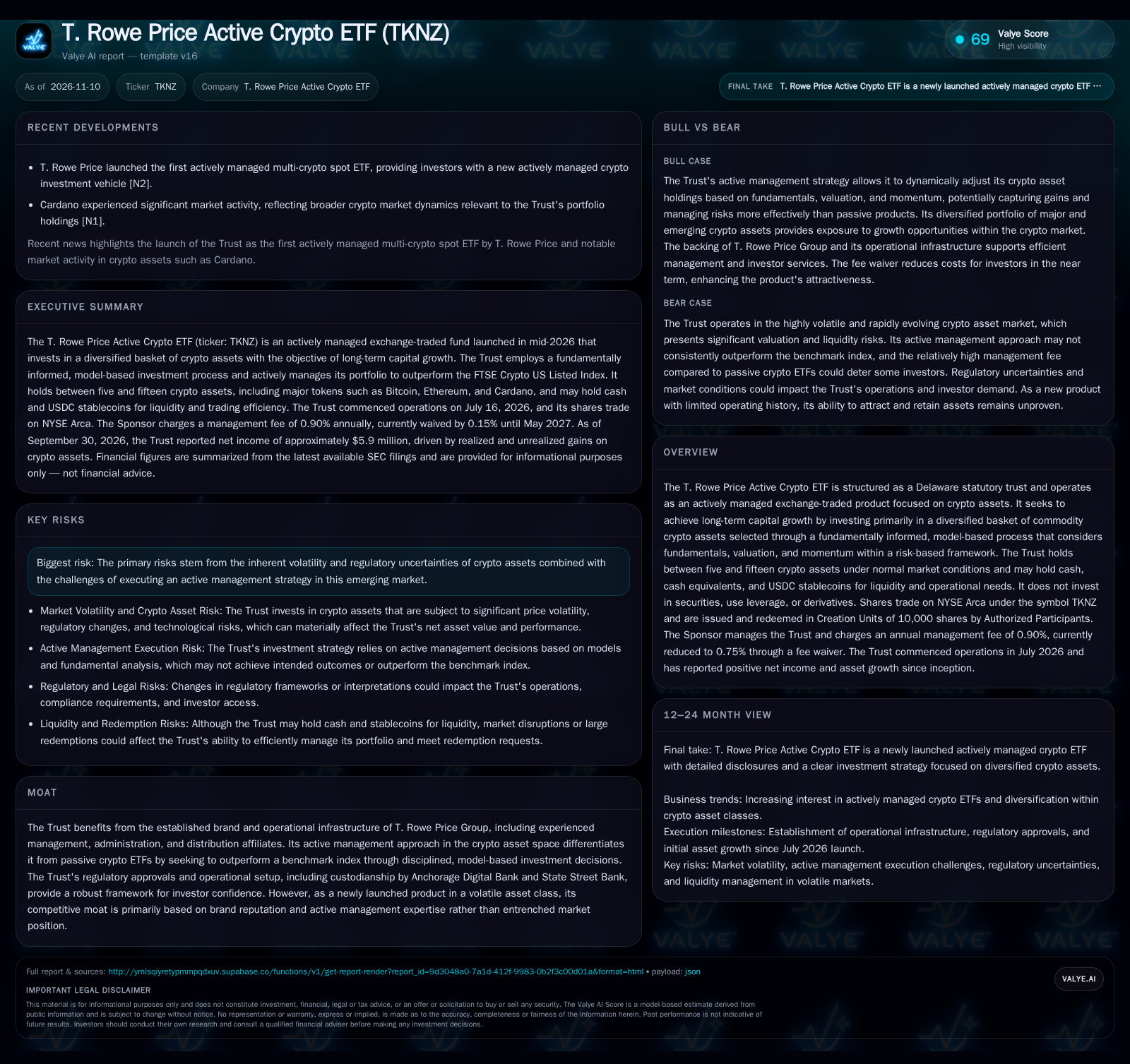
TKNZ is the first actively managed, multi-crypto spot ETF launched by T. Rowe Price, targeting long-term capital growth through a model-based allocation to 10 major crypto assets. Since its July 2026 inception, it has grown net assets from $15 million to $25.4 million and NAV per share from $25.00 to $33.45 as of September 30, 2026. The ETF’s ability to sustain asset growth and outperform passive benchmarks will hinge on its active management process, cost structure, and resilience to crypto market volatility and regulatory shifts. [S1] [N2]
T. Rowe Price’s Active Crypto ETF (TKNZ) marks a significant institutional entry into the crypto ETF landscape, offering investors a fundamentally driven, actively managed approach to a diversified basket of digital assets. Launched in July 2026, the fund has quickly grown in both assets and net asset value, underscoring early market appetite for actively managed crypto exposure. However, the ETF’s future trajectory will be shaped by its ability to deliver on the promise of active outperformance, justify its fee premium, and withstand the inherent volatility and regulatory uncertainty in the crypto asset class. The next phase will test both the resilience of its investment process and the depth of investor demand as the market for digital asset ETFs matures.
Early Asset Growth and NAV Appreciation Set the Stage
TKNZ commenced operations on July 16, 2026, as the first actively managed multi-crypto spot ETF in the U.S. market. The product has grown its net assets from $15 million at launch to $25.4 million as of September 30, 2026, with shares outstanding rising from 600,000 to 760,000. Over the same period, NAV per share increased from $25.00 to $33.45, capturing both market appreciation in its underlying crypto assets and net inflows from investors. The ETF currently holds 10 major crypto assets, including Bitcoin, Ethereum, and Solana, and reported net income of $5.9 million for its first partial quarter, driven largely by unrealized gains. These early results reflect both the volatility of crypto markets and initial investor interest in an active approach. [S1] [N2]
How Active Management Could Add Value in a Crypto ETF
TKNZ’s business model relies on earning a management fee (0.90%, net 0.75% until May 2027) on average daily net assets, with the potential to scale as assets under management (AUM) grow. Unlike passive crypto ETFs, TKNZ employs a fundamentally informed, model-based process to select and rebalance a diversified portfolio of 5-15 crypto assets. The fund’s economics are highly sensitive to AUM growth, as fixed operational costs are minimal—routine expenses are paid by the sponsor—and the management fee is the primary recurring expense. This structure creates operating leverage: incremental AUM translates directly into higher fee revenue with limited increase in expenses.
The ETF does not use leverage or derivatives, which limits risk but also constrains potential sources of outperformance to asset selection and portfolio allocation. Since the product does not invest in securities or commodities outside of crypto assets, its performance is closely tied to the volatility and directional moves of the crypto market. The ability to generate alpha (outperformance versus the FTSE Crypto US Listed Index) depends on the sponsor’s skill in rotating among assets, managing liquidity, and potentially exploiting inefficiencies or momentum within the crypto universe. If active management proves effective, the fee premium could be justified; if not, AUM growth may stall relative to lower-cost passive alternatives.
Brand, Structure, and Differentiation in a Crowded Crypto ETF Field
TKNZ’s primary competitive edge is the T. Rowe Price brand, which brings institutional credibility, operational robustness, and distribution reach to a nascent segment of the ETF market. Its active management differentiates it from the wave of passive spot crypto ETFs, which generally seek to track a single asset (like Bitcoin) or a static basket at lower cost. The ETF’s ability to hold multiple major and emerging tokens, rebalance actively, and potentially avoid underperforming assets could offer a performance advantage—if the investment process adds value.
However, the product faces counterforces: fee sensitivity among ETF investors, the efficiency and transparency of passive products, and the inherent challenge of consistently adding value in a volatile, informationally opaque market. Substitutes include single-asset spot Bitcoin and Ethereum ETFs, multi-asset passive crypto baskets, and direct crypto trading platforms. As more entrants launch similar products, differentiation will hinge on both realized track record and the sponsor’s ability to communicate process and risk management to a skeptical, cost-conscious audience.
Active Outperformance Drives Inflows and Expands the Category
The most favorable scenario is one where TKNZ’s active model consistently delivers outperformance relative to the FTSE Crypto US Listed Index and passive crypto ETFs, attracting inflows from both retail and institutional investors. This could occur if the manager’s asset selection and tactical rebalancing successfully navigate crypto market cycles, avoid major drawdowns, and capitalize on momentum or valuation dislocations. Sustained net inflows would drive AUM expansion, increasing management fee revenue and reinforcing the product’s visibility and perceived value.
Evidence that would confirm this scenario includes multi-quarter or annualized outperformance against the benchmark, positive net flows relative to passive peers, and potential narrowing of the fee waiver as the product scales. Conversely, underperformance, stagnant AUM, or a reversal of inflows would falsify this scenario and suggest limited appetite for active management in crypto ETFs.
Delivering Market Exposure with Moderate Tracking Error
The most plausible path is that TKNZ delivers market-like returns with moderate tracking error versus its benchmark, reflecting the inherent difficulty of generating consistent alpha in the crypto space. The ETF may attract a niche following among investors seeking a diversified, institutionally managed crypto allocation, but AUM growth could plateau if performance is similar to lower-fee passive alternatives. The fee waiver may need to be extended or made permanent to maintain competitiveness.
Confirmation would come from NAV performance closely tracking the benchmark, with modest net inflows and steady, though not spectacular, growth in assets. If disclosed, retention rates and churn among investors would help determine whether the product is perceived as a core or tactical holding. Falsification would be evidence of sustained outflows, persistent underperformance, or fee compression in the category that erodes economics for active managers.
Volatility, Regulatory Shocks, or Underperformance Undermine Traction
In an adverse scenario, TKNZ could suffer from a confluence of crypto market volatility, regulatory shocks, or sustained underperformance versus passive benchmarks. Large drawdowns in crypto prices could trigger rapid outflows, forcing the ETF to liquidate assets at unfavorable prices and potentially widen NAV discounts. Regulatory changes—such as new SEC restrictions on in-kind redemptions or crypto asset custody—could disrupt operations or investor access.
This scenario would be confirmed by sharp declines in NAV, AUM contraction, widening bid-ask spreads, or operational disruptions related to custody or redemptions. Additional evidence would include negative press around regulatory actions, persistent tracking error, or sponsor decisions to further lower fees or subsidize expenses to stem outflows.
Variables That Will Shape TKNZ’s Trajectory in Active Crypto ETF Management
Monthly and quarterly net flows into and out of TKNZ, as these will reveal whether investor interest is sustained beyond the launch period.
Relative NAV performance versus the FTSE Crypto US Listed Index and leading passive crypto ETFs—multi-quarter outperformance would validate the active approach.
Any disclosures of portfolio turnover or rebalancing frequency, which would shed light on the manager’s willingness to make dynamic allocation shifts.
The persistence and scope of the fee waiver beyond May 2027, as it will affect the ETF’s net cost versus competitors.
Regulatory developments affecting crypto ETF operations, such as SEC changes to custodial, redemption, or reporting requirements.
Liquidity metrics—such as bid-ask spreads, trading volumes, and premium/discount to NAV—which will affect investor usability, especially in volatile markets.
If disclosed, investor retention and churn data to assess whether TKNZ is being adopted as a core holding or used for tactical allocations.
Any material changes in the list of eligible crypto assets or the investment model, which could signal strategic pivots or responses to market evolution.
Disclaimer: This is research-only, informational analysis and not investment advice. It may include AI-generated interpretation and general industry context. Always verify important details using primary sources.

Comments