
PepGen: Advancing RNA Therapeutics for DM1—The Economics and Execution Stakes of a Single-Asset Biotech
PepGen’s lead candidate for myotonic dystrophy type 1 is progressing in clinical trials, backed by a sizeable liquidity buffer and recent clinical milestones. As a single-asset, pre-revenue biotech, the company’s long-term value depends on successful clinical outcomes, regulatory approvals, and the ability to convert pipeline innovation into a sustainable business.
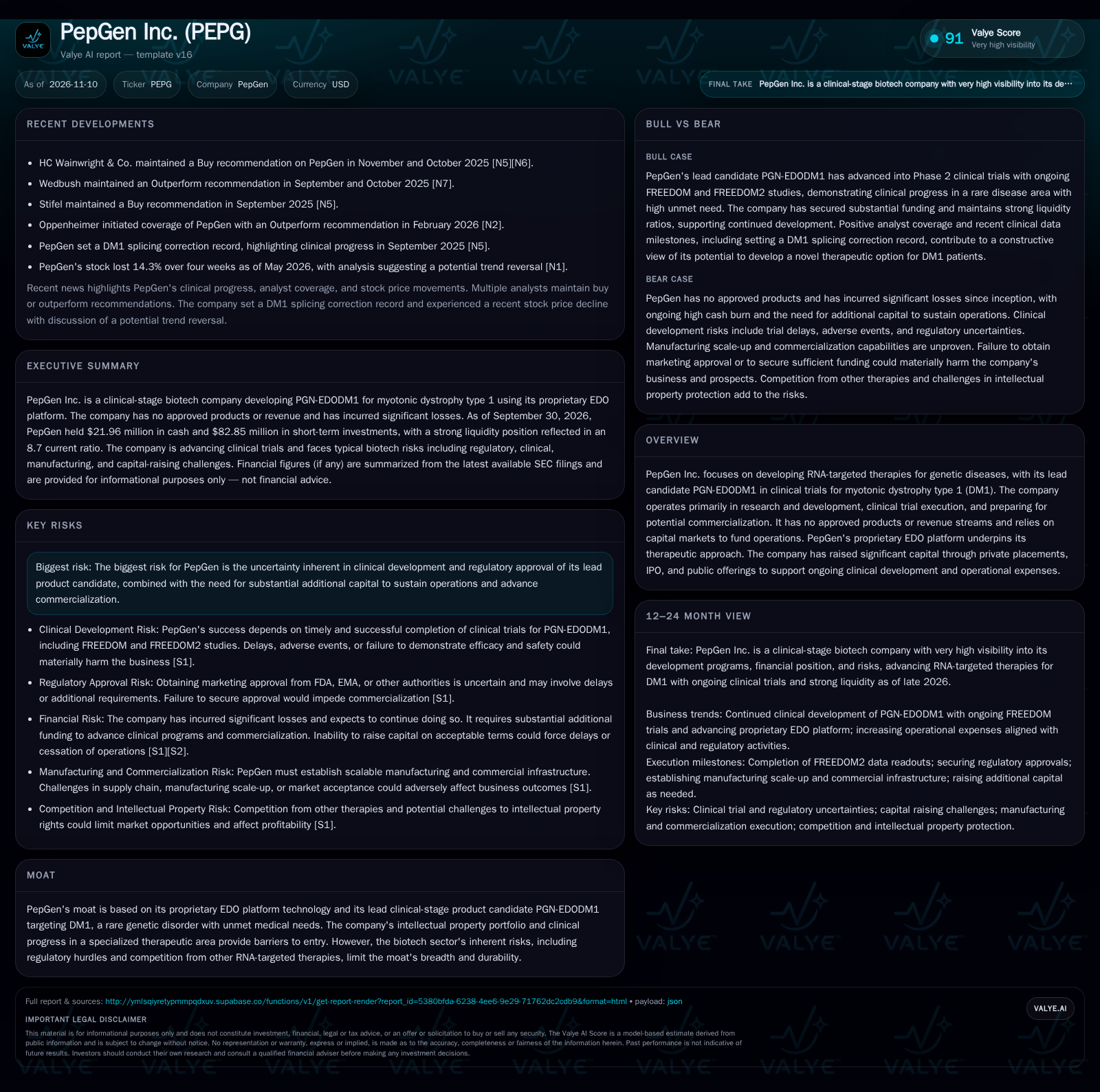
PepGen is a clinical-stage biotech with no commercial products, focused on RNA-targeted therapies for DM1. Its lead candidate, PGN-EDODM1, is in ongoing clinical trials, and the company holds $104.41 million in liquid assets as of September 30, 2026. Major risks include clinical and regulatory uncertainty, manufacturing scale-up, and the need for further capital. Recent clinical milestones and strong analyst coverage provide positive signals, but the path to commercialization remains uncertain. [S1] [S2] [N2] [N5] [N6] [N7]
PepGen Inc. is a clinical-stage biotechnology company singularly focused on developing RNA-targeted therapies for rare genetic disorders, with its lead candidate PGN-EDODM1 advancing in clinical trials for myotonic dystrophy type 1 (DM1). While recent clinical milestones and positive analyst coverage suggest momentum, PepGen’s long-term outcome hinges on the successful navigation of clinical, regulatory, and commercial execution hurdles typical for pre-commercial biotechs.
PepGen’s Position: Clinical Milestones, Liquidity Buffer, and the Stakes of a Single-Asset Pipeline
PepGen’s business is defined by its status as a clinical-stage biotech with no approved therapies or product revenue to date. Its lead program, PGN-EDODM1, is in ongoing clinical development targeting myotonic dystrophy type 1 (DM1), with notable progress including a recent record in DM1 splicing correction [S1] [N5]. As of September 30, 2026, the company reported $21.96 million in cash and $82.85 million in short-term investments, totaling $104.41 million in liquid assets, and a current ratio of 8.7, indicating reported liquidity position [S2]. This financial position is the result of sequential capital raises, including $107.6 million net proceeds from a 2025 public offering [S1]. However, PepGen has accumulated significant losses—$89.7 million net loss in 2025 and a $361.1 million deficit—reflecting the high cash burn typical of clinical-stage biotech operations [S1]. The company’s fate is tightly linked to the outcome of ongoing FREEDOM and FREEDOM2 clinical trials, and its ability to secure additional capital as development progresses.
How PepGen’s Economics Could Unfold: Cash Burn, Development Costs, and the Commercialization Hurdle
PepGen’s current economics are dominated by R&D and clinical trial expenses, with no product revenue and a reliance on external capital to fund operations [S1]. The company expects expenses to rise as it accelerates clinical development, scales manufacturing, and undertakes regulatory activities. The cost structure is highly fixed in the near term, with minimal variable costs until commercialization. If PGN-EDODM1 demonstrates efficacy and safety, and regulatory approval is secured, the economics will shift dramatically: the company could face substantial upfront launch investments in manufacturing, sales, and market access. Pricing power in rare disease markets is often high, but payor scrutiny and the need to demonstrate therapeutic value can constrain realized prices. The capital intensity of late-stage development and launch means PepGen will almost certainly require additional funding before breakeven, whether from additional equity raises, strategic partnerships, or licensing. Operating leverage could be significant if PGN-EDODM1 achieves commercial success, as manufacturing scale could yield margin expansion, but this is highly contingent on both regulatory and market acceptance.
Proprietary Platform Versus Emerging Rivals: Barriers and Threats in RNA Therapeutics for DM1
PepGen’s competitive positioning is anchored by its proprietary EDO platform and intellectual property portfolio, with a focus on DM1—a rare disease with high unmet need [S1]. Barriers to entry arise from the complexity of RNA-targeted drug development, know-how, and patent protection. However, the durability of these barriers is limited by the rapid pace of innovation in RNA therapeutics and the potential for competing approaches, including antisense oligonucleotides, gene therapy, and other RNA-modulating technologies. PepGen’s moat is further complicated by its reliance on licensed intellectual property, which, if lost or challenged, could undermine exclusivity [S1]. Competitor categories include both established rare disease biotech firms and emerging RNA-targeted therapy developers, many of whom may have deeper pipelines or stronger commercialization capabilities. The question is whether PepGen’s platform demonstrates a differentiated efficacy and safety profile in DM1 sufficient to secure regulatory approval, market access, and patient/provider adoption before others establish a commercial presence.
What Success Looks Like: Clinical Validation Drives Regulatory Approval and Attracts Strategic Partners
The favorable scenario for PepGen hinges on PGN-EDODM1 delivering compelling efficacy and safety data in the ongoing FREEDOM and FREEDOM2 trials, setting a new bar for DM1 treatment. If these clinical milestones are achieved, the company could secure regulatory approval, opening the door to first-mover advantage in a rare disease market with high unmet need. Such a breakthrough would likely attract strategic partnerships or acquisition interest, providing access to commercial infrastructure and potentially non-dilutive funding. Strong pricing and reimbursement in rare diseases could yield attractive margins, and positive data could also validate the EDO platform for other indications. Evidence that would confirm this scenario includes: statistically significant clinical trial results, regulatory acceptance (e.g., FDA/EMA filings or designations), and public announcements of partnership or licensing deals. Falsification would come from missed endpoints, major safety signals, or regulatory setbacks.
Clinical Progress with Persistent Uncertainties: The Most Likely Mid-Term Outcome
The most plausible near- to mid-term outcome is that PepGen continues to advance PGN-EDODM1 through clinical development, incurring rising expenses and gradually depleting its liquidity buffer. Modest but positive clinical progress may support additional capital raises, potentially at dilutive terms, to fund late-stage trials and initial commercialization infrastructure. The company could secure regulatory feedback or early access designations, but approval is unlikely before further pivotal data are available. Manufacturing scale-up and commercial readiness efforts would begin, but with continued uncertainty around ultimate market adoption and pricing. Falsification would be signaled by major clinical setbacks, inability to raise funds, or the emergence of superior competitive therapies in DM1.
When Clinical or Capital Risk Materializes: The Mechanisms of Failure for a Pre-Revenue Biotech
The adverse scenario centers on clinical or regulatory setbacks—such as failure to meet primary endpoints, safety concerns, or extended delays in the FREEDOM trials—undermining confidence in PGN-EDODM1 and the EDO platform. In this case, PepGen’s liquidity would be rapidly consumed without a viable path to revenue, forcing a halt to development, restructuring, or distressed asset sales. Capital markets could close to further funding, or new capital might only be available on highly dilutive terms. The loss of critical intellectual property licenses, or the emergence of a superior therapy from a competitor, could accelerate decline. Evidence of this scenario would include negative clinical readouts, regulatory rejections, material cash burn with little progress, failed capital raises, or public disclosure of strategic reviews or layoffs.
Milestones to Clarify PepGen’s Trajectory in RNA Therapeutics
Clinical trial readouts from FREEDOM and FREEDOM2 for PGN-EDODM1: Statistically significant efficacy and safety data would be decisive.
Regulatory feedback or milestones (e.g., FDA/EMA designations, acceptance of filings): Early signals of regulatory momentum would support the bull thesis.
Announcements of strategic partnerships, licensing, or non-dilutive funding: These would validate external confidence and support commercialization.
Progress toward manufacturing scale-up and supply chain readiness: Evidence of concrete steps here would mitigate operational risk.
Intellectual property developments, including new patents or license disputes: Any loss or strengthening of IP position would be highly material.
Emergence of new or superior RNA-targeted therapies for DM1 by competitors: Tracking the competitive pipeline is essential for anticipating market dynamics.
If disclosed, planned timelines for pivotal trial completion and commercial launch: Clarity on these milestones would sharpen scenario analysis.
Disclaimer: This is research-only, informational analysis and not investment advice. It may include AI-generated interpretation and general industry context. Always verify important details using primary sources.

Comments