
MNTN, Inc.: Platform Leverage in Connected TV Performance Marketing Faces Customer and Market Volatility
MNTN, Inc. has built a performance-driven connected TV advertising platform, underpinned by reported liquidity position and modest profitability. The company’s dependence on CTV adoption and customer concentration sets the stage for both outsized growth potential and pronounced vulnerability to shifts in digital advertising spend.
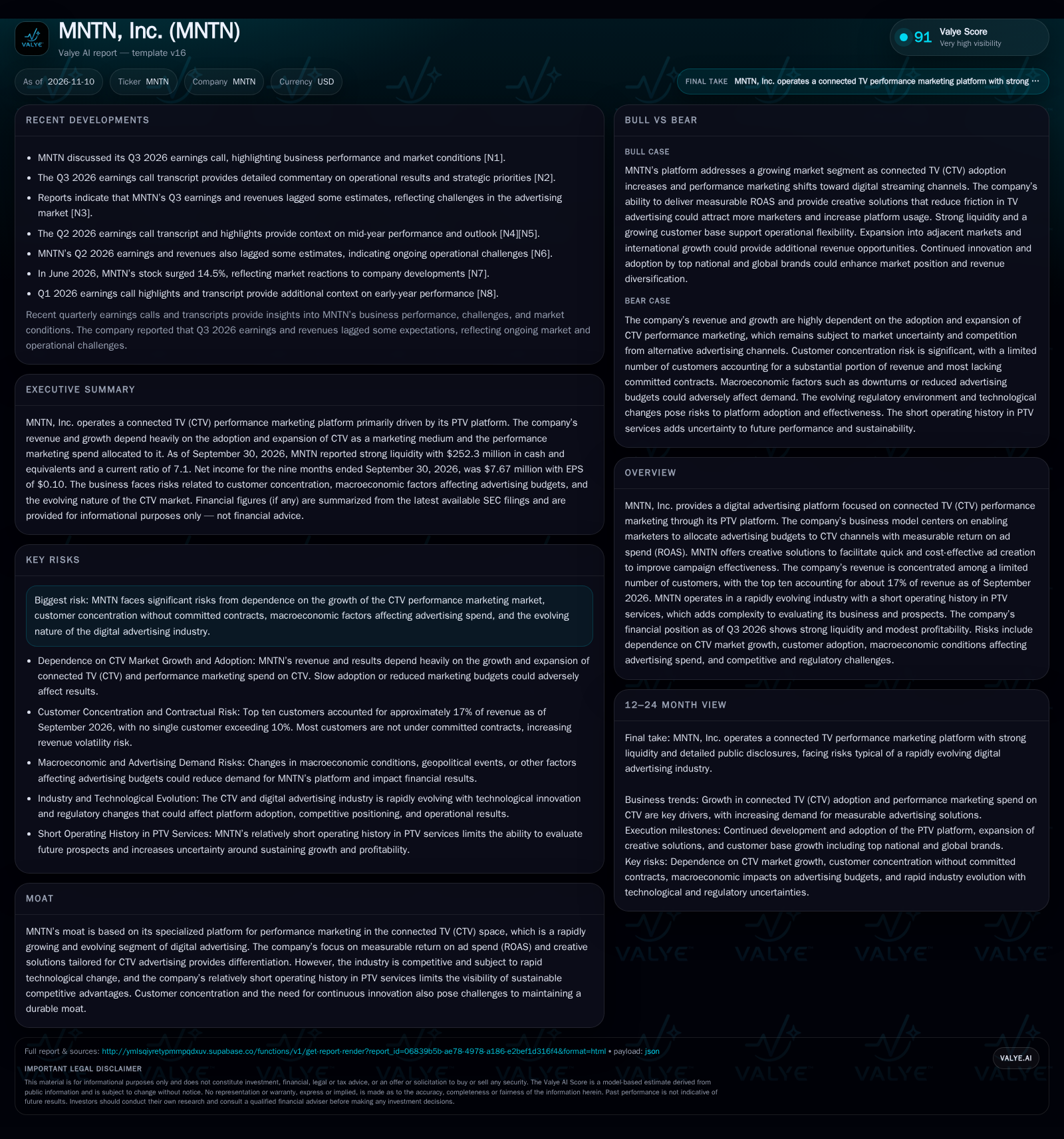
MNTN, Inc. operates a platform for connected TV (CTV) performance marketing, with the PTV platform as its core offering. As of September 2026, the company reported $252.3 million in cash, a current ratio of 7.1, and net income of $7.67 million, but also revealed significant customer concentration and a reliance on uncommitted contracts. Future growth hinges on broader CTV adoption and the ability to diversify its customer base, while operational risks include macroeconomic headwinds and rapid industry evolution. [S2]
MNTN, Inc. sits at the intersection of connected TV (CTV) growth and the shift to performance-driven digital advertising. With a platform designed to simplify and measure TV ad campaigns, the company is well-positioned to benefit from the migration of marketing budgets from linear TV to streaming environments. [S2]
Recent Performance Anchored by Profitability but Underscored by Revenue Concentration
MNTN, Inc. reported $7.67 million in net income for the nine months ended September 30, 2026, with basic and diluted EPS of $0.10. The company reported cash and liquidity metrics for the period; these figures do not by themselves establish operating runway, investment capacity, financial flexibility, or financing capacity. This points to a business model vulnerable to abrupt shifts in client spending or churn, amplifying revenue volatility risk. Recent quarters saw earnings and revenues lag analyst estimates, reflecting both market headwinds and potentially transient operational challenges. [S2] [N3] [N6]
Revenue Drivers, Cost Structure, and the Leverage of Platform Economics in CTV
MNTN generates revenue by enabling marketers to allocate advertising budgets to connected TV (CTV) channels via its PTV platform, with an emphasis on measurable return on ad spend (ROAS). The core economic engine is likely a mix of platform fees, media spend commissions, and creative services—though the commercial mechanics are not specified in the report. If the platform operates as a take-rate on campaign spend, MNTN’s revenue scales with CTV advertising budgets rather than a fixed subscription base, exposing it to cyclicality and macro-driven budget contractions.
The company’s creative solutions, which promise quicker and more cost-effective ad production, may allow for higher customer throughput and lower per-campaign friction, supporting volume-driven scalability. Fixed costs are likely dominated by software development, infrastructure, and sales, while variable costs scale with campaign volume and support. The high gross margin potential of software platforms could offer operating leverage as top-line grows, but the lack of committed contracts and customer churn risk may result in revenue swings that limit margin expansion.
Capital needs appear limited at present, given the reported liquidity position and modest profitability. However, any future push into international markets, major product expansion, or significant customer acquisition efforts could require renewed investment.
Navigating a Fragmented and Rapidly Evolving CTV Advertising Ecosystem
MNTN’s differentiation stems from its focus on performance marketing within the CTV channel—a space where traditional brand advertising is giving way to measurable, digital-first campaigns. The platform’s promise of measurable ROAS and creative tools addresses marketer demand for accountability and speed. However, the competitive landscape is crowded, with both large digital advertising platforms and specialized CTV ad tech firms competing for share. Entrants range from established digital giants to pure-play CTV platforms and cross-channel programmatic providers.
Key sources of potential competitive advantage include proprietary data, integration with streaming inventory, and the ability to deliver creative at scale with minimal friction. Yet, these advantages are not insurmountable; competitors can invest in similar tooling or leverage broader data ecosystems. Customer switching costs may be moderate if campaign performance does not exceed alternatives or if integrations are not deeply embedded in marketer workflows.
The company's short operating history in PTV services limits the visibility of a durable moat, and the lack of committed contracts further exposes it to competitive churn. Regulatory shifts or changes in data privacy could also alter the basis of competition, especially if performance metrics become harder to attribute or target.
Network Effects and CTV Market Expansion Drive Sustained Outperformance
If connected TV continues to outpace linear and other digital channels in advertising growth, MNTN stands to capitalize as performance marketers shift budgets toward measurable, high-ROI platforms. Upside could be realized if the company’s PTV platform becomes a default choice for brands seeking frictionless, accountable CTV campaigns—either through superior creative tools, better campaign outcomes, or exclusive inventory access.
A virtuous cycle may develop if growing advertiser demand attracts more publishers and inventory partners, expanding the platform’s data and targeting capabilities. As more campaigns are executed and measured on the platform, MNTN could refine its algorithms, improve ROAS, and drive customer retention, potentially leading to higher wallet share and lower churn. Expansion into adjacent media channels or international markets could further amplify growth.
Evidence confirming this scenario would include a rising number of active customers, increased share of wallet from existing clients, disclosures of multi-year or committed contracts, and sustained margin expansion alongside top-line growth. Demonstrable improvements in customer ROAS and references to exclusive or differentiated inventory would further support the thesis.
Performance Tied to Cyclical Ad Spend and Gradual Customer Diversification
The most plausible outcome is continued, albeit uneven, growth as CTV adoption increases, but with results closely tracking broader advertising cycles and macroeconomic conditions. MNTN is likely to experience pronounced seasonality, with strong Q4s and softer Q1s, and revenue volatility tied to the absence of long-term contracts and customer concentration.
Incremental platform improvements and creative solutions could help retain and gradually expand the customer base, but competitive pricing pressure and the ease of switching may cap margin upside. The company may continue to post modest profitability, supported by a reported balance sheet position, but without a breakthrough in customer commitment or platform stickiness, operating leverage will be limited.
Confirmation of this scenario would be evident in steady but lumpy revenue growth, periodic earnings misses or beats aligned with advertising cycles, and continued reliance on a concentrated but slowly diversifying customer roster. Falsification would come from either a rapid loss of key customers or the announcement of new, large-scale, multi-year contracts that materially change revenue visibility.
Customer Churn and Market Slowdown Expose Platform Fragility
The downside risk centers on a combination of macroeconomic contraction (reducing overall ad spend), slowing CTV adoption, and heightened competition eroding MNTN’s customer base. Because most customers are not locked into committed contracts, a shift in budget priorities or dissatisfaction with campaign performance could result in rapid revenue attrition.
If larger digital advertising platforms or CTV-focused competitors introduce superior offerings—whether through price, features, or inventory access—MNTN could face margin compression and an uphill battle to retain its top customers. Regulatory changes (such as tighter data privacy rules) could also diminish the company’s ability to deliver performance-based outcomes, further weakening its value proposition.
This scenario would be confirmed by sequential declines in revenue, public disclosures of major customer losses or reduced spend, and widening net losses despite continued liquidity. Additional evidence would include increased customer acquisition costs, negative operating leverage, or management commentary highlighting intensifying competition and market headwinds.
Milestones and Metrics That Will Define MNTN’s CTV Platform Trajectory
Quarterly changes in the concentration of revenue among the top ten customers—greater diversification would reduce volatility risk; increased concentration would heighten vulnerability.
The proportion of revenue under committed, multi-year contracts (if disclosed), which would signal improved visibility and customer stickiness.
Trends in active customer count and average campaign spend per customer, as indicators of both platform adoption and depth of client relationships.
Gross margin and operating margin evolution, especially in relation to top-line growth and customer mix.
Evidence of customer retention rates or churn (if disclosed), providing insight into platform value and competitive moat.
Updates on the pace of CTV advertising market growth versus alternative digital channels.
Management commentary on regulatory developments affecting data usage and measurement in CTV advertising.
Any expansion into new geographies, media channels, or product categories that could alter the growth trajectory or capital requirements.
Disclaimer: This is research-only, informational analysis and not investment advice. It may include AI-generated interpretation and general industry context. Always verify important details using primary sources.

Comments