
EquipmentShare’s Digital Ambitions: Platform Leverage, Capital Strategy, and the Realities of Construction Tech Adoption
EquipmentShare’s transition to public markets in 2026 marks a pivotal moment for its tech-enabled rental model. With robust revenue, insider alignment, and a capital-light fleet strategy, the company seeks to digitize construction workflows through its T3 platform. The question is whether its technology edge and financial posture can overcome entrenched industry habits, margin pressure, and fierce competition from established industrial peers.
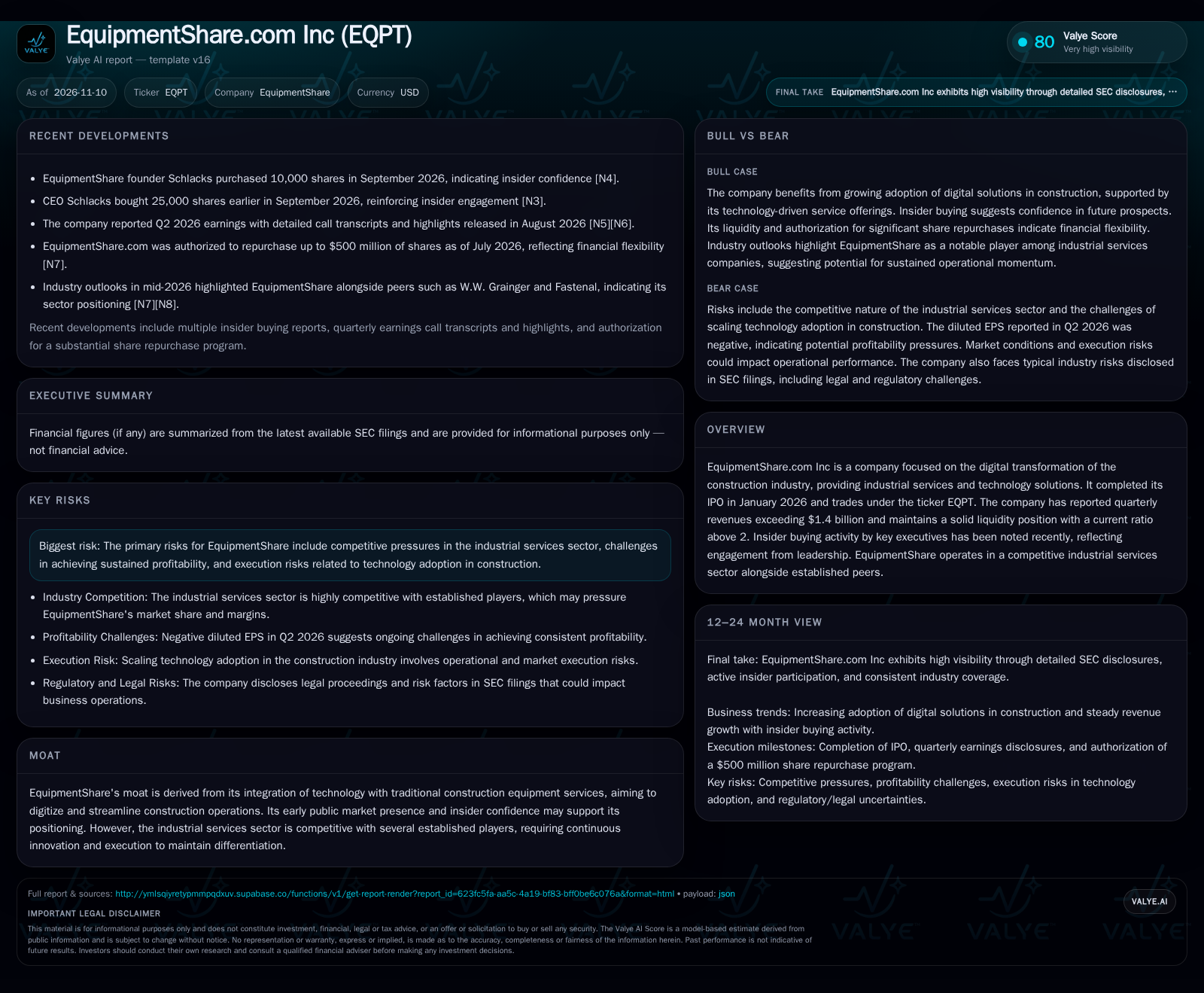
EquipmentShare, now publicly traded as EQPT, reported $1.468 billion in Q3 2026 revenue and net income of $20 million, supported by a reported current ratio and meaningful insider buying. Its T3 platform underpins a tech-driven rental and asset management business, but challenges remain in scaling profitability and defending share in a fragmented, price-sensitive sector. The company’s capital-light OWN Program and $500 million buyback authorization highlight potential financial flexibility, but execution risks and industry competition remain central to the thesis. [S2] [N3] [N4] [N7]
EquipmentShare.com Inc’s 2026 debut on Nasdaq comes at a time when construction is under intense pressure to digitize operations and boost productivity. With more than $1.4 billion in quarterly revenue, a deep asset base, and a cloud-driven platform (T3) aimed at transforming jobsite management, EquipmentShare aspires to bridge the gap between traditional equipment rental and next-generation industrial IoT.Insider transaction activity was reported in the cited source; this activity does not by itself establish insider confidence. Yet, as the company scales its capital-light OWN Program and seeks to convert digital adoption into higher margins, it faces the realities of entrenched industry behaviors, volatile construction cycles, and formidable peers. The core question: can EquipmentShare’s tech-enabled model deliver durable economic advantage in a crowded, cost-conscious sector?
Recent Financial Performance and Strategic Moves Define the Post-IPO Landscape
EquipmentShare reported $1.468 billion in revenue and $20 million in net income for Q3 2026, reflecting substantial operating scale as a newly public company. The company’s $500 million share repurchase authorization, coupled with notable insider buying—including founder and CEO share purchases—signals both potential financial flexibility and leadership alignment with shareholders. At the operational level, EquipmentShare is running 408 full-service branches, 9 dealerships, and 31 hardware stores across 45 states, with a managed fleet exceeding 302,000 pieces and extensive deployment of its T3 asset-tracking platform. However, Q2 2026 saw negative diluted EPS, underscoring that consistent profitability remains a work in progress. [S2] [N3] [N4] [N7]
How Digital Integration and Capital-Light Fleet Models Could Reshape Construction Economics
EquipmentShare’s core revenue drivers are equipment rental, retail hardware sales, and value-added digital services through its T3 platform. The business model blends traditional rental economics—where utilization rates, asset turnover, and maintenance costs drive margins—with a technology overlay that could enable premium pricing or higher customer retention if workflow digitization proves sticky. A key innovation is the OWN Program, which allows EquipmentShare to lease back equipment from third-party owners under revenue-sharing arrangements, limiting upfront capital outlays and supporting rapid fleet expansion. This capital-light approach may improve return on assets and reduce the cyclicality typically associated with large fleet investments.
The T3 platform, deployed across 430,000 trackers, aims to could create network effects by integrating fleet, people, and materials management—potentially embedding EquipmentShare deeper into customer workflows. If successful, this could shift some revenue from pure hardware rental to higher-margin software and analytics. However, the construction sector’s notorious price sensitivity and slow tech adoption suggest that pricing power and digital upsell will need time to mature. Fixed costs are significant due to branch infrastructure and technology investment, but the mix of owned, leased, and revenue-shared equipment introduces flexibility. Operating leverage could expand if digital adoption accelerates and utilization rates remain high, but margin volatility is a risk if competitive pricing undermines yields or if tech-enabled services fail to command a premium.
Technology-Enabled Differentiation Meets Entrenched Rivals and Industry Inertia
EquipmentShare operates in a fragmented, competitive landscape dominated by established industrial rental and supply companies such as W.W. Grainger, MSC Industrial, and Fastenal. Its differentiation hinges on the integration of the T3 platform with rental and asset management, aiming to turn equipment into a digitally managed service rather than a commodity. This tech-enabled approach could, in theory, could raise switching costs and deepen customer engagement if data-driven insights reduce downtime or improve jobsite productivity.
However, established competitors have scale, purchasing power, and entrenched customer relationships—advantages that can pressure EquipmentShare’s margins and slow its market share gains. Many industrial services incumbents have responded by developing their own digital platforms, narrowing the gap. In addition, the construction sector’s conservative culture and fragmented procurement can slow the adoption of new technology solutions, even when operational benefits are clear. The OWN Program’s capital-light structure may allow EquipmentShare to scale faster than pure asset owners, but it also introduces reliance on third-party capital and the need to maintain robust partner economics.
If Digital Adoption Accelerates, Platform Economics Could Drive Margin Expansion
In the most favorable scenario, EquipmentShare leverages its T3 platform to become the default digital backbone for mid- to large-scale construction firms, driving higher retention and recurring revenue from analytics, workflow management, and integrated asset tracking. The capital-light OWN Program enables rapid geographic and fleet expansion without balance-sheet strain, while internal operational efficiency improves through scale. As customers realize tangible productivity and cost benefits from T3, EquipmentShare could achieve pricing power not just in rentals but also in software subscriptions and value-added services.
Evidence that would support this scenario includes: accelerating growth in T3-enabled contracts, rising proportion of revenue from digital services, stabilization or improvement in gross and operating margins, and clear customer case studies demonstrating productivity gains. Additional insider buying and continued buyback activity would reinforce management’s confidence. A useful metric would be the rate of T3 adoption among legacy and new customers, if disclosed. Confirmation would also come from industry commentary or competitive responses acknowledging EquipmentShare’s growing digital influence.
The Most Likely Outcome: Gradual Share Gains and Incremental Margin Progress in a Difficult Sector
The most plausible trajectory for EquipmentShare is steady, but moderate, share gains as it expands its branch network and deepens T3 platform penetration among existing customers. Rental revenue remains the primary driver, with digital services as a growing but still secondary contributor.
Under this scenario, the company posts consistent revenue growth and improves profitability incrementally, but operating leverage is offset by ongoing investment in technology and sales. Gross margins may improve slightly as digital services scale, but the business remains exposed to construction cycles and competitive pricing. Confirmation would include continued growth in fleet under management, stable or gradually improving net income, and progress on digital upsell metrics. Falsification would be sustained negative EPS, lagging T3 adoption, or evidence that digital offerings are not differentiating the customer experience.
Competitive Price Wars and Slow Tech Adoption Could Trap EquipmentShare in Low-Margin Territory
In a bearish scenario, the combination of intense price competition and slow customer uptake of digital solutions limits EquipmentShare’s ability to command a premium for its T3-enabled offerings. Larger incumbents leverage their scale to undercut pricing or match digital features, eroding EquipmentShare’s margin advantage. The capital-light OWN Program, while limiting direct asset risk, exposes the company to partner renegotiations or unfavorable lease terms if utilization falters. Legal or regulatory issues, as disclosed in filings, could further distract management or add cost.
Indicators for this scenario include: declining or stagnant gross margins, persistent negative net income or EPS, rising customer churn, and evidence that OWN Program economics are deteriorating (such as increased partner payouts or lower renewal rates). Slowing growth in T3-enabled equipment or branch expansion, or negative industry commentary on EquipmentShare’s differentiation, would also support the downside view.
Testing the EquipmentShare Thesis: Where Platform Adoption, Margins, and Execution Will Show Up Next
The proportion of revenue directly attributable to digital services and T3 platform subscriptions, if disclosed, would help assess the durability of technology-driven differentiation.
Quarterly trends in gross and operating margins will reveal whether digital and capital-light strategies are translating into improved profitability.
Growth in the number of trackers and assets under T3 management—especially among new versus legacy customers—will indicate traction in digital adoption.
Utilization rates for both owned and OWN Program fleet segments, if disclosed, would clarify capital efficiency and operational leverage.
Branch network expansion and market share in key geographies should be monitored for evidence of successful scaling.
Insider transaction activity was reported in the cited source; this activity does not by itself establish insider confidence.
Disclosure of customer churn or retention rates, particularly for tech-enabled offerings, would help test whether EquipmentShare is building real switching costs.
Resolution or escalation of any disclosed legal or regulatory proceedings could materially affect operational focus or cost structure.
Disclaimer: This is research-only, informational analysis and not investment advice. It may include AI-generated interpretation and general industry context. Always verify important details using primary sources.

Comments