
NIKA Pharmaceuticals: Exclusive Rights, Capital Strain, and the Test of Execution in Specialty Pharma
NIKA Pharmaceuticals has amassed a portfolio of exclusive rights for novel pharmaceuticals and supplements, and now holds an 80% stake in a European manufacturing venture. Yet, with no revenue, a substantial net loss, and a pronounced liquidity gap, the company’s ability to convert intellectual property into commercial traction and financial stability remains uncertain.
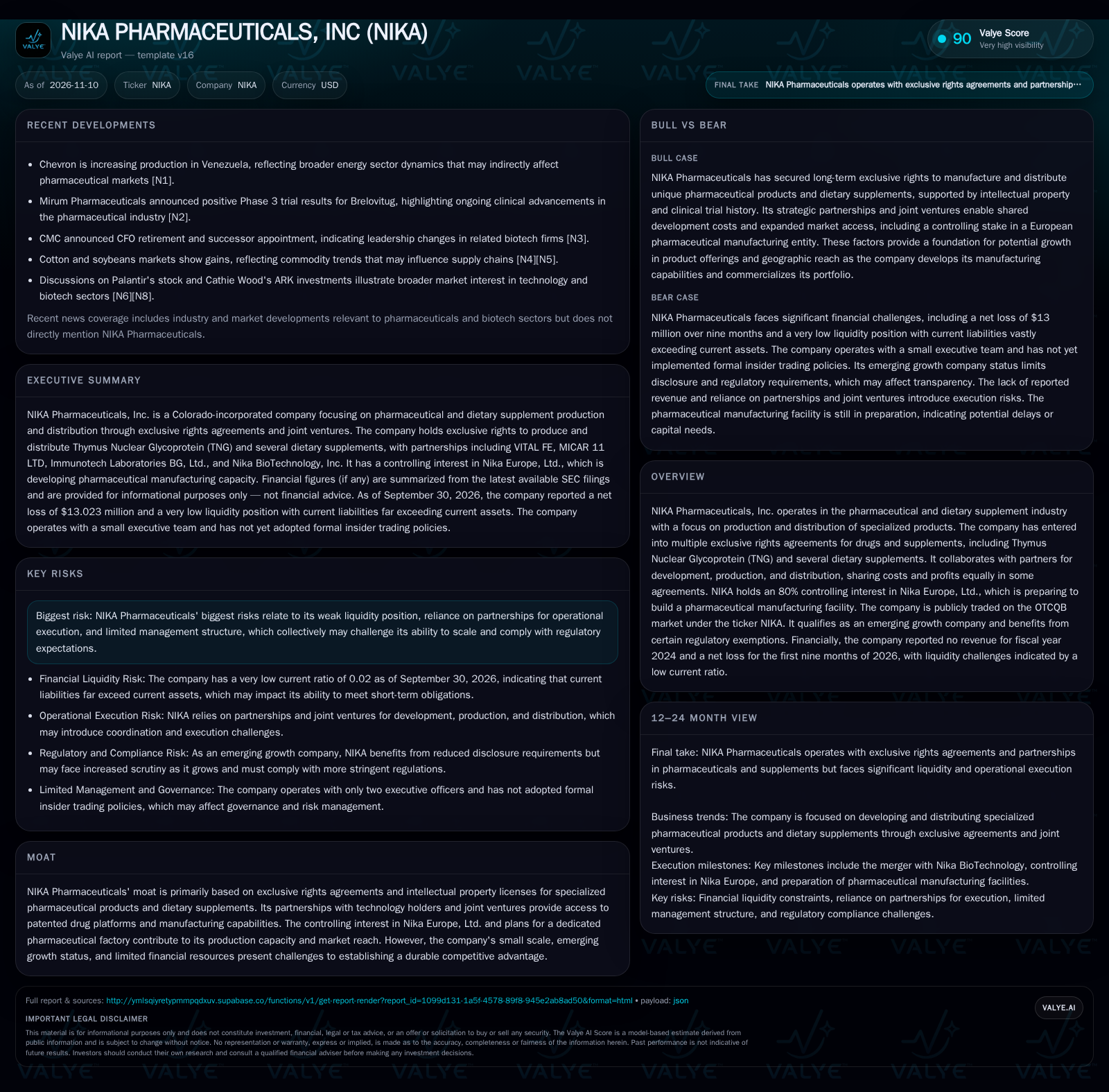
NIKA Pharmaceuticals controls exclusive rights to several pharmaceutical and supplement products and owns a majority stake in a planned European manufacturing facility. However, the company has reported no revenue, a significant net loss, and a severe liquidity shortfall as of September 2026. The core question is whether NIKA can bridge the execution gap and secure the capital and operational scale needed to commercialize its portfolio before financial pressures become existential. [S2]
NIKA Pharmaceuticals, Inc. has built a foundation of exclusive rights to promising pharmaceuticals and supplements, alongside a controlling stake in a soon-to-be-built European manufacturing facility. This structure offers theoretical access to high-margin specialty markets and a pathway to vertical integration. However, as of late 2026, NIKA’s balance sheet reveals acute financial stress: no reported revenue, a substantial net loss, and current liabilities dwarfing assets. The next phase hinges on whether NIKA can surmount operational bottlenecks and capital constraints to become a viable player—before its financial runway is exhausted.
Exclusive Rights and Manufacturing Ambitions Collide with a Severe Liquidity Gap
NIKA Pharmaceuticals has accumulated a suite of exclusive rights agreements for both pharmaceutical (notably Thymus Nuclear Glycoprotein, or TNG) and dietary supplement products, many with 15-year terms. These rights, alongside collaboration agreements with technology holders and a controlling stake in Nika Europe, Ltd., position the company as a potential aggregator and developer in specialty pharma and supplements. However, as of September 30, 2026, the company reported zero revenue for 2024, a net loss of $13.023 million for the first nine months of 2026, and just $352,000 in cash versus $349 million in current liabilities—a current ratio of 0.02. The manufacturing facility in Europe remains in the preparation phase, and the company’s ability to fund its completion or to commercialize its IP assets is not yet demonstrated. These facts underscore both the scale of NIKA’s ambitions and the gravity of its current financial and operational constraints. [S2]
How NIKA’s Business Model Could Create—or Destroy—Shareholder Value
NIKA’s business model is built on the acquisition of exclusive rights to specialty pharmaceuticals and supplements, with a focus on eventual in-house or partnered manufacturing and distribution. In theory, the company could generate revenue through direct sales, out-licensing, or co-development deals, with profit-sharing mechanisms in place for certain partnerships. Specialty pharma products such as TNG, if proven and commercialized, can command high gross margins due to pricing power and limited direct competition. Dietary supplements, while subject to greater commoditization, can yield attractive margins if differentiated by clinical evidence or regulatory exclusivity.
However, the economics are currently hypothetical: with no reported revenue, the fixed costs of maintaining rights, developing manufacturing infrastructure, and supporting a small executive team have resulted in persistent net losses. The company reported cash and liquidity metrics for the period; these figures do not by themselves establish operating runway, investment capacity, financial flexibility, or financing capacity. If the manufacturing facility becomes operational, the company could benefit from substantial operating leverage—turning fixed costs into scalable profits if sales materialize. Conversely, if commercialization lags or regulatory or technical hurdles arise, fixed costs could drive deeper losses and force dilution or asset sales.
NIKA’s Moat Relies on Exclusivity, but Scale and Execution Remain Unproven
NIKA’s potential advantage rests on its portfolio of long-term exclusive rights and intellectual property licenses. In principle, these agreements could provide a defensible moat if the underlying assets—such as TNG or the Inactivated Pepsin Fraction platform—prove clinically and commercially viable. The joint ventures and profit-sharing agreements may enable broader market access and risk-sharing with technology originators.
Yet, the company currently lacks the scale, operational infrastructure, and financial resources to fully exploit these advantages. In specialty pharmaceuticals, barriers to entry include not just IP, but also regulatory approvals, manufacturing quality, and commercialization capabilities. Competitors in the specialty pharma and supplement categories range from large established drug companies with global distribution to nimble biotech startups with deeper capital reserves. NIKA’s reliance on external partnerships and joint ventures introduces coordination risks and may limit its control over timelines and outcomes. Without evidence of successful product launches or manufacturing execution, the durability of NIKA’s competitive position remains speculative.
If NIKA Secures Funding and Executes Manufacturing, Commercialization Could Unlock Significant Value
The most favorable scenario for NIKA involves successfully raising the capital required to complete its European manufacturing facility, gaining regulatory approvals for its lead pharmaceutical and supplement products, and executing on commercialization. If the company can launch TNG or other differentiated products with clinical backing, it could generate high-margin revenue streams and validate its exclusive rights strategy. Operating leverage would improve as fixed manufacturing costs are spread over greater sales volume, and profit-sharing from joint ventures could supplement direct sales.
Confirmation of this scenario would require disclosures of new funding rounds, debt or equity placements, or strategic partnerships with commercial-stage pharmaceutical companies. Regulatory milestones—such as successful product registrations or approvals—would signal progress. Early sales contracts, distribution agreements, or licensing deals would further support the case. If NIKA can report meaningful revenue and progress on manufacturing capacity within the next 12-24 months, the upside thesis strengthens.
Commercialization Delays and Funding Uncertainty Define the Most Likely Near-Term Outcome
Given the current financial position and lack of reported revenue, the most plausible scenario for NIKA is a period of continued operational and funding challenges. The company may seek to bridge its liquidity gap through additional equity or debt offerings, but the scale of current liabilities relative to assets could make terms unfavorable or highly dilutive. Manufacturing facility development may be delayed or staged, with incremental progress contingent on raising capital or forming new strategic alliances.
In this scenario, NIKA remains primarily a holder of exclusive rights, with commercialization timelines extending beyond the next 12-24 months. Execution risk remains high, and the company’s survival likely depends on its ability to secure bridge financing or attract partners willing to invest in product development. Evidence confirming this scenario would include further net losses, continued absence of revenue, and announcements of financing efforts without corresponding commercial progress.
Acute Liquidity Crisis or Failure to Execute Could Force Asset Sales or Restructuring
The adverse scenario for NIKA is dominated by its severe liquidity shortfall. If the company is unable to raise sufficient capital or convert rights into revenue-generating agreements rapidly, it faces the risk of defaulting on obligations, being forced to sell its exclusive rights or equity interests at distressed prices, or entering restructuring. Delays or failures in building the manufacturing facility could erode partner confidence and further limit funding options.
Signs confirming this scenario would include creditor actions, disclosures of going concern warnings, asset sales, or a sharp reduction in headcount or operational activity. A lack of progress on product approvals, manufacturing buildout, or new commercial agreements would reinforce the downside case. Inability to meet short-term obligations could result in loss of control over key assets or joint ventures.
Milestones That Will Determine Whether NIKA Can Bridge the Gap from IP to Revenue
Updates on the status and timeline for completion of the Nika Europe, Ltd. pharmaceutical manufacturing facility would help test whether vertical integration and production capability are achievable.
Announcements of new financing rounds, debt placements, or strategic investments are critical for assessing whether NIKA can address its acute liquidity needs.
Regulatory filings or approvals for Thymus Nuclear Glycoprotein (TNG) and other lead products would be tangible markers of commercial progress.
Evidence of initial product sales, licensing deals, or distribution agreements would indicate the company is moving beyond the pre-revenue stage.
If disclosed, details on the economics of NIKA’s profit-sharing and joint venture arrangements would clarify potential revenue and margin structure.
Disclosures regarding changes in executive leadership, governance policies, or board composition may signal shifts in operational strategy or risk management.
Statements or filings regarding going concern risk, asset impairments, or restructuring would indicate heightened financial distress.
A useful metric would be the cash burn rate and projected runway under current operating assumptions, if provided in future filings.
Disclaimer: This is research-only, informational analysis and not investment advice. It may include AI-generated interpretation and general industry context. Always verify important details using primary sources.

Comments