
Paysign’s Prepaid Platform: Scaling Patient Affordability and Defending Niche Payment Markets
Paysign’s record-setting Q3 2026 revenue, expanding patient-affordability business, and deep penetration in plasma donor payments underscore its evolving economics and competitive position. The company’s next phase hinges on sustaining growth in healthcare-adjacent verticals while navigating regulatory and operational dependencies.
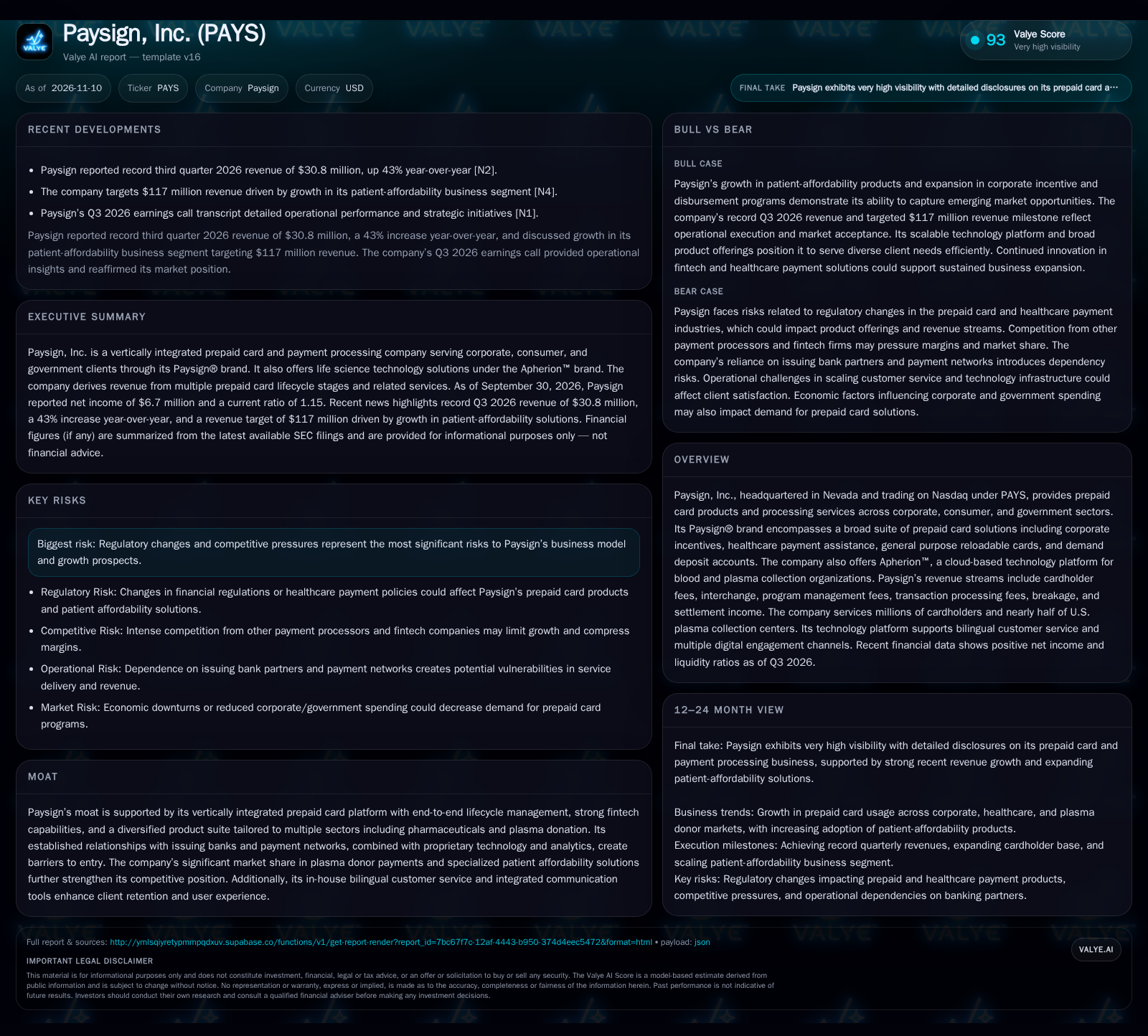
Paysign reported a 43% year-over-year revenue jump in Q3 2026, driven by growth in patient-affordability solutions and strong performance in prepaid card programs. With 8.4 million cardholders across 670 programs and a major share of the plasma payment market, Paysign’s vertically integrated model offers revenue diversity—but exposes it to regulatory and competitive threats. The company’s ability to scale niche healthcare payments while defending margins and managing partner dependencies will determine its long-term trajectory. [S1] [N2] [N4]
Paysign, Inc. stands at a critical inflection point as its prepaid card and payment processing platform posts record revenue growth and broadens its reach in healthcare and corporate segments. By embedding itself in plasma donor compensation and patient-affordability programs, Paysign has carved out defensible niches, but now faces the challenge of scaling these businesses against mounting regulatory scrutiny and intensifying competition. The company’s near-term trajectory will be shaped by its ability to leverage its technology platform, diversify its revenue streams, and manage operational dependencies that could test its resilience in the evolving fintech landscape.
Record Revenue and Expanding Healthcare Verticals Shape Paysign’s 2026 Outlook
Paysign reported third quarter 2026 revenue of $30.8 million, marking a 43% year-over-year increase, and is targeting $117 million in annual revenue largely driven by its patient-affordability segment expansion. This acceleration signals both demand for healthcare-adjacent payment solutions and Paysign’s operational execution. The company now supports approximately 8.4 million cardholders across 670 programs, with a particularly strong position in the plasma payment vertical, serving about 48% of U.S. and Puerto Rican plasma collection centers. The company reported cash and liquidity metrics for the period; these figures do not by themselves establish operating runway, investment capacity, financial flexibility, or financing capacity. These facts highlight both Paysign’s ability to drive top-line growth and the centrality of the patient-affordability and plasma segments to its business model. [S1] [S2] [N2] [N4]
Revenue Streams and Margin Levers in Prepaid and Healthcare Payment Ecosystems
Paysign’s economics derive from a multi-pronged revenue model: cardholder fees, interchange, program management fees, transaction and claims processing, breakage, and settlement income. This blend enables the company to capture value at various points in the prepaid card lifecycle. The prepaid card business typically features a mix of fixed infrastructure costs—technology platform, compliance, customer service—and variable costs tied to transaction volume and card issuance. As Paysign scales cardholder and transaction counts, incremental transaction and management fees can yield operating leverage, provided that customer support and regulatory costs do not rise commensurately.
The patient-affordability and plasma donor solutions—especially via the Apherion™ platform—introduce additional software-like revenue streams, such as licensing, hosting, and consulting fees. These can carry higher gross margins than traditional card processing, contingent on adoption and integration depth with healthcare partners. However, the durability of these economics depends on Paysign’s ability to maintain its value proposition amid pricing pressure from larger payments incumbents and evolving regulatory requirements for healthcare reimbursements and donor compensation.
Capital intensity remains moderate compared to legacy banks, but the business does require ongoing investment in compliance, fraud prevention, and platform upgrades. [S1] [S2]
Defensible Niches and the Challenge from Fintech Scale Players
Paysign’s strongest competitive foothold is in specialized verticals—most notably plasma donor payments, where it services nearly half the market. This niche focus could increase switching friction for healthcare and life science organizations, as integration with clinical workflows and compliance requirements can favor established relationships. The company’s vertically integrated platform and broad product suite (from corporate rewards to healthcare reimbursement) allow it to tailor solutions for diverse clients, potentially reducing churn and increasing cross-sell opportunities.
However, Paysign faces intensifying competition from both established payment processors and new fintech entrants targeting prepaid, healthcare, and government disbursement markets. Larger competitors may enjoy lower unit costs, greater regulatory resources, and broader distribution networks, enabling them to compete aggressively on price or bundle services. The risk is that commoditization could erode Paysign’s program management and interchange margins, especially in non-niche segments.
Technology substitution is also a threat: direct-to-bank digital disbursements, real-time payment networks, or embedded finance solutions offered by larger platforms could reduce the need for dedicated prepaid cards. Paysign’s moat thus depends on deep vertical integration, regulatory expertise, and the stickiness of its healthcare and donor payment relationships rather than generic scale or pricing advantages. [S1]
Accelerated Adoption of Patient-Affordability Solutions Drives Margin Expansion
The most favorable scenario for Paysign is that its patient-affordability business segment continues to outpace expectations, fueled by rising demand from pharmaceutical manufacturers, clinical trial sponsors, and healthcare providers seeking streamlined reimbursement and assistance platforms. If Paysign can further penetrate these high-value segments—where regulatory complexity and integration requirements are high—it could command premium pricing for its Apherion™ software and associated services.
This would manifest as sustained double-digit revenue growth, improving gross margins as software and licensing revenue outpaces lower-margin cardholder fees, and further expansion of the cardholder base. Confirmation would come from continued record-setting quarterly revenue, increasing contribution from patient-affordability and life science technology fees, and evidence of new multi-year customer wins or deeper integrations with top-tier healthcare organizations. A falsification would be stagnation in the patient-affordability segment or visible pricing compression in reported margins. [N2] [N4]
Sustained Growth in Core Verticals Amid Incremental Margin Pressure
The most plausible trajectory is that Paysign maintains solid revenue growth—driven by incremental expansion in plasma donor payments, healthcare reimbursement, and corporate incentive programs—while facing moderate pressure on margins due to competition and compliance costs. The company continues to add cardholder programs at a steady pace, retains its market share in plasma payments, and gradually increases its footprint in healthcare and pharmaceutical reimbursement.
Margins may modestly compress as larger payment processors compete on price and as regulatory compliance expenses rise, but Paysign’s vertical focus and integrated technology platform enable it to defend its niche. Confirmation would be continued growth in cardholder count, stable or rising average revenue per program, and gross margin stability. Falsification would include material market share loss in core verticals, a sharp uptick in operating expenses, or declining renewal rates from major healthcare or plasma clients. [S1] [N1]
Regulatory Shifts and Banking Partner Disruptions Undermine Growth
Adverse outcomes could materialize if regulatory changes—such as new caps on interchange fees, restrictions on donor compensation, or heightened compliance mandates in healthcare payments—significantly reduce Paysign’s addressable market or increase operating costs. Additionally, if one of Paysign’s issuing bank partners or payment network providers were to exit the prepaid market or alter terms unfavorably, Paysign could face abrupt program disruptions, client attrition, or increased costs to transition accounts.
This scenario would likely be evidenced by flat or declining revenue, shrinking cardholder counts, and margin compression as regulatory and operational burdens rise. Early warning signs would include negative commentary on regulatory developments, loss of major plasma or healthcare clients, or public disclosure of partner instability. A falsification would be the absence of such regulatory or partner shocks and continued expansion in regulated healthcare verticals. [S1]
Milestones and Frictions That Will Confirm or Challenge Paysign’s Healthcare Payment Thesis
Quarterly patient-affordability segment revenue growth and its percentage of total revenue, if disclosed, as an indicator of success in higher-margin healthcare payments.
Changes in the number of plasma collection centers served and Paysign’s market share in plasma donor payments, which would signal competitive dynamics in its strongest vertical.
Average revenue per cardholder program and trends in cardholder fees versus software/licensing income, clarifying mix shift and margin trends.
Gross margin and operating margin movement, revealing the impact of scale, pricing, and compliance costs.
Retention rates or renewal activity with major healthcare and plasma clients, if disclosed, as a proxy for switching frictions and competitive pressure.
Commentary or disclosures regarding regulatory changes affecting prepaid, healthcare, or donor payment products.
Dependence on and developments with issuing bank partners and payment networks, including any partner concentration or contract renewal risks.
R&D or technology platform investment levels, which would indicate Paysign’s commitment to maintaining product differentiation and compliance readiness.
Disclaimer: This is research-only, informational analysis and not investment advice. It may include AI-generated interpretation and general industry context. Always verify important details using primary sources.

Comments