
Texas Precious Metals Trust: Assessing Value Amid Minimal Disclosure and Uncertain Business Model
With only a quarterly net income figure and no available detail on operations, sector, or cash flow, Texas Precious Metals Trust presents an extreme case of information opacity. Investors must rely on scenario analysis and industry inference to gauge possible business models, economics, and risks.
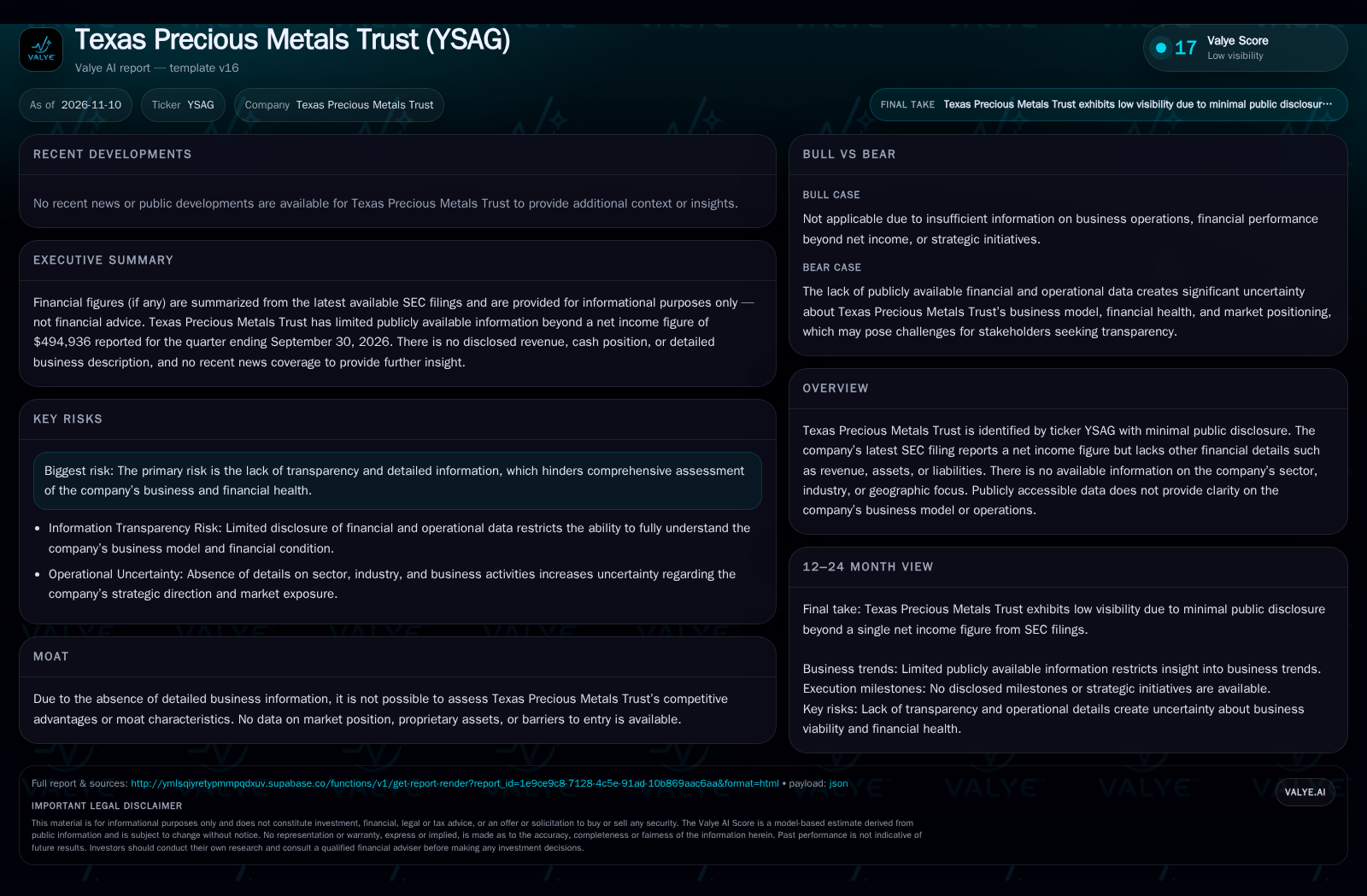
Texas Precious Metals Trust (YSAG) reported quarterly net income of $494,936 as of September 2026, but offers no public information on its revenue, assets, sector, or business model. The lack of disclosure forces analysis to focus on plausible structural scenarios—such as precious metals custodianship, fund structure, or trust management—while highlighting significant transparency risks and the need for future disclosure as a test of viability and value.
Texas Precious Metals Trust (YSAG) stands out not for what it reveals, but for what it withholds. With only a quarterly net income figure—$494,936 disclosed for Q3 2026—and no accompanying data on its revenue, assets, liabilities, or sector, the company offers minimal visibility into its actual operations or risk profile. This rare level of opacity forces a scenario-driven approach, where investors and analysts must draw on industry frameworks and inferential logic to assess possible business structures, economic models, and value creation mechanisms. Until further detail is provided, the trust exemplifies the analytical challenges of investing in entities with sparse disclosure and uncertain business foundations.
What We Know: Net Income, but No Operational Visibility
The only concrete data point available for Texas Precious Metals Trust is a net income of $494,936 for the quarter ending September 30, 2026. There is no disclosure of revenue, asset base, liabilities, sector affiliation, or geographic footprint. This absence of detail means there is no direct evidence of the company’s business model, product or service offering, or operating mechanics. The reported net income, while positive, cannot be contextualized in terms of margin, capital base, or recurring vs. nonrecurring activity. As a result, the company’s value proposition, sustainability, and risk profile remain opaque.
Possible Revenue Models and Economic Structures
With no business description, plausible economic structures for Texas Precious Metals Trust must be inferred from the name and industry conventions. Common models under a 'Precious Metals Trust' banner include custodianship of physical gold or silver, operation as a closed-end or exchange-traded commodity trust, or management of pooled physical assets on behalf of investors. In these models, revenue is typically generated from management fees, storage fees, or transaction spreads. Cost structures are often dominated by fixed custodial, insurance, and compliance costs, with variable expenses tied to transaction volume or asset inflows/outflows.
If the trust operates as a pass-through entity holding physical metal, its net income could reflect management fees net of operating expenses, with profitability hinging on scale (assets under custody) and fee rate. Alternatively, if the trust engages in proprietary trading or lending activities, income could be more volatile and dependent on market conditions. The lack of balance sheet data precludes analysis of leverage, capital adequacy, or asset-liability matching—crucial for assessing risk and resilience in commodity-linked entities.
Capital requirements vary widely by model: a pure custodian or passive trust may require limited working capital, while any entity engaging in leveraged trading, lending, or derivative exposure would need robust capital buffers and liquidity management.
Market Positioning: Hypothetical Advantages and Pressures
Absent disclosure, Texas Precious Metals Trust’s competitive stance can only be framed against archetypal peer groups—such as established precious metals ETFs, physical bullion custodians, or regional trust structures. In these markets, scale, brand reputation, security, cost efficiency, and regulatory compliance drive competitive advantage. Larger, transparent trusts benefit from operating leverage, lower per-unit costs, and greater investor trust, while smaller or opaque entities struggle to attract and retain assets.
Potential counterforces include competition from low-fee ETFs, direct bullion ownership, digital gold products, and alternative stores of value. If Texas Precious Metals Trust relies on a niche or regional client base, it may face less direct competition but also limited growth prospects and higher customer concentration risk. Without evidence of proprietary technology, unique storage solutions, or regulatory privileges, any claim to a durable moat remains speculative.
Switching frictions in the trust and custodianship business are typically low for institutional clients but can be higher for retail holders, depending on transferability and tax treatment. However, without disclosure of client composition, it is impossible to assess retention dynamics.
If Transparency Arrives: Pathways to Recognition and Asset Growth
The most constructive scenario for Texas Precious Metals Trust is that future disclosures reveal a well-capitalized, efficiently managed trust with a meaningful asset base and recurring fee income. In this case, current net income could reflect a scalable business with strong client relationships and operational discipline. If the trust is able to demonstrate audited assets under custody, clear management fee structures, and robust compliance, investor confidence could increase, potentially leading to asset inflows and improved valuation multiples.
Evidence that would confirm this scenario includes: detailed SEC filings disclosing assets, revenues, and client composition; independent audits or third-party verifications of metal holdings; and announcements of new client mandates or partnerships. If the company can establish a track record of transparency and operational reliability, it could plausibly attract institutional and retail clients seeking a trusted, efficient vehicle for precious metals exposure.
Sustained Opacity with Modest Activity: The Most Likely Status Quo
The most plausible near-term outcome is continued minimal disclosure, with the trust maintaining a narrow set of operations sufficient to produce modest, positive net income but with limited scale and visibility. In this scenario, Texas Precious Metals Trust may serve a small, possibly regional client base, with operations focused on custodianship or trust management. The business may remain stable but marginal—unable to scale meaningfully or command premium valuation due to lack of transparency and limited investor trust.
Confirmation of this scenario would come from ongoing sparse filings, static or slowly changing net income figures, and absence of material news or business development. Falsification would require either a significant increase in disclosure (revealing scale or strategic expansion) or a marked deterioration in financial results, suggesting operational or compliance issues.
Risks of Hidden Liabilities or Erosion Without Disclosure
The adverse scenario is that the lack of disclosure masks operational weakness, deteriorating economics, or latent liabilities. Without transparency on assets, revenue sources, or business mechanics, there is a risk that positive net income is nonrecurring, the result of one-off events, or not sustainable. Hidden risks may include regulatory noncompliance, legal disputes, asset impairment, or dependence on a single client or transaction.
Confirmation of this scenario would include abrupt swings to net losses, restatement of prior results, regulatory actions, or sudden management turnover. Any news of litigation, asset write-downs, or inability to meet client redemptions would further erode confidence. Sustained opacity itself may drive away clients and counterparties, compounding the risk of an adverse spiral.
What Could Clarify Value and Test Resilience for Texas Precious Metals Trust
Any disclosure of assets under custody or management, which would illuminate the trust’s scale and potential fee base.
Revelation of revenue composition—whether income is derived from recurring fees, one-off transactions, or other sources (if disclosed).
Breakdown of operating expenses and evidence of fixed versus variable cost structure, to assess operating leverage.
Audited financial statements or third-party verification of physical metal holdings, supporting trustworthiness and solvency.
Regulatory filings or statements clarifying the company’s compliance posture and jurisdictional risk.
Evidence of client concentration risk or diversification—such as major customer disclosures or loss of large accounts.
Announcements of strategic partnerships, new product launches, or entry into new markets that could indicate growth potential.
Disclosure of management structure, governance practices, or insider transactions, to provide insight into alignment and oversight.
Disclaimer: This is research-only, informational analysis and not investment advice. It may include AI-generated interpretation and general industry context. Always verify important details using primary sources.

Comments