
Editas Medicine: Clinical Gene Editing Progress Confronts Patent Uncertainty and Commercial Realities
Editas Medicine is advancing its first-in-human gene-editing therapy for hypercholesterolemia, supported by substantial liquidity and a narrowing net loss. However, the company’s future hinges on resolving high-stakes patent disputes and converting clinical milestones into durable commercial opportunity.
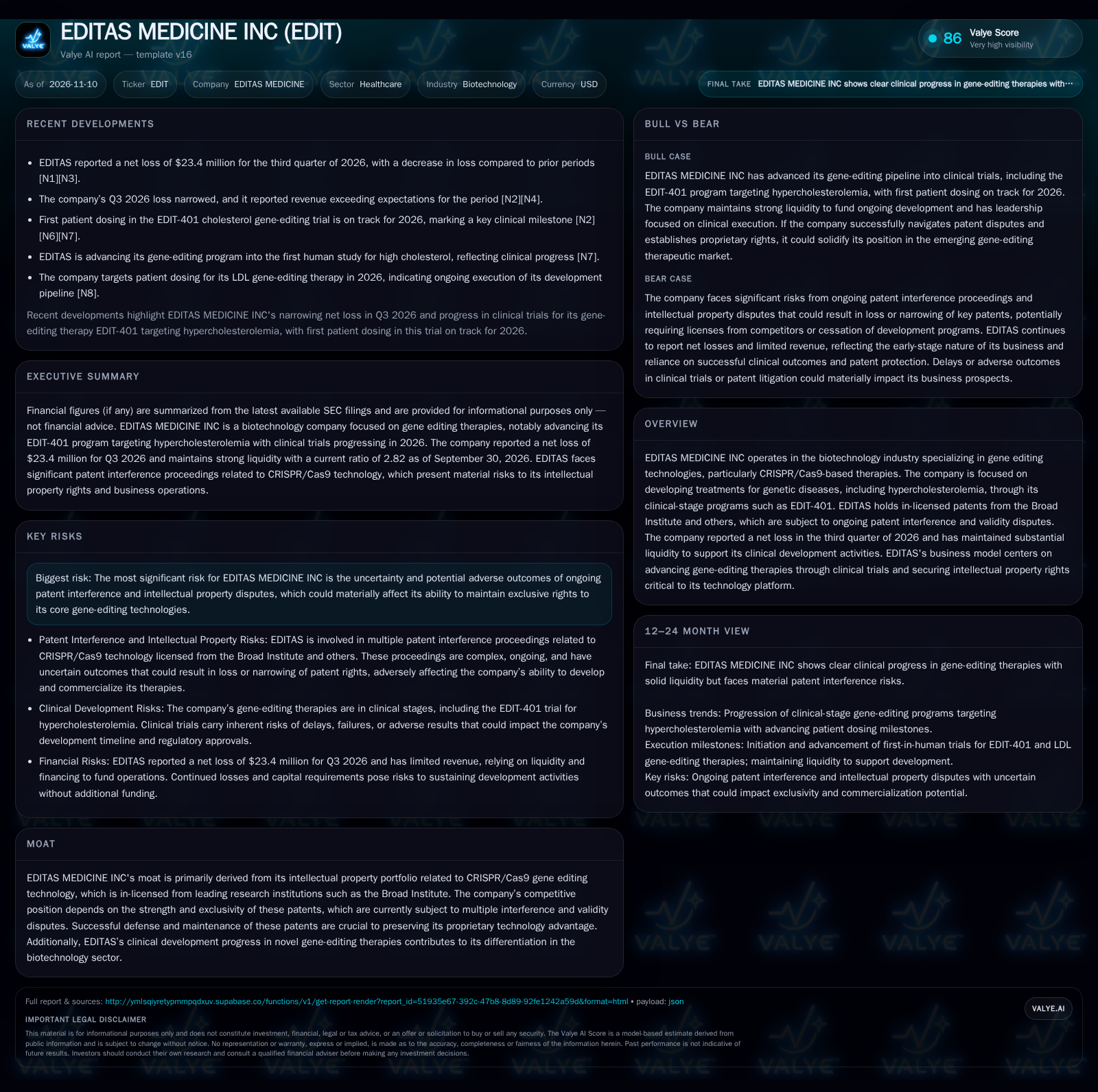
Editas Medicine reported a narrowed net loss and is on track to dose its first patient in the EDIT-401 gene-editing trial for hypercholesterolemia in 2026. The company holds approximately $190 million in liquid assets, supporting ongoing R&D. Yet, Editas faces ongoing, unresolved patent interference proceedings over its core CRISPR/Cas9 technology, which could materially impact its ability to commercialize future therapies. The company's path to revenue depends on both clinical and legal outcomes. [S1] [N1] [N2] [N6] [N7] [N8]
Editas Medicine stands at a pivotal moment: the company is poised to enter first-in-human studies for its EDIT-401 gene-editing therapy targeting hypercholesterolemia, supported by a reported liquidity position buffer and a trend of narrowing quarterly losses. Yet, Editas’s ambitions are shadowed by unresolved patent disputes over its CRISPR/Cas9 platform, introducing material uncertainty around its ability to defend and monetize its technology. The next 12-24 months will test both Editas’s clinical execution and its legal positioning, as it attempts to move from R&D-focused biotech to a company with durable competitive advantages and a path to commercial impact.
Clinical Milestones and Patent Battles Define Editas’s Present Risk-Reward
Editas Medicine reported a net loss of $23.4 million for the third quarter ended September 30, 2026, a narrowing loss compared to prior periods. The company reported cash and liquidity metrics for the period; these figures do not by themselves establish operating runway, investment capacity, financial flexibility, or financing capacity. The most important operational milestone is the anticipated first patient dosing in the EDIT-401 hypercholesterolemia gene-editing trial, expected in 2026, which would mark Editas’s entry into human therapeutic development for cardiovascular disease. However, the company’s ability to commercialize its platform is deeply entangled with ongoing patent interference proceedings over its CRISPR/Cas9 technology, involving multiple parties and uncertain outcomes. These legal uncertainties could force Editas to obtain costly licenses or abandon key programs, directly impacting its long-term business prospects. [S1] [N1] [N2] [N6] [N7] [N8]
Beyond the headline financials and clinical milestones, a critical operational consideration for Editas lies in its capacity to manage the intersection of scientific innovation and legal strategy. The timing of patent dispute resolutions could significantly influence the company's clinical development cadence and investor confidence. For instance, protracted legal uncertainty may constrain Editas’s ability to enter into strategic partnerships or secure licensing agreements, as potential collaborators often seek clear intellectual property landscapes before committing resources. Conversely, a favorable legal outcome could unlock not only freedom to operate but also enhance the company's negotiating leverage in collaborations or financing, underscoring the intertwined nature of clinical and legal progress in shaping Editas’s near-term trajectory.
Gene-Editing Value Chain: Funding R&D, Clinical Execution, and the Commercialization Gauntlet
Editas Medicine’s business model is emblematic of early-stage biotechnology: it relies on raising capital to fund multi-year research and clinical development, with commercial revenue yet to materialize in a meaningful way. Its 2019 revenue was just $2.07 million, underscoring the pre-commercial status of its pipeline. The economics of gene-editing therapies are characterized by high upfront R&D and clinical trial expenses, with the prospect of outsized returns if a therapy advances to regulatory approval and commercialization. Pricing for successful single-administration gene-editing therapies could be substantial, given their potential for durable or curative outcomes, but payer adoption, long-term efficacy, and safety will be key determinants. Fixed costs dominate until late-stage development, at which point variable manufacturing, distribution, and post-market commitments (such as long-term follow-up) become material. Editas’s capital needs will likely persist until at least one therapy reaches late-stage clinical milestones or a strategic partnership/licensing deal provides non-dilutive funding.
The economic model underpinning gene-editing therapies inherently involves balancing substantial upfront investments against uncertain timelines and regulatory hurdles. Editas must strategically allocate its capital to optimize clinical trial design, patient recruitment, and manufacturing scale-up, all while managing cash burn in the absence of meaningful revenue. Given the single-administration nature of many gene-editing therapies, the company faces unique pricing and reimbursement challenges: payers will scrutinize long-term durability and safety to justify premium pricing. Therefore, Editas’s economic success hinges not only on clinical efficacy but also on demonstrating cost-effectiveness and securing payer acceptance, which may require innovative outcomes-based contracting or risk-sharing agreements to mitigate payer concerns about long-term value and upfront costs.
Defending a Moat in Gene Editing: IP, Clinical Progress, and the Threat of Substitution
Editas’s competitive positioning is rooted in its intellectual property portfolio, particularly its in-licensed patents from the Broad Institute covering CRISPR/Cas9 gene-editing technology. This legal foundation is under direct threat from ongoing patent interference proceedings involving well-resourced competitors and academic consortia. In a gene-editing landscape crowded with other CRISPR/Cas9 players, alternative gene-editing modalities (such as base editing and prime editing), and non-CRISPR gene therapies, the strength and exclusivity of Editas’s IP is its primary moat. Clinical progress in EDIT-401 could create first-mover advantage in hypercholesterolemia, but this is contingent on both trial success and freedom to operate. If Editas loses key patent disputes, it risks being leapfrogged by competitors who can operate unencumbered or force Editas into costly cross-licensing arrangements. Moreover, payers and clinicians may ultimately prefer therapies with robust long-term data, cost-effectiveness, and clear regulatory pathways, putting pressure on Editas to deliver not just novel science but practical, scalable solutions.
Editas’s competitive moat is further complicated by the rapid evolution of gene-editing technologies and the potential emergence of alternative modalities that may circumvent existing patent landscapes. If competitors develop novel editing platforms that offer improved specificity, reduced off-target effects, or simplified delivery mechanisms, Editas’s CRISPR/Cas9-based approach could face substitution risk regardless of patent outcomes. Moreover, the company’s ability to maintain clinical differentiation will depend on generating robust data that not only demonstrate efficacy but also address safety and manufacturing scalability. In this context, strategic decisions around pipeline diversification and technology platform enhancements could be critical to sustaining competitive advantage amid a dynamic innovation ecosystem and evolving regulatory expectations.
Clinical Success and Patent Clarity Unlock Transformational Value
The most favorable scenario for Editas sees the company successfully dosing patients in the EDIT-401 clinical trial, demonstrating compelling safety and efficacy signals in early human data. Simultaneously, Editas either prevails in key patent interference proceedings or reaches settlements that secure its freedom to operate for CRISPR/Cas9-based therapies. This twin-track progress would position Editas as a leader in gene-editing therapeutics for cardiovascular disease, potentially attracting strategic partnerships, non-dilutive capital, and setting the stage for eventual regulatory approval and commercial launch. Confirming evidence would include positive interim clinical data, favorable court or USPTO decisions, and announced collaborations with pharmaceutical partners. Falsification would come from trial setbacks—such as safety concerns or lack of efficacy—or adverse legal rulings that materially restrict Editas’s ability to develop or market its therapies.
Prolonged Clinical Validation and Legal Uncertainty Delay Inflection
The most plausible trajectory for Editas is one of incremental clinical progress in EDIT-401, with first patient dosing achieved and early safety data collected, but efficacy and durability of response remaining unproven over the medium term. At the same time, patent interference and validity disputes continue without definitive resolution, prolonging uncertainty around Editas’s long-term IP position. The company continues to fund R&D from its liquidity reserve, with potential for additional capital raises as development costs accrue. Evidence confirming this scenario would include regular clinical updates without breakthrough results, continued legal filings, and a steady burn rate with little change in revenue. Falsification would require either a decisive legal outcome (positive or negative) or a step-change in clinical data that accelerates the path to partnership or product approval.
Patent Losses or Clinical Stumbles Threaten Platform Viability
In an adverse scenario, Editas faces either a pivotal loss in patent proceedings that strips it of key CRISPR/Cas9 rights or a material clinical setback in the EDIT-401 program—such as patient safety concerns or failure to demonstrate efficacy. Either event could force Editas to halt or license out its programs, seek expensive third-party licenses, or pivot to less differentiated technologies. The company’s liquidity would provide only a temporary buffer as the business model is restructured or wound down. Confirming evidence would include unfavorable USPTO or court decisions, negative clinical announcements, or the company signaling a strategic pivot away from its core platform. Falsification would require the avoidance of such outcomes through favorable legal or clinical developments.
Milestones and Contingencies That Will Shape Editas’s Value Proposition
Updates on EDIT-401 clinical trial: patient dosing initiation, safety outcomes, and efficacy data releases will be crucial to assess the program’s viability.
Progress and outcomes of ongoing patent interference and validity proceedings involving CRISPR/Cas9 technology, especially any USPTO decisions or settlements.
Any announced strategic partnerships, licensing deals, or non-dilutive funding that could extend runway or validate the platform.
Expansion or pipeline updates: initiation of new clinical programs or indication expansions would signal R&D momentum.
Regulatory feedback or designations (e.g., Orphan Drug, Fast Track) that could accelerate or de-risk development timelines.
If disclosed, pre-commercial manufacturing and supply chain readiness for gene-editing therapies, which would test scalability.
Payer and reimbursement developments in the gene-editing space, which could affect future pricing and market access assumptions.
Disclaimer: This is research-only, informational analysis and not investment advice. It may include AI-generated interpretation and general industry context. Always verify important details using primary sources.

Comments