
Baldwin Insurance Group: Integrating Acquisitions and Navigating Go-Private Disruption in a Competitive Insurance Landscape
Baldwin Insurance Group faces a pivotal period as it integrates a string of acquisitions, grapples with near-term financial pressures, and manages the uncertainties of a pending go-private transaction—all while leveraging technology and a diversified operating model in a fragmented but fiercely competitive insurance distribution market.
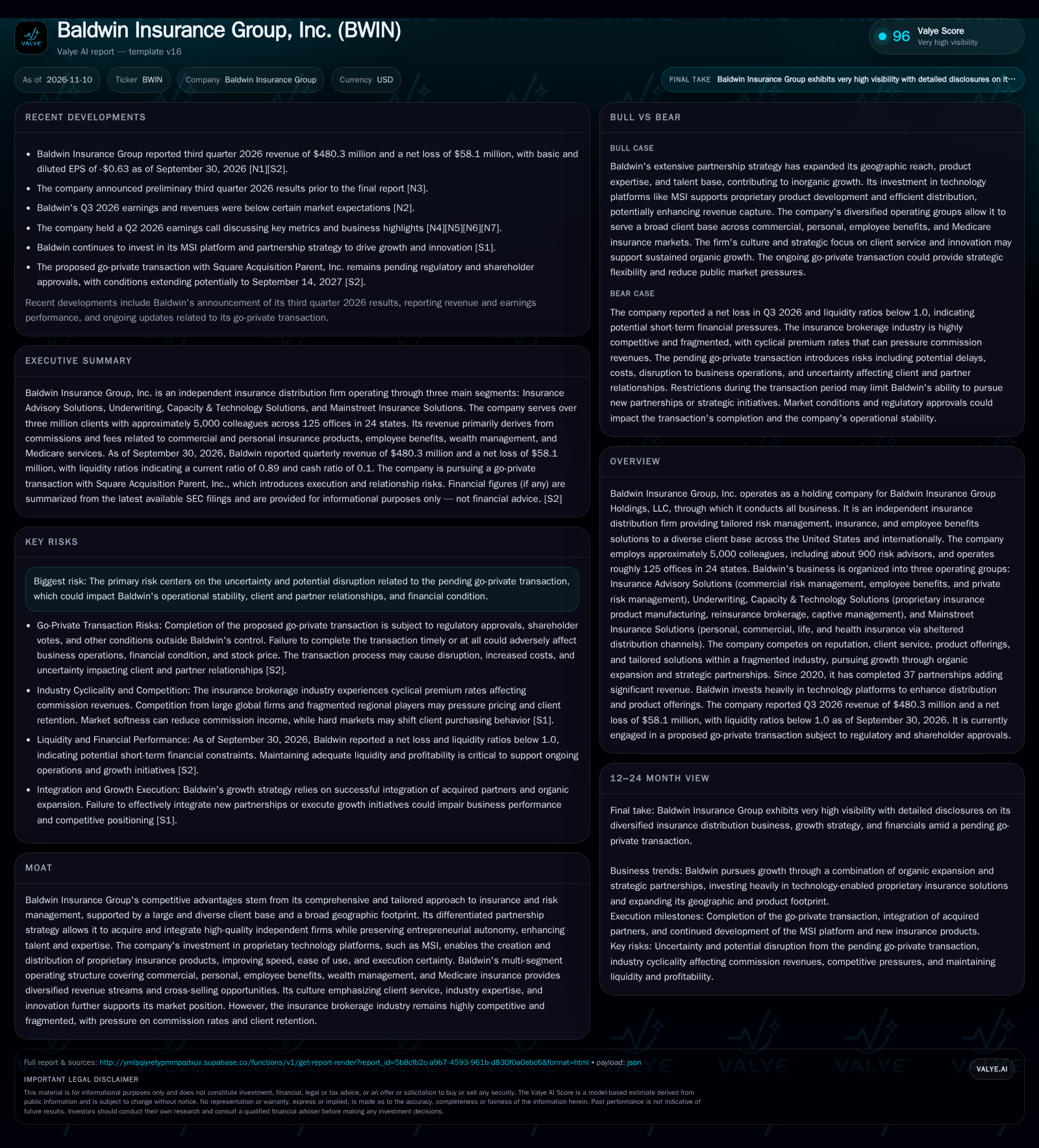
Baldwin Insurance Group reported Q3 2026 revenue of $480.3 million and a net loss of $58.1 million, underperforming some expectations and highlighting short-term financial strain. The company is pursuing a go-private transaction that could introduce both strategic flexibility and near-term disruption. Baldwin’s growth has leaned heavily on acquisitions—37 partnerships since 2020—accompanied by investments in proprietary technology platforms. [S2]
Baldwin Insurance Group stands at a strategic crossroads as it seeks to balance integration of a rapid-fire acquisition spree with the uncertainties of a pending go-private transaction. The company’s Q3 2026 results—marked by a meaningful net loss and liquidity ratios below 1.0—underscore the immediate operational and financial pressures facing the business. Yet Baldwin’s diversified platform, deep investment in proprietary technology, and national footprint in insurance distribution position it for long-term opportunity—provided it can successfully manage integration risk, competitive threats, and the transition to private ownership. The next 12-18 months will likely determine whether Baldwin can convert scale and technology into sustainable earnings, or whether transaction-related disruption and industry headwinds will erode its competitive position.
Latest Results, Transaction Overhang, and Integration Stakes
Baldwin Insurance Group reported Q3 2026 revenue of $480.3 million and a net loss of $58.1 million, translating to basic and diluted EPS of -$0.63. [S2]
A proposed go-private transaction with Square Acquisition Parent, Inc. remains pending, with completion contingent on regulatory and shareholder approvals that could extend into September 2027. This process introduces the risk of delays, additional costs, and potential disruption to client and partner relationships. [S2]
Since 2020, Baldwin has executed 37 acquisitions, adding $909 million in acquired revenue—an aggressive pace that increases integration complexity and operational demands. [S1]
These facts frame a period of heightened uncertainty: short-term financial stress, transaction-related distractions, and the challenge of unifying a rapidly expanded portfolio.
Revenue Streams, Margin Levers, and the Role of Technology in Economics
Baldwin’s revenue is primarily generated through commissions on insurance premiums and fees for management and consulting services. The earnings profile is shaped by three operating groups: Insurance Advisory Solutions (IAS), Underwriting, Capacity & Technology Solutions (UCTS), and Mainstreet Insurance Solutions (MIS). IAS targets commercial and high-net-worth clients; UCTS manufactures proprietary insurance products and manages captive solutions; MIS distributes personal and small commercial insurance through embedded channels.
Commission-based revenue is volume-driven and subject to cyclical premium rates, which can fluctuate with market conditions and client purchasing behavior. Fee income from consulting and management services may offer some stability, but is often tied to the same client retention and pricing dynamics that drive commission revenue.
Operating leverage in this model is mixed. While the insurance distribution business has high variable costs—primarily personnel and commission expenses—there are potential fixed-cost efficiencies from technology investments. Baldwin’s MSI platform is designed to enable proprietary product offerings and more efficient distribution. If the company can scale technology-driven solutions, there is potential to increase margins over time. However, integration costs from acquisitions, technology investment amortization, and compensation for risk advisors can compress margins in the near term.
Capital needs are significant given the acquisition-driven growth strategy and ongoing technology investment.
Fragmented Industry, Acquisition Opportunities, and the Fight for Client Loyalty
Baldwin operates in a highly fragmented insurance brokerage industry, competing on reputation, client service, breadth of product offerings, and the ability to deliver tailored solutions. Its peer set includes national and global insurance brokers as well as regional independents—each pursuing scale, cross-selling, and technology-enabled service models.
The company’s acquisition strategy leverages industry fragmentation to rapidly build scale, expand geographic reach, and add new product capabilities. Notably, Baldwin’s approach emphasizes preserving the entrepreneurial autonomy of acquired partners, which may help retain local talent and client relationships.
However, industry fragmentation is a double-edged sword: while it creates acquisition targets, it also means that pricing power is limited and client retention is always at risk. Larger competitors may have greater resources to invest in technology, marketing, and talent, while smaller independents can compete on local knowledge and personal service.
Technology is a potential differentiator. If Baldwin’s MSI platform succeeds in creating proprietary products and streamlining distribution, this could drive retention and margin improvement. However, similar investments by competitors and the slow pace of client behavior change in insurance mean that any technological advantage is likely to be incremental rather than transformative—unless paired with superior execution and integration of acquired talent.
Integration Synergies and Technology-Driven Margin Expansion
In a favorable scenario, Baldwin successfully integrates its acquired firms, retaining key talent and clients while realizing cost and cross-selling synergies. The MSI platform accelerates proprietary product adoption, allowing the company to capture greater economics per client and improve distribution efficiency.
This scenario would be confirmed by a return to operating profitability, margin expansion, and organic revenue growth outpacing sector averages. Evidence could include improved retention rates among acquired agencies, rising fee income from proprietary products, and declining expense ratios as technology investment begins to pay off.
Successful completion of the go-private transaction could provide management with greater strategic flexibility, reduced reporting burdens, and the ability to pursue long-term initiatives without quarterly market scrutiny.
Falsification would occur if integration challenges persist, talent attrition accelerates, or if technology-driven products fail to gain traction—leaving margins and growth below peers despite scale.
Navigating Transaction Disruption While Maintaining Core Operations
The most plausible near-term outcome is a period of operational and financial volatility as Baldwin manages the go-private process alongside ongoing integration efforts. Revenue may remain stable or grow modestly, but net margins are likely to be pressured by transaction costs, integration expenses, and cautious client behavior amid uncertainty.
The company’s technology investment could gradually improve distribution efficiency and enable incremental margin gains, but the full economic benefit is likely to be realized over several years rather than quarters.
This scenario would be confirmed by relatively flat or modestly improving revenue, stable or slightly compressed margins, and little change in client churn or advisor turnover. Transaction completion in late 2027 would remove one overhang but may not immediately transform operating economics.
Falsification would occur if revenue or client retention declines sharply, if the transaction is delayed beyond guidance, or if liquidity issues force asset sales or external capital raises under distressed terms.
Transaction Disruption, Integration Stumbles, and Liquidity Strain
The adverse scenario sees the go-private transaction delayed or abandoned, resulting in prolonged uncertainty, increased costs, and distraction from core operations. Integration of acquired firms falters, leading to advisor and client attrition, and acquired revenue fails to fully materialize.
Liquidity constraints, as signaled by current ratios below 1.0, could force Baldwin to curtail growth initiatives, seek expensive external financing, or divest assets at suboptimal valuations. Industry-wide pricing pressure or a cyclical downturn in premiums could exacerbate revenue declines.
This scenario would be confirmed by a sustained or widening net loss, negative operating cash flow, rising advisor turnover, and evidence of client defections or lost market share. Regulatory or shareholder opposition could further delay or derail the transaction, compounding disruption.
Falsification would require evidence of resilient client retention, improved cash generation, or a swift and uneventful transaction close that restores operational focus and confidence.
Testing Baldwin’s Integration, Liquidity, and Technology Leverage in the Months Ahead
Progress and milestones in completing the go-private transaction—including regulatory approvals, shareholder votes, and revised timelines—will directly affect operational focus and risk.
Quarterly trends in net income and operating cash flow will reveal whether margin pressures are abating or compounding, especially as integration and transaction costs accumulate.
Retention rates for acquired advisors and clients, if disclosed, would offer a direct measure of integration success and the durability of acquired revenue.
Organic revenue growth rates (excluding acquired revenue) would help test Baldwin’s ability to drive sustainable performance beyond M&A.
Adoption metrics for proprietary MSI-driven insurance products—such as share of total premiums or fee income attributable to MSI—would indicate the impact of technology investment.
Expense ratios, particularly sales and administrative costs as a percentage of revenue, could confirm whether technology and scale are yielding operational leverage.
Industry-wide premium rate trends or market commentary on pricing conditions could provide context for commission revenue volatility and competitive dynamics.
Disclaimer: This is research-only, informational analysis and not investment advice. It may include AI-generated interpretation and general industry context. Always verify important details using primary sources.

Comments