
Digital Turbine: Platform Leverage, Policy Risks, and the Stakes of Mobile Ecosystem Intermediation
Digital Turbine’s integrated platform drives mobile app discovery and monetization across device OEMs, carriers, advertisers, and publishers. While recent results show profitable growth and AI-led initiatives, the company’s fortunes remain tightly linked to the policies and priorities of dominant mobile platforms and partners.
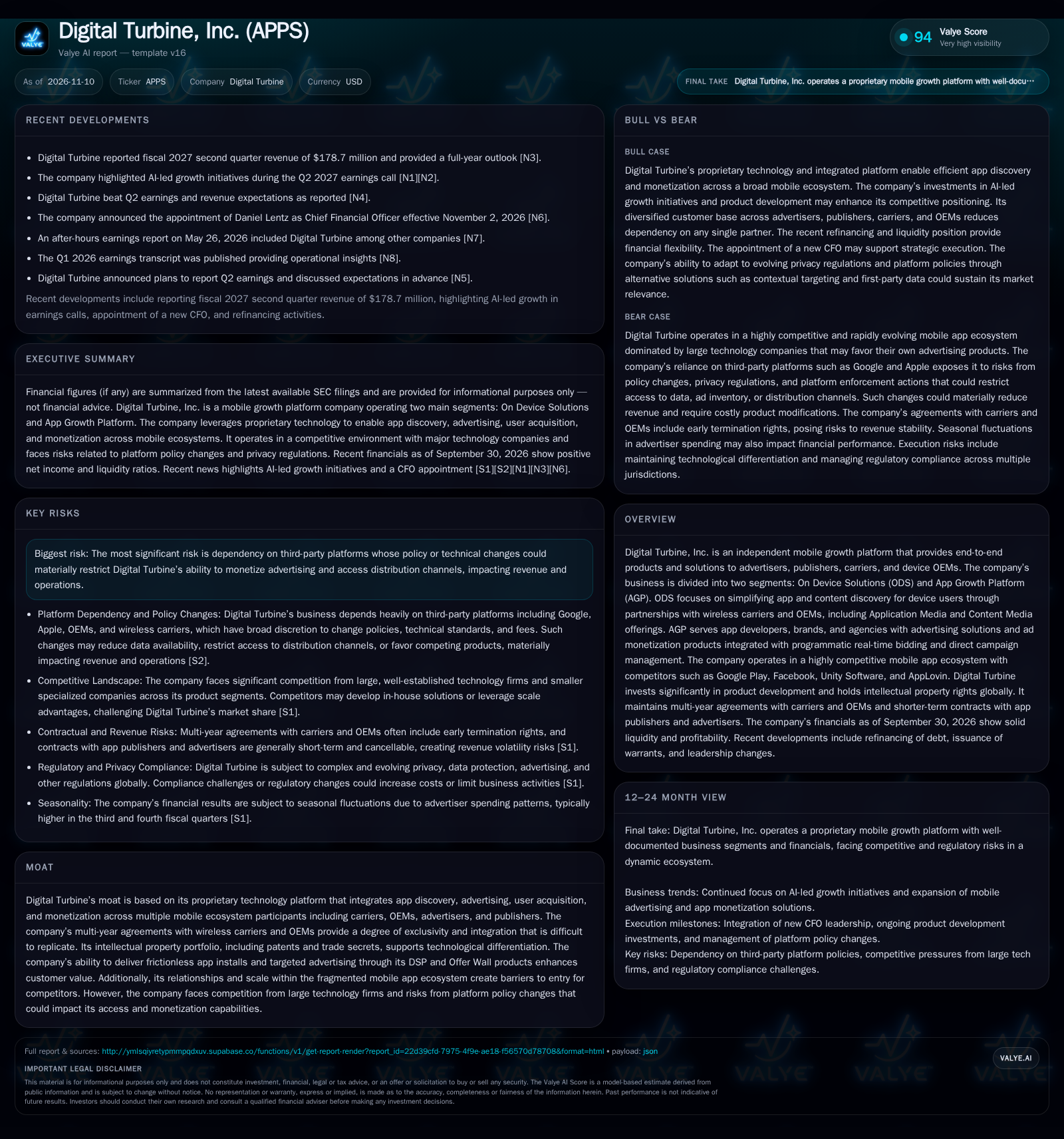
Digital Turbine posted Q2 FY27 revenue of $178.7 million and positive net income, highlighting AI-driven growth initiatives and a new CFO appointment. The company’s platform connects app discovery, advertising, and monetization for a broad set of ecosystem participants. Its revenue model relies on a mix of multi-year and short-term contracts, but major risks remain from platform dependency, policy changes, and intense competition from tech giants. The core question is whether proprietary technology and ecosystem integration can sustain differentiation as mobile privacy and distribution rules evolve. [S1] [S2] [N1] [N3] [N6]
Digital Turbine sits at the intersection of mobile device manufacturers, wireless carriers, app developers, advertisers, and publishers, providing a platform that aims to streamline app discovery and maximize advertising monetization. Recent financials and leadership updates reflect ongoing efforts to leverage AI and proprietary tech to differentiate in a crowded, rapidly evolving market. However, the company’s fortunes are closely tied to the policies of dominant mobile platforms and partners, raising fundamental questions about the durability of its current economics and the sustainability of its ecosystem position as privacy and distribution rules shift.
Recent Performance, AI Initiatives, and Leadership Transition
Digital Turbine reported fiscal Q2 2027 revenue of $178.7 million and net income of $10.28 million, with basic EPS of $0.08 and diluted EPS of $0.06 [S2] [N3]. This marks a period of continued profitability and positive operating leverage. The company highlighted AI-driven growth initiatives in recent earnings calls, indicating a strategic focus on leveraging machine learning and automation to improve targeting, campaign performance, and operational efficiency [N1] [N2]. Daniel Lentz was appointed as Chief Financial Officer effective November 2, 2026, signaling a potential shift in financial strategy and execution [N6]. On the balance sheet, Digital Turbine reported $51.35 million in cash and equivalents and a current ratio of 1.25 as of September 30, 2026 [S2].
How Digital Turbine Makes Money: Revenue Models, Contract Mix, and Margin Drivers
Digital Turbine’s economics are built around intermediation and enablement in the mobile app ecosystem. The company’s On Device Solutions (ODS) segment delivers apps and content directly to device users through integration with wireless carriers and OEMs. Revenue here is typically generated via revenue share agreements tied to app installs, engagement, and content consumption, with monetization further enhanced by proprietary tools like SingleTap® and DT DSP that streamline user acquisition. Content Media within ODS monetizes user attention via programmatic and sponsored content advertising.
The App Growth Platform (AGP) segment targets app developers, brands, agencies, and publishers, providing advertising solutions and ad monetization infrastructure. AGP revenue is earned through revenue shares, as well as direct arrangements such as cost-per-mille (CPM), cost-per-install (CPI), cost-per-play (CPP), or cost-per-action (CPA) models. Notably, contracts with carriers/OEMs are often multi-year—potentially providing integration stickiness—while publisher and advertiser contracts are usually short-term and cancellable with little notice, adding revenue volatility.
Variable costs are tied to revenue shares and payouts to ecosystem partners, while fixed costs are dominated by ongoing product development and intellectual property protection—$40.5 million was invested in R&D in fiscal 2026 [S1]. Operating leverage is plausible if revenue growth outpaces incremental costs, but the short duration of many contracts and the need for constant product investment limit margin expansion. The company’s recent refinancing and at-the-market offering expand its funding flexibility, but also add interest expense and potential dilution if warrants are exercised.
Ecosystem Integration versus Platform Dominance: Competitive Realities
Digital Turbine operates in a highly fragmented and competitive environment, facing direct and indirect competition from mobile platform operators (Google, Apple), major ad networks (Facebook, Snapchat), independent ad tech providers (Unity Software, AppLovin, Trade Desk), and even carriers and OEMs developing in-house solutions [S1]. The company’s competitive levers include proprietary app delivery and ad targeting technology, established relationships with carriers and OEMs, and an intellectual property portfolio that may provide some technical differentiation.
However, the counterforces are formidable. Platform operators wield outsized influence via control of distribution, device software, and privacy standards. Policy changes—such as restrictions on pre-installed app placements, limits on device-level data, or new privacy regimes—can quickly erode Digital Turbine’s advantages. Moreover, large tech firms can bundle their own advertising solutions, leveraging scale and data advantages that are difficult for intermediaries to match. The company’s position is strongest where carrier and OEM partners value independent enablement and where regulatory or competitive barriers limit platform self-preferencing, but these dynamics are subject to rapid change.
If AI-Led Product Innovation and Ecosystem Partnerships Outpace Platform Risk
The bullish scenario for Digital Turbine depends on the company’s ability to continually enhance its proprietary technology—especially AI-driven targeting, campaign optimization, and frictionless app install solutions—so that carriers, OEMs, publishers, and advertisers see unique value versus both in-house and platform-native alternatives. If AI-led initiatives meaningfully improve user engagement and advertiser ROI, Digital Turbine could deepen its integration with device partners and expand wallet share among publishers and advertisers.
Confirmation would come from sustained multi-year renewals or expansions with major carriers and OEMs, growth in high-margin direct advertiser relationships, and evidence that AI-powered offerings are winning incremental business or improving take rates. In this scenario, regulatory or platform policy shifts would be manageable, either because Digital Turbine’s solutions are compliant by design (e.g., contextual targeting, first-party data) or because partners actively resist platform lock-in. Upside would also be supported by operating leverage, as incremental revenue from new products or geographies drops through to profit faster than fixed costs grow.
Sustaining a Profitable Niche Amid Platform and Privacy Flux
The most plausible scenario is that Digital Turbine maintains profitable growth by continuing to serve as a value-adding intermediary for a subset of carriers, OEMs, publishers, and advertisers that seek alternatives to platform-dominated solutions. Revenue remains seasonal and sensitive to advertising cycles, but ongoing investment in product development and compliance keeps the company relevant as privacy and policy standards evolve. AI-led improvements drive incremental gains, but do not fundamentally alter the competitive balance.
This scenario would be confirmed by stable or modestly expanding revenue across both ODS and AGP segments, continued multi-year partner agreements (even if some are lost or renegotiated), and manageable customer churn among publishers and advertisers. Gross margins may remain range-bound due to revenue share structures and the need for ongoing R&D. The company would need to demonstrate agility in adapting to regulatory and platform shifts—such as new privacy laws or changes in device-level data access—without suffering material contract losses or margin compression.
When Platform Policy Shifts or Partner Integration Erodes Revenue Stability
The principal risk is that major platform operators—Google, Apple, or dominant OEMs/carriers—implement policy or technical changes that restrict Digital Turbine’s ability to pre-install apps, collect device-level data, or access distribution and monetization channels. Such changes could be abrupt and outside the company’s control, resulting in loss of key integration points or the need for costly product re-architectures. Early termination of multi-year agreements with carriers or OEMs would amplify revenue volatility.
This scenario would be confirmed by sudden declines in ODS segment revenue, loss of major carrier or OEM relationships, or regulatory actions that invalidate existing targeting or monetization practices. High customer churn among publishers and advertisers—especially if driven by platform self-preferencing or new privacy restrictions—would further pressure revenue and margins. In this world, Digital Turbine’s operating leverage could turn negative, with fixed R&D and compliance costs outpacing shrinking gross profit, and refinancing needs potentially rising if cash flow deteriorates.
What Will Determine the Durability of Digital Turbine’s Platform Economics?
Renewal and expansion rates of multi-year carrier and OEM agreements—especially after material platform or privacy policy changes.
Revenue and margin trends in both ODS and AGP segments, with segment-level disclosure (if available) clarifying product and customer mix shifts.
Adoption, retention, and monetization rates for AI-driven features and new product offerings; a useful metric would be incremental revenue attributed to AI-powered campaigns, if disclosed.
Churn rates among app publishers and advertisers, particularly after major platform or regulatory shifts; would help test the resilience of short-term contracts.
Gross margin evolution and R&D as a percentage of revenue, indicating operating leverage or the need for continued heavy investment.
Updates on data access, privacy compliance, or platform integration—especially in response to new rules from Google, Apple, or major OEMs.
Execution and impact of the new CFO’s strategies, including any changes in capital allocation, cost discipline, or financial risk management.
Disclaimer: This is research-only, informational analysis and not investment advice. It may include AI-generated interpretation and general industry context. Always verify important details using primary sources.

Comments