
Focus Universal: IoT Ambitions, Recurring Losses, and the Realities of Capital-Dependent Growth
Despite reported liquidity position and a notable real estate acquisition agreement, Focus Universal continues to post recurring losses and declining revenue from IoT products.
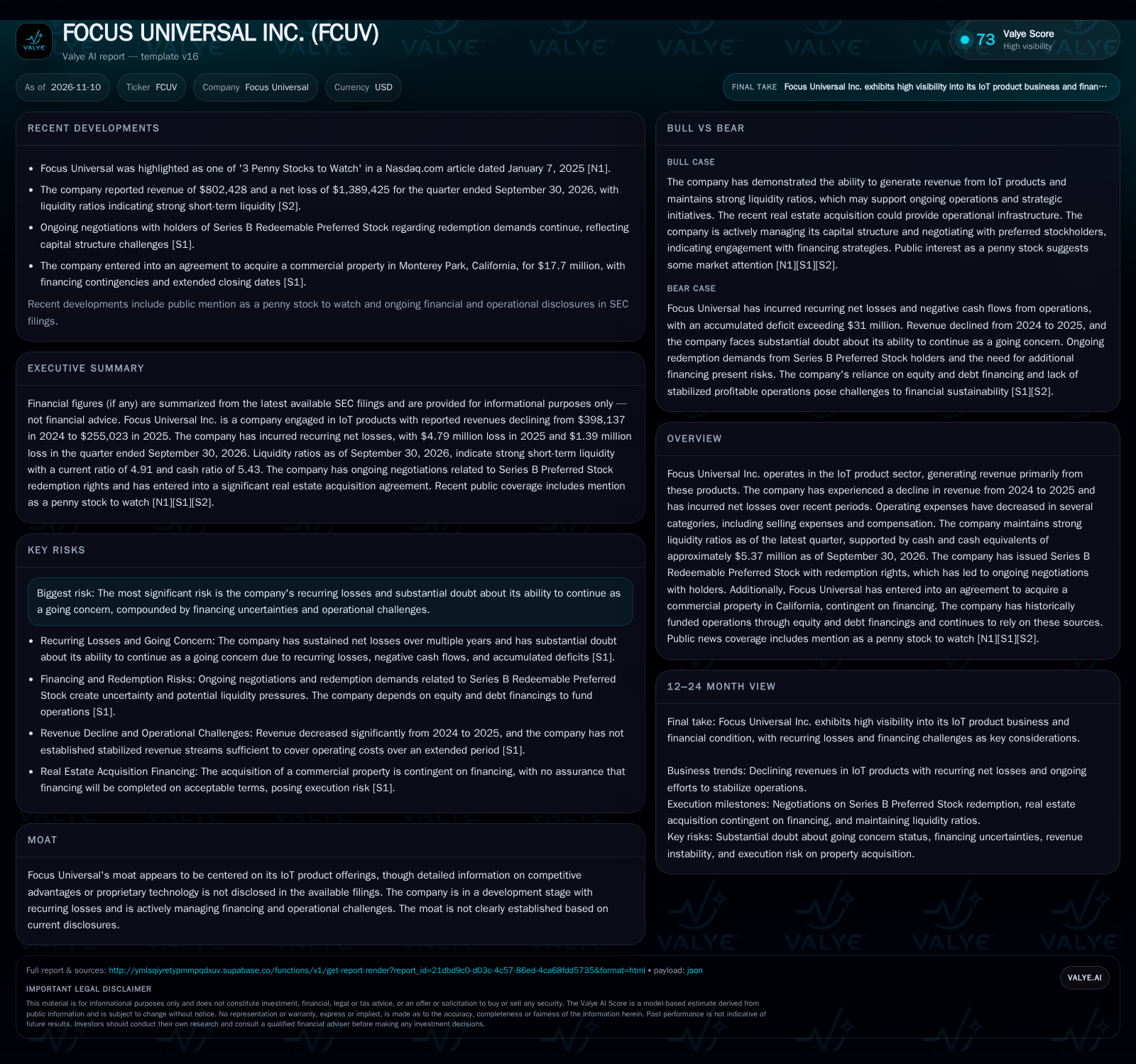
Despite reported liquidity position and a notable real estate acquisition agreement, Focus Universal continues to post recurring losses and declining revenue from IoT products. The company’s reliance on external financing, unresolved preferred stock redemption demands, and execution risk around property expansion present significant uncertainties for value creation and business sustainability. [S1] [S2]
Focus Universal Inc. presents a paradox often seen in early-stage, capital-dependent technology ventures: strong headline liquidity metrics coexist with deep recurring losses, declining IoT revenue, and unresolved capital structure issues. The company’s efforts to stabilize operations via cost controls and a major real estate acquisition come against a backdrop of ongoing reliance on external financing and substantial doubt about its going-concern status. With the IoT sector’s long commercialization cycles and the company’s unique mix of operational contraction and expansion ambitions, investors must weigh whether Focus Universal’s liquidity and asset moves can meaningfully alter a pattern of under-monetization and persistent losses.
Liquidity Strength Masks Underlying Revenue and Loss Trends
Focus Universal reported $802,428 in revenue and a net loss of $1,389,425 for the quarter ended September 30, 2026. For the full year 2025, revenue declined to $255,023 from $398,137 in 2024, marking a notable contraction in IoT product sales. Despite this, the company’s short-term liquidity ratios remain high—current ratio at 4.91 and cash ratio at 5.43 as of September 2026—supported by $5.37 million in cash equivalents. The company continues to incur substantial net losses, with a $4.79 million deficit in 2025 and an accumulated deficit exceeding $31 million. Simultaneously, it is engaged in ongoing negotiations with Series B Preferred Stock holders over redemption rights and has entered into a $17.7 million real estate acquisition agreement, contingent on securing financing. These facts illustrate a company with significant balance sheet liquidity but core operational and financing vulnerabilities. [S1] [S2]
How Focus Universal’s IoT Model Faces Scale, Margin, and Funding Limitations
Focus Universal’s revenue base is concentrated in IoT products, but the declining top line and persistent losses suggest the company has not yet achieved meaningful operating scale or positive unit economics. In the IoT sector, profitability typically hinges on the ability to either move large volumes of hardware at reasonable gross margins or to layer on higher-margin recurring software/services revenue—neither of which is clearly established in the current disclosures. The company’s cost structure comprises selling, R&D, professional, and G&A expenses, with recent reductions unable to offset revenue declines. This pattern indicates negative operating leverage: as revenues shrink, fixed and semi-variable costs absorb a larger share of gross profit, deepening losses.
Capital requirements are significant, as evidenced by the $17.7 million real estate acquisition plan—likely intended to support expanded operations or R&D, but introducing further leverage or dilution risks if financed externally. With negative cash flows from operations and ongoing reliance on equity and debt financings, Focus Universal’s economics are fundamentally capital-intensive and susceptible to dilution or covenant constraints. The recurring need for outside capital also creates execution risk, especially if preferred stock redemption demands accelerate or market conditions tighten. [S1]
Competitive Pressures and the Challenge of Building Defensible IoT Value
The IoT sector is intensely competitive, with established players and well-funded startups targeting device, platform, and integration opportunities. Focus Universal’s filings do not disclose proprietary technology, unique channel access, or substantial partnerships that would underpin a durable competitive advantage. Without clear evidence of differentiated IP, network effects, or switching frictions, the company’s ability to defend market share or command premium pricing appears limited.
Moreover, the declining revenue suggests that Focus Universal may be losing ground to substitute solutions or failing to scale adoption. Larger IoT competitors can often bundle hardware and software, drive down costs through volume, or leverage existing customer relationships to accelerate cross-sell. In contrast, smaller players like Focus Universal may struggle with customer acquisition costs, price competition, and the need for ongoing R&D investment to keep up with evolving standards and interoperability requirements. The question is whether the company can identify a niche or novel application where it can achieve sustainable margins before further capital constraints erode its ability to compete.
What a Turnaround Would Look Like: Revenue Stabilization and Strategic Asset Leverage
A positive scenario for Focus Universal would involve stabilization or growth in IoT product revenues—potentially through a successful new product launch, increased adoption in a targeted vertical, or a shift to higher-margin recurring software or services layered on its existing hardware. The successful completion and productive use of the Monterey Park property could enable expanded R&D, production, or partnership activity, signaling to customers and investors that the company is moving beyond survival mode.
Confirmation of this scenario would include a return to sequential revenue growth, evidence of gross margin improvement (if disclosed), and successful negotiation of preferred stock redemption terms that remove near-term financing overhang. Additional indicators would be new commercial partnerships, customer wins, or third-party validations of technology differentiation. Falsification would come from continued revenue decline, further operating losses, or an inability to close the real estate acquisition on favorable terms.
Stalled Growth and Managing for Survival Amid Capital Constraints
The most plausible near-term outcome is that Focus Universal continues to operate with constrained growth, managing expenses tightly while seeking new sources of external financing. Revenues may remain flat or continue to decline unless a new commercial breakthrough is achieved. The company’s liquidity ratios may remain superficially strong if additional financings are secured, but the underlying business would remain loss-making and capital consumptive.
Confirmation of this scenario would be further equity or debt raises, continued negotiations or extensions around preferred stock redemptions, and limited progress on the Monterey Park property. Falsification would come from either a sharp revenue rebound or a liquidity crisis triggered by failed financing or accelerated redemption demands.
Capital Structure Shocks and the Risk of Forced Contraction or Asset Sales
The adverse case for Focus Universal centers on a scenario where capital structure pressures—such as forced redemption of Series B Preferred Stock or inability to secure financing for the real estate acquisition—trigger a rapid drawdown of liquidity. This could force the company to scale back operations, delay or abandon the Monterey Park project, or pursue asset sales to meet obligations.
Confirmation would include disclosure of missed or delayed payments to creditors, an abrupt drop in cash or current ratio metrics, workforce reductions, or a going-concern qualification in filings. Falsification would require evidence that the company has secured long-term, non-dilutive financing or has resolved preferred stock issues without a material impact on operating flexibility.
Milestones and External Conditions That Will Define Focus Universal’s Next Chapter
Sequential quarterly revenue growth or stabilization in IoT product sales would help establish whether the company’s core business is recovering or continuing to contract. [S1] [S2]
Gross margin trends, if disclosed, would clarify whether the product mix or pricing structure is improving and if cost controls are translating into better underlying economics.
Resolution of Series B Redeemable Preferred Stock redemption demands—such as a negotiated buyback, conversion, or extension—would indicate progress on capital structure risk. [S1]
Updates on the financing and closing of the Monterey Park real estate acquisition will signal whether expansion plans are viable or likely to be deferred. [S1]
Operating cash flow trends, if disclosed, would provide a direct read on whether the company is moving closer to self-sustaining operations.
Evidence of new commercial partnerships, customer contracts, or technology licensing deals would help validate the potential for scale or differentiation.
Changes in management commentary around going-concern status or strategic alternatives would provide early warning of either a turnaround plan or a shift toward asset sales or restructuring.
Disclaimer: This is research-only, informational analysis and not investment advice. It may include AI-generated interpretation and general industry context. Always verify important details using primary sources.

Comments