
Quantinuum’s Quantum Ambitions: Scaling Trapped-Ion Technology from Lab to Market
The next phase will test whether its trapped-ion platform can cross from scientific promise to business reality.
The key questions now: Can Quantinuum translate technical milestones into broad customer adoption, and can it scale manufacturing while fending off competitive and technological threats? [S1] [N1] [N7] [N8]
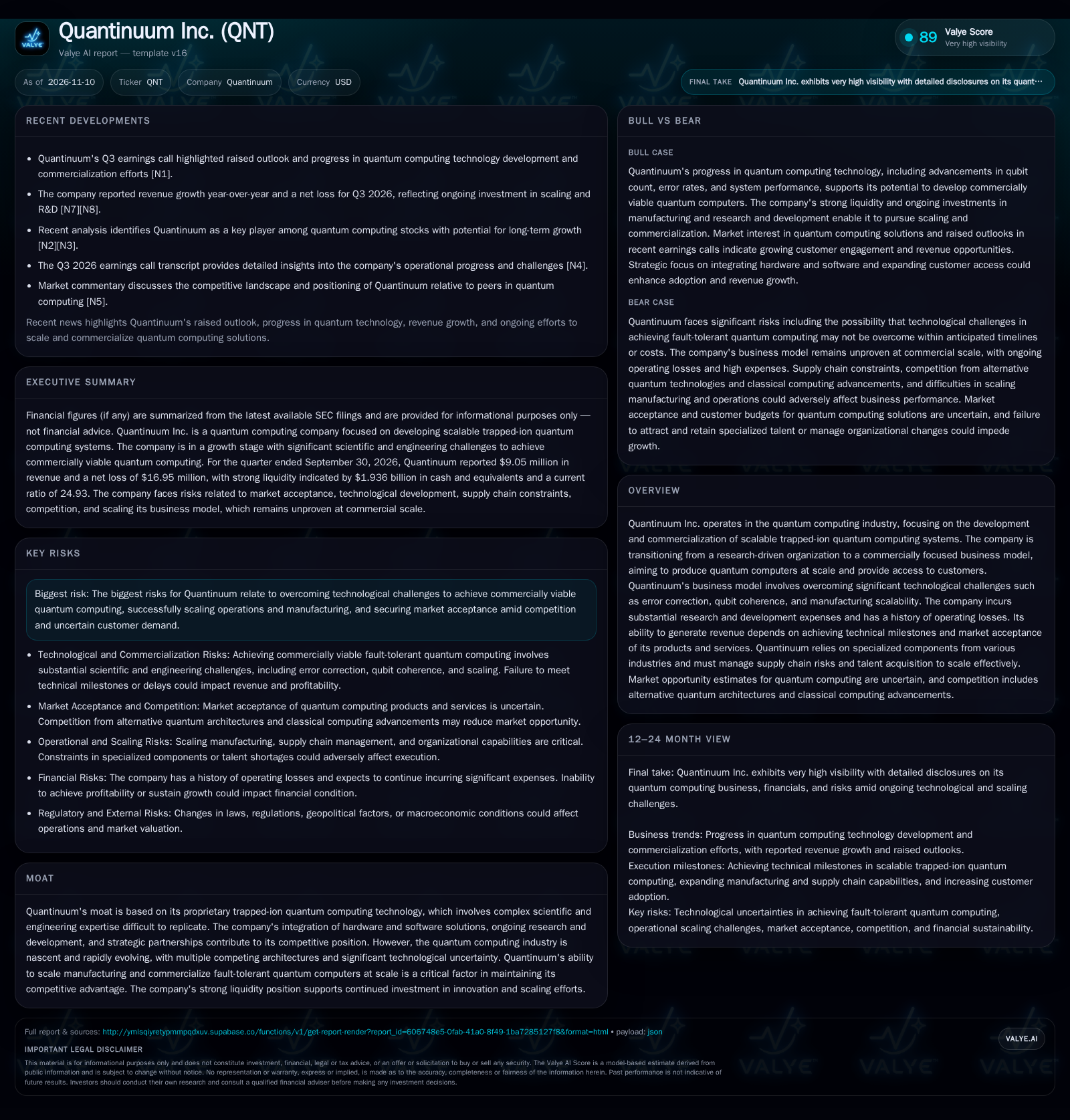
Quantinuum Inc. is attempting one of the most challenging transitions in deep tech: moving from research-driven quantum innovation to a commercially viable platform business. With $9.05 million in Q3 2026 revenue, a net loss of $16.95 million, and nearly $2 billion in cash, the company possesses the financial runway to pursue quantum advantage at scale. Yet the leap from technical progress in trapped-ion quantum computing to widespread adoption and profitable operations remains fraught with operational, scientific, and market risks. The next two years will clarify whether Quantinuum’s formidable liquidity and R&D investments can be parlayed into durable commercial leadership—or whether the company will remain a well-funded science project in a field crowded with emerging alternatives. [S1] [N1] [N7] [N8]
Quantinuum’s Financial and Technical Position Sets the Stage for Commercialization
Quantinuum reported $9.05 million in revenue and a net loss of $16.95 million for Q3 2026, continuing a pattern of heavy investment in research and scaling efforts. As of September 30, 2026, the company held $1.936 billion in cash and cash equivalents, with current assets of $1.993 billion and current liabilities of $79.95 million, resulting in a current ratio of 24.93. This positions Quantinuum with one of the strongest liquidity cushions in the emerging quantum computing sector. The company’s recent earnings call highlighted a raised outlook and year-over-year revenue growth, suggesting progress in customer engagement and technical development. However, the business remains loss-making and unproven at commercial scale, with major risks tied to technological hurdles, operational scaling, and market acceptance. [S1] [N1] [N7] [N8]
The Revenue Model: From R&D Spend to Scalable Quantum Services
Quantinuum’s business model aspires to generate revenue through the commercialization of scalable trapped-ion quantum computing systems, likely combining hardware sales or leases, cloud-based quantum computing access, and associated software/services. At present, revenue remains modest relative to R&D and scaling expenses, reflecting the nascent state of the quantum computing market and the high cost base required to reach technical milestones.
The economics of quantum computing are complex: initial fixed costs are substantial, driven by hardware development, fabrication, and specialized talent. Variable costs may be relatively lower for cloud-access quantum services, but the path to operating leverage depends on achieving sufficient customer adoption and utilization. Pricing power could exist if Quantinuum’s systems deliver clear quantum advantage—solving problems intractable for classical computers or outperforming rival quantum architectures—but this remains to be demonstrated at scale.
Sustained losses are expected as the company invests in error correction, qubit coherence, and manufacturing scalability. Capital needs are currently well covered by the cash balance, but future burn rates will depend on the pace of commercialization versus ongoing R&D intensity. Achieving recurring revenue streams, either through multi-year enterprise contracts or platform subscriptions, would be a major step toward validating the business model, but such mechanics are not yet established in public disclosures. [S1]
Competing on Architecture, Scale, and Ecosystem Integration
Quantinuum’s moat is built on its proprietary trapped-ion quantum computing technology, which is recognized for high-fidelity qubits and long coherence times—attributes that could provide an edge over superconducting or photonic qubit competitors if successfully scaled. However, the quantum computing landscape is highly dynamic, with multiple architectures (superconducting, photonic, neutral atom, silicon spin, and more) vying for supremacy. Each approach faces its own scaling and error-correction challenges.
Competition also comes from classical computing, where advances in high-performance computing, GPUs, and quantum-inspired algorithms may reduce the immediate need for true quantum advantage. Quantinuum’s integration of hardware and software, along with the potential development of a robust ecosystem, could increase switching costs if customers begin to rely on its platform for mission-critical workloads. However, in the absence of industry-wide standards and with rapid technological evolution, customer lock-in and platform dominance are not assured.
Supply chain dependencies on specialized photonics, electronics, and precision mechanics introduce another layer of vulnerability, as do talent constraints in quantum engineering. Ultimately, Quantinuum’s sustained advantage will depend on delivering clear, reproducible quantum advantage in commercially relevant applications—and on doing so ahead of both quantum and classical rivals. [S1]
Breakthroughs in Fault Tolerance Drive Adoption and Margin Expansion
In a favorable scenario, Quantinuum achieves key technical milestones in error correction and qubit scaling, enabling the first commercially viable, fault-tolerant trapped-ion quantum computers. This unlocks use cases that demonstrate clear quantum advantage—such as in cryptography, materials discovery, or complex optimization—prompting enterprise customers to commit to multi-year contracts or significant cloud-access volumes.
Such technical leadership could position Quantinuum as a preferred partner for Fortune 500 companies and government agencies, enabling the company to transition from project-based R&D revenue to recurring platform fees and services. Operating leverage would improve as the per-customer cost of system delivery falls with scale, and the company could begin to realize premium pricing for differentiated performance.
Evidence supporting this scenario would include rapid growth in backlog or contracted revenue, announcements of major enterprise/government partnerships, and independent benchmarking of quantum advantage on real-world tasks. Falsification would come from continued delays in technical milestones, lack of new customer wins, or credible third-party demonstrations that alternative architectures have surpassed trapped-ion systems in practical performance.
Incremental Progress: Technical Milestones but Measured Commercial Traction
The most plausible outcome over the next 12–24 months is steady technical progress—improved qubit counts, lower error rates, and expanded developer tools—paired with measured but not explosive commercial traction. Quantinuum may secure additional pilot programs, research partnerships, and some early enterprise adoption, but broad market acceptance is likely to lag as customers wait for proof of quantum advantage and standardized workflows.
Revenue could grow in the low double digits as use cases expand, but losses persist due to ongoing R&D and scaling costs. Manufacturing and supply chain challenges may slow system deployments. The competitive landscape remains unsettled, with rival architectures making parallel progress and the risk that classical computing continues to close the performance gap for many workloads.
Confirmation of this scenario would include gradual revenue growth, new pilot or research partnerships, and periodic technical milestone announcements without a step-change in customer adoption. Falsification would be signaled by either a sudden influx of commercial contracts (suggesting the upside case) or persistent technical stagnation and customer attrition (suggesting the downside case).
Technical Barriers and Market Skepticism Stall Commercialization
In the adverse scenario, Quantinuum’s R&D fails to deliver fault-tolerant systems on a commercially relevant timeline or budget. Persistent error rates, qubit instability, or manufacturing bottlenecks prevent the company from scaling beyond niche or academic use cases. Meanwhile, customer skepticism rises as classical computing solutions or rival quantum architectures demonstrate better real-world performance or cost-effectiveness.
Revenue growth stagnates or reverses, and the company is forced to slow investment or pivot business models. Supply chain disruptions or talent shortages could exacerbate these pressures.
This scenario would be confirmed by technical milestone delays, lack of new commercial customers, reductions in R&D headcount or program scope, and negative third-party assessments of Quantinuum’s technology relative to peers. Conversely, clear technical breakthroughs or major new contracts would falsify the downside case.
What Will Reveal Quantinuum’s Trajectory in Quantum Commercialization?
Quarterly revenue growth rate and composition—particularly the mix of recurring versus project-based income—if disclosed.
Number and size of new enterprise or government commercial contracts announced, and their duration and scope.
Technical milestone disclosures: qubit count, error rates, and independent benchmarking of quantum advantage.
Manufacturing and supply chain capacity expansion updates, including ability to meet delivery timelines.
R&D expense trends relative to revenue growth, signaling efficiency of capital deployment.
Customer churn or retention rates—if disclosed—as evidence of satisfaction and platform stickiness.
Competitive benchmarking: head-to-head demonstrations versus other quantum or classical solutions.
Talent acquisition and retention in quantum engineering and operations, as a proxy for scaling readiness.
Disclaimer: This is research-only, informational analysis and not investment advice. It may include AI-generated interpretation and general industry context. Always verify important details using primary sources.

Comments