
Independent Bank Corp.: Navigating Regional Concentration, Rate Sensitivity, and Scale Disadvantages in New England Banking
Independent Bank Corp.’s Q3 2026 profitability demonstrates sound credit and operational management, but its regional loan concentration, exposure to interest rate swings, and competition from larger banks create a challenging path to durable outperformance. The question is whether its risk controls, customer relationships, and franchise stability can offset the structural disadvantages of regional scale.
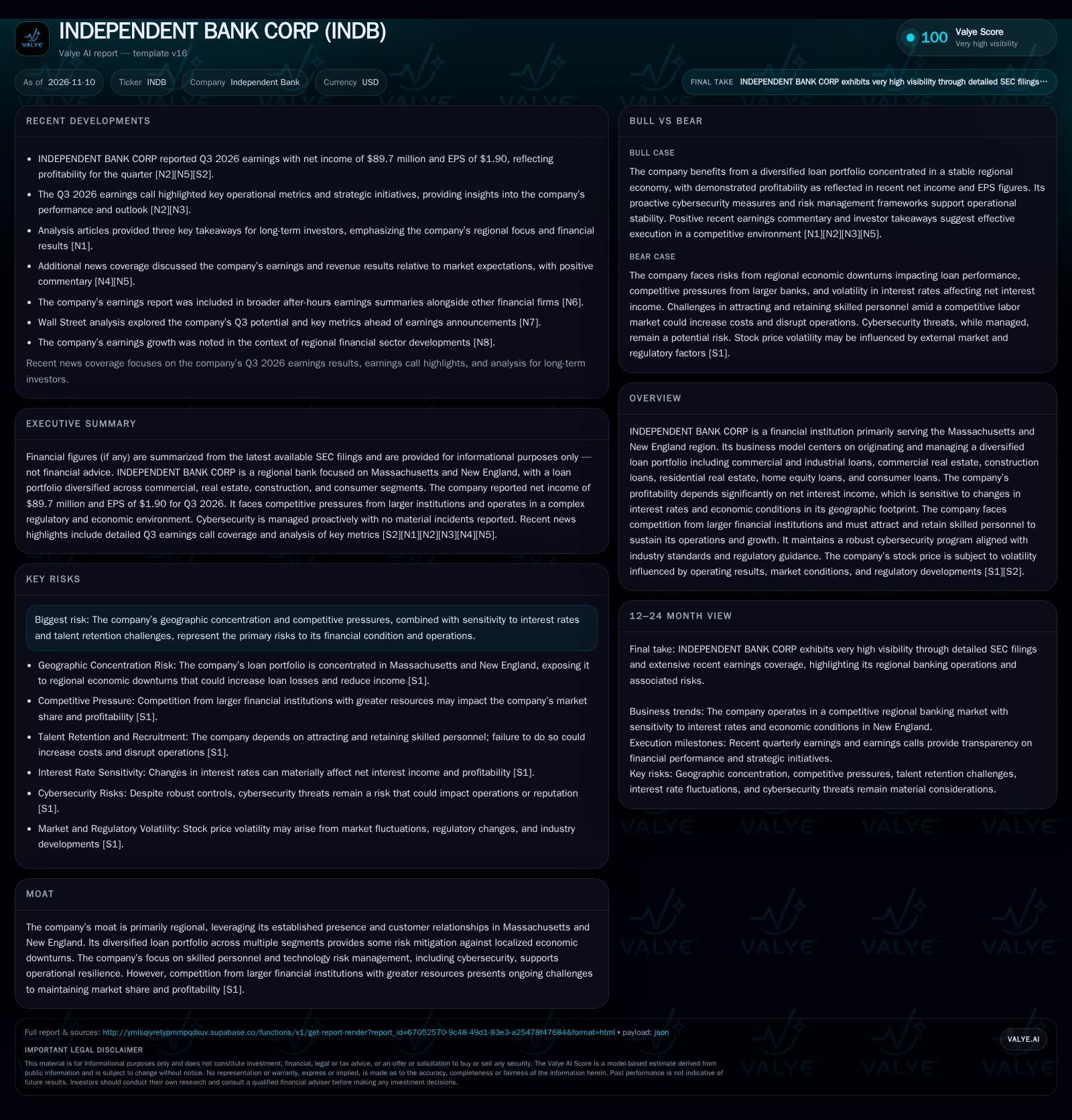
Independent Bank Corp. posted $89.7M in Q3 2026 net income and $1.90 EPS, reflecting profitability despite a concentrated loan book in Massachusetts and New England. Its business remains highly sensitive to local economic trends and interest rate changes. Ongoing competition from larger banks and the need to attract skilled personnel are persistent headwinds. Strong cybersecurity controls have prevented material incidents, but operational and regulatory risks remain. The core thesis hinges on whether prudent risk management and regional franchise strength can sustainably protect returns in a structurally competitive and cyclical environment. [S1] [S2]
Independent Bank Corp. stands as a profitable regional lender, reporting $89.7 million in net income for Q3 2026, but its success is tightly bound to the fortunes of Massachusetts and the New England economy. This geographic concentration, coupled with the structural realities of competing against national and superregional banks, creates a double bind: the company must defend margins and asset quality in a market where it cannot match larger peers’ scale or pricing flexibility. The crucial question is whether Independent Bank’s established customer relationships, disciplined risk management, and operational controls can consistently offset these underlying disadvantages, especially as interest rates and labor costs fluctuate.
Recent Profitability and the Stakes of Regional Exposure
Independent Bank Corp. reported net income of $89.7 million and earnings per share of $1.90 for the third quarter of 2026, demonstrating ongoing profitability in a period marked by mixed macroeconomic signals. The company’s loan portfolio remains diversified by segment—spanning commercial, real estate, construction, and consumer loans—but is highly concentrated in Massachusetts and New England. This regional focus amplifies sensitivity to local economic conditions, especially as commercial real estate and residential markets in the area face cyclical pressures. The company also reported no material cybersecurity incidents through year-end 2025, reflecting effective controls but not eliminating operational risk. [S1] [S2]
Earnings Drivers: Net Interest Income and the Cost of Funds
The core economic engine for Independent Bank is net interest income—the spread between interest earned on loans and securities and the cost of funding (primarily customer deposits and wholesale borrowings). In a rising rate environment, banks can sometimes expand net interest margins if loan yields reprice faster than deposit costs. However, regional banks often face funding disadvantages versus larger peers, as they may need to offer higher deposit rates to retain customers or turn to more expensive wholesale funding when local liquidity tightens.
The company’s diversified loan mix allows some risk spreading, but commercial real estate and construction exposures can create asset quality volatility if local economies weaken. Operating leverage in banking is modest: while fixed costs (branches, compliance, technology) are high, incremental revenue from new loans can drop to the bottom line if credit quality holds. However, credit losses rise sharply in downturns, and loan loss provisioning can rapidly erode profitability.
Capital needs are governed by regulatory requirements and the need for loss absorption. Regional banks must balance capital return (dividends, buybacks if any) with maintaining a buffer for economic shocks—particularly important given the company’s regional loan concentration.
Competing for Customers and Talent in a Scale-Driven Landscape
Independent Bank operates in a region crowded with national, superregional, and local banks, as well as non-bank lenders. Larger competitors benefit from scale in technology investment, product breadth, marketing, and funding costs, often allowing them to compete aggressively on both price and service. For a regional bank, the primary defenses are deep customer relationships, local market knowledge, and community embeddedness.
However, these advantages are under constant pressure. Larger banks can poach key personnel with higher compensation and broader career opportunities, while digital entrants can erode traditional relationship banking. Independent Bank’s ability to attract and retain skilled personnel is cited as a critical risk, as is the need to keep pace with technological change, including cybersecurity and digital delivery.
Switching costs for commercial and retail customers are moderate: while relationship depth and local service matter, digital convenience and pricing can prompt customers to move accounts or loans if competitors offer compelling alternatives. The company’s moat is thus primarily regional and relational, but it is not immune to erosion.
When Regional Strength and Discipline Deliver Outperformance
In a favorable scenario, Massachusetts and New England experience stable or improving economic conditions, supporting healthy loan demand and benign credit trends. Independent Bank leverages its customer relationships to grow share in commercial and consumer lending, while maintaining strong underwriting and credit controls. Interest rates remain at levels that allow the company to expand net interest margins without triggering a costly deposit war.
Operational discipline—reflected in continued absence of material cybersecurity incidents and low credit losses—enables the bank to achieve above-peer returns on assets and equity. The company successfully attracts and retains key personnel, leveraging its local reputation and culture. Evidence for this scenario would include sustained or rising net interest margin, below-peer credit loss rates, and continued growth in core deposits and loans.
Falsification would come from rising credit losses, deposit outflows, or a narrowing net interest margin despite stable rates, suggesting competitive or funding disadvantages are overwhelming relationship and risk-management strengths.
Structural Constraints Limit Upside Despite Sound Execution
The most plausible outcome is that Independent Bank maintains profitability and sound credit quality, but growth and margin expansion are constrained by regional economic realities and competitive pressures. Net interest income may fluctuate with interest rate cycles, but the company will be forced to compete aggressively for both customers and deposits, limiting pricing power.
Credit metrics are likely to remain within normal ranges, barring a sharp local downturn, but the company’s concentrated footprint means even moderate regional weakness can have outsized effects on asset quality and earnings. Personnel costs may rise as the bank competes for skilled staff in a tight labor market, while regulatory and technology investments absorb more of the expense base.
Confirmation would come from stable but unspectacular returns on equity, loan growth tracking regional GDP, and credit costs that move with local economic cycles. Falsification would be a sustained improvement in loan/deposit growth or margins that outpace regional peers, or a sharp deterioration in asset quality.
How Regional Shocks and Scale Disadvantages Could Erode Franchise Value
In a negative scenario, the New England economy experiences a downturn—perhaps from commercial real estate stress, rising unemployment, or sector-specific shocks. Loan losses rise, especially in commercial and construction portfolios, forcing the bank to increase provisioning and curtail new lending. Funding costs spike as depositors seek higher rates or shift to larger banks perceived as safer.
The company’s smaller scale limits its ability to absorb operational shocks or invest rapidly in technology and compliance, exposing it to both reputational and operational risk. A material cybersecurity incident, while not yet observed, could exacerbate outflows and regulatory scrutiny.
This scenario would be confirmed by rising non-performing assets, declining net interest margin, negative operating leverage, and potentially regulatory intervention if capital ratios fall. Falsification would be resilience in credit and deposit metrics despite regional stress, indicating superior risk controls or franchise stickiness.
Testing the Franchise: Metrics and Developments That Will Challenge or Support the Core Thesis
Net interest margin trends: Sustained expansion or compression relative to regional peers would clarify pricing power and funding cost dynamics.
Loan growth by segment and geography: Outperformance or underperformance versus local and national competitors would signal franchise strength or weakness.
Credit quality metrics: Non-performing asset ratios, charge-offs, and provisioning trends are critical for assessing risk management and regional economic sensitivity.
Core deposit growth and funding mix: Shifts toward more expensive funding or deposit outflows would highlight competitive and franchise pressure.
Personnel turnover and compensation expense: If disclosed, these would indicate whether the bank is succeeding or struggling in the talent market.
Cybersecurity incident disclosures: Any material events or near-misses would test the robustness of current controls.
Regulatory capital ratios: Deterioration or improvement, especially in periods of stress, would impact the bank’s flexibility and risk profile.
Stock price volatility and trading volume: While not fundamental, sudden moves may reflect shifting investor perceptions of operational or credit risk.
Disclaimer: This is research-only, informational analysis and not investment advice. It may include AI-generated interpretation and general industry context. Always verify important details using primary sources.

Comments