
Crona Corp.: Early-Stage Funeral Casket Importer Grapples with Liquidity and Execution Hurdles
Crona Corp. has pivoted to supplying imported funeral caskets in the US market but remains pre-revenue, with significant working capital deficits and a skeletal management structure. The company’s ability to secure financing and establish operational traction will determine whether its cost-driven approach can translate into sustainable market presence.
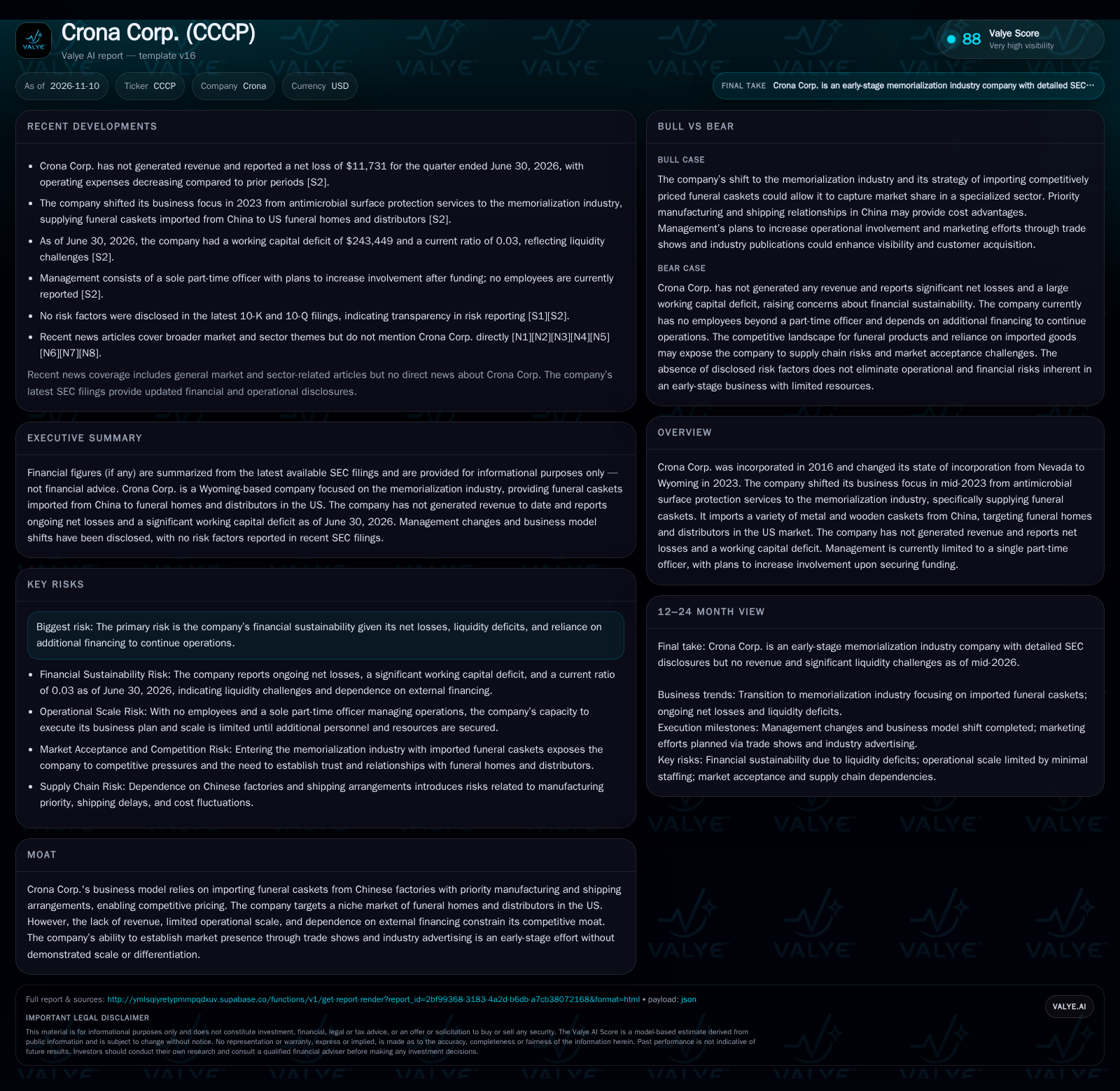
Crona Corp. shifted to importing funeral caskets for the US memorialization industry in 2023 but, as of mid-2026, has not generated revenue and reports persistent net losses. With a working capital deficit of over $240,000, no employees, and a sole part-time officer, the company’s future hinges on obtaining external funding and building commercial relationships. Its low-cost sourcing strategy may create opportunities if operational scale and customer trust can be established, but execution and financial risks remain acute. [S2]
Crona Corp. embodies the acute challenges of a microcap business in transition. The next year will test whether cost advantages in sourcing can offset the steep barriers to entry and operational fragility.
Liquidity Deficit and Lack of Revenue Define Crona’s Immediate Reality
The most material facts shaping Crona Corp.’s situation as of June 30, 2026, are its absence of revenue, a net loss of $11,731 for the latest quarter, and a working capital deficit of $243,449. The company reported cash and liquidity metrics for the period; these figures do not by themselves establish operating runway, investment capacity, financial flexibility, or financing capacity. All operating expenses for the first half of 2026 were paid via related-party advances from the sole officer, who is currently the only person involved in day-to-day operations on a part-time basis. Management has disclosed plans to increase operational involvement if and when new funding is secured, but as of the latest report, no such funding has materialized. [S2]
How Crona’s Low-Cost Import Model Could (or Could Not) Generate Value
Crona’s business model is built around importing funeral caskets from Chinese factories, leveraging priority manufacturing and shipping relationships to compete on price in the US market. The economics of this approach rely on achieving sufficient volume to benefit from scale-driven cost advantages in procurement and logistics. In the funeral products industry, gross margins are often influenced by input costs, shipping, inventory management, and the ability to command a premium for specialty finishes or customizations.
Currently, the company has not secured any revenue, so its cost structure is dominated by fixed overhead and minimal variable operating costs. With no employees and only a part-time officer, fixed G&A is low, but so is commercial capacity. The absence of any research and development spending suggests no proprietary product innovation, further emphasizing a pure distribution and trading model. This structure can enable rapid scaling if customer relationships are won and working capital is available, but it also exposes Crona to acute liquidity risk: every casket sale would require upfront capital, and the company’s current balance sheet leaves it unable to fund inventory or absorb payment delays.
The path to sustainable economics would require not only securing capital to fund inventory and marketing but also establishing repeat business with funeral homes or distributors—ideally under terms that allow Crona to balance cash conversion cycles and avoid margin erosion from price competition. If the company can secure volume contracts or preferred supplier relationships, operating leverage could quickly improve; if not, fixed costs may remain low, but the business will fail to scale beyond a marginal sideline.
Assessing Crona’s Place in a Consolidated and Relationship-Driven Industry
The US funeral casket market is mature, highly consolidated, and dominated by established distributors, vertically integrated manufacturers, and long-standing relationships between suppliers and funeral homes. Large incumbents benefit from scale, brand trust, and established logistics, making it challenging for new entrants to win share without either a disruptive cost advantage or a differentiated value proposition.
Crona’s approach, centered on low-cost imported caskets, targets price-sensitive segments of the market—potentially small independent funeral homes or price-driven distributors. However, switching costs for funeral homes can be high due to the reputational risk of supply chain failures and the importance of reliability in memorial services. The company’s lack of operating history, limited staff, and absence of a physical distribution footprint are significant competitive handicaps. Furthermore, reliance on Chinese manufacturing exposes Crona to currency, tariff, and supply chain risk, all of which can erode any cost advantage if not managed at scale.
While some segment of the market may be open to new suppliers offering lower prices, success will likely depend on Crona’s ability to demonstrate reliability, quality consistency, and responsive service. Without these attributes, the company risks being relegated to the lowest-margin, most volatile slice of the market.
What It Would Take for Crona to Break Through: Funding, Execution, and Market Entry
The most favorable outcome for Crona would stem from securing external financing sufficient to fund inventory, expand management bandwidth, and invest in marketing. This capital could enable the company to establish a modest inventory base, accelerate outreach to funeral homes and distributors, and begin fulfilling initial orders. If Crona’s priority relationships with Chinese factories translate into meaningful cost savings, and if those savings can be passed on to customers without sacrificing quality or reliability, the company could carve out a niche among price-sensitive buyers.
Confirmation of this scenario would come from the first reported revenues, evidence of repeat or multi-unit orders, and a shift from related-party funding to commercial cash flow. Additional signals would include the hiring of operational staff, expansion of trade show participation, and the establishment of formal contracts or distribution agreements. Falsification would be evident if, despite new funding, Crona remains unable to secure sales or if initial customers do not reorder—suggesting either insufficient value proposition or execution risk.
Execution Remains the Bottleneck as Crona Seeks a Foothold
The most plausible near-term outcome is continued operational stasis until Crona secures meaningful external financing. With no revenue and only related-party advances funding basic expenses, the company’s ability to build commercial traction is severely limited. Even if funding is secured, the company faces the reality that market entry in the funeral casket space is slow—trust must be earned, and sales cycles can be lengthy as funeral homes vet new suppliers.
In this scenario, Crona may achieve initial sales on a spot or trial basis, but scaling up to a sustainable business will require consistent execution, demonstration of reliability, and the ability to manage working capital tightly. Confirmation would come from small but growing revenues, gradual hiring, and evidence of repeat purchasing. Falsification would be persistent absence of sales, ongoing losses without progress toward customer acquisition, or further dilution as the company struggles to fund operations.
Acute Liquidity Stress and Inertia Could Force Strategic Alternatives
The most adverse scenario is that Crona fails to secure external funding, leading to an inability to pay liabilities or invest in the basic requirements of a functioning trading business. With no employees, minimal assets, and mounting payables, the company may be forced to suspend operations, seek a distressed sale, or pursue bankruptcy protection if creditors act.
Even if a modest amount of funding is secured, failure to convert that into commercial traction—either because of price competition, supply chain disruptions, or inability to establish trust with customers—could result in ongoing losses and eventual insolvency. Confirmation of this downside would be continued absence of revenue, increasing current liabilities, and disclosure of default events, litigation, or formal restructuring processes.
Near-Term Developments That Will Clarify Crona’s Commercial Viability
Evidence of initial revenue generation—any reported sales to funeral homes or distributors would signal commercial traction.
Securing external funding through equity, debt, or other financing mechanisms, and the terms of such financing.
Change in management structure, including hiring of employees or increased involvement by the current officer, would indicate operational scaling.
Formalization of customer relationships, such as distribution agreements or repeat purchase orders, would help validate demand.
Disclosure of inventory procurement and management practices, including how working capital is allocated and whether supplier terms are favorable.
Participation in additional trade shows, industry events, or new marketing initiatives, and any resulting lead generation or conversion data.
Updates regarding supply chain reliability, including shipping timelines, cost fluctuations, or disruptions in sourcing from China.
Disclaimer: This is research-only, informational analysis and not investment advice. It may include AI-generated interpretation and general industry context. Always verify important details using primary sources.

Comments