
NaturalShrimp’s Post-Receivership Pivot: Technology Licensing as a Last Stand for Value Recovery
Following asset liquidation and operational cessation, NaturalShrimp has restructured around perpetual technology licenses from Hydrenesis, seeking a path forward in aquaculture and water treatment. The company’s future now hinges on the viability and commercialization of these licensed technologies amid persistent financial distress.
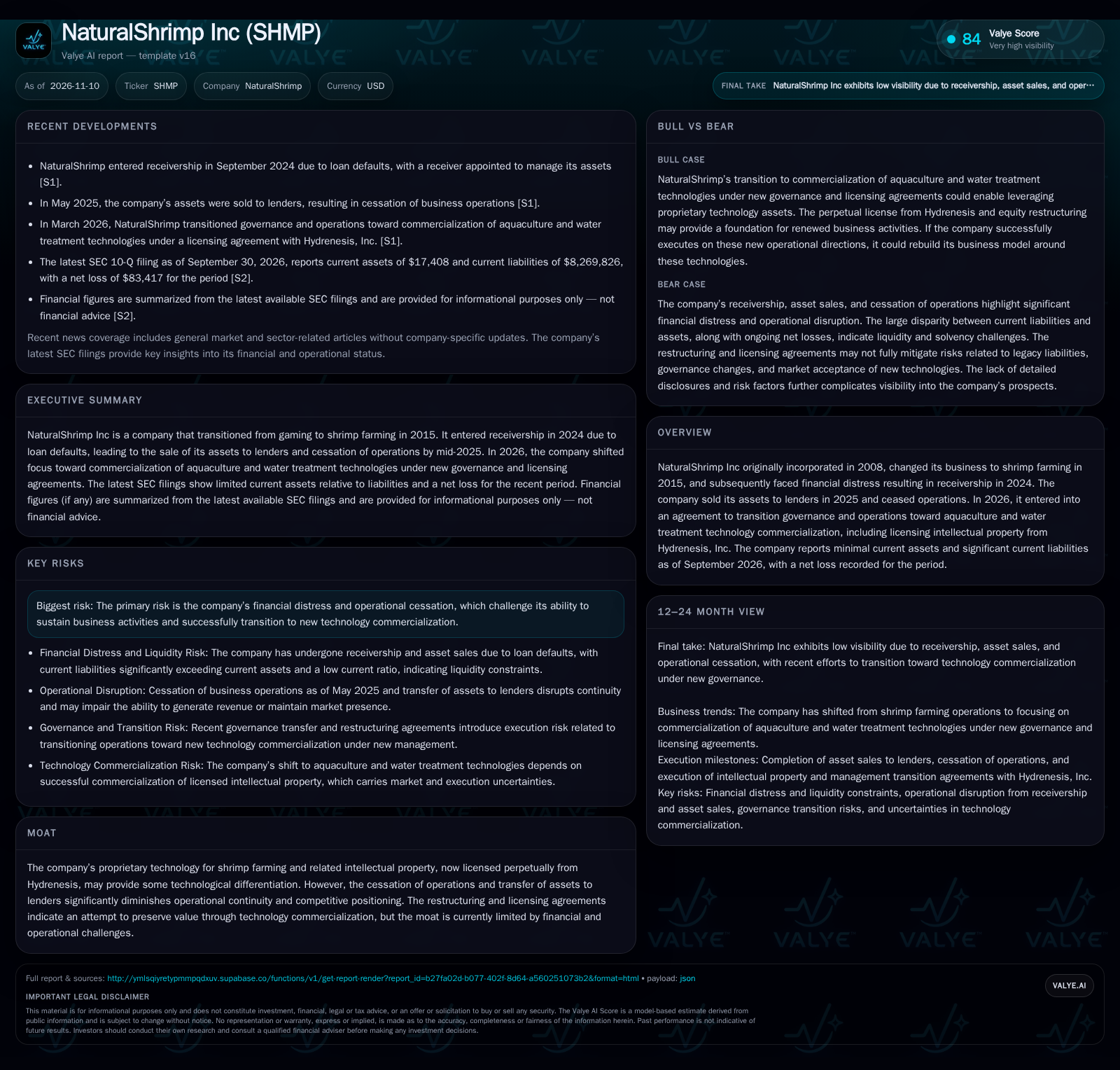
NaturalShrimp ceased its shrimp farming business after entering receivership and selling core assets to lenders in 2025. In 2026, it transitioned to a technology commercialization model through a perpetual license from Hydrenesis, but maintains minimal assets, significant liabilities, and ongoing net losses. The central question is whether its new technology focus and licensing agreements can overcome legacy financial and operational headwinds to create a viable business [S1] [S2].
NaturalShrimp’s journey from a shrimp farming hopeful to a distressed asset in receivership has culminated in a dramatic pivot: the company has liquidated its core operations, transferred assets to creditors, and now seeks a future built on commercializing licensed aquaculture and water treatment technology. This transition, formalized via a perpetual license from Hydrenesis in March 2026, represents a last-ditch effort to extract value from intellectual property rather than operations. The company remains burdened by a lopsided balance sheet, with minimal assets and significant liabilities, and its prospects hinge entirely on the successful adoption and monetization of its new technology platform—a path fraught with execution and market risks [S1] [S2].
Asset Liquidation and Technology Licensing Define the New Reality
The most consequential developments for NaturalShrimp are its entry into receivership in September 2024, the completed sale of substantially all operating assets to lenders by May 2025, and cessation of its prior business activities [S1]. This left the company with a shell structure and residual liabilities. In March 2026, NaturalShrimp entered an agreement with Hydrenesis and David Antelo, transferring governance and operational direction and securing a perpetual license to certain aquaculture and water treatment technologies [S1]. As of September 30, 2026, the company reported only $17,408 in current assets against $8.27 million in current liabilities, and a net loss of $83,417 for the period, reflecting a precarious financial position [S2]. These facts underscore that NaturalShrimp’s future is tied not to farming operations, but to the fate of its newly licensed technology platform.
Rebuilding a Revenue Model Around Licensed IP: Opportunities and Constraints
NaturalShrimp’s post-liquidation economics are entirely contingent on its ability to commercialize the licensed aquaculture and water treatment technologies. Unlike traditional farming operations, a technology licensing or commercialization model typically relies on either direct IP licensing fees, royalties from third-party adopters, or the ability to develop and sell proprietary systems or services. This structure can, in theory, yield high gross margins if the IP is valuable and scalable, as it minimizes capital intensity and variable costs associated with physical production. However, success depends on market demand for the technology, the strength and enforceability of the IP, and the company’s ability to secure commercial partners or customers.
Given the absence of operating assets and the company’s current financial distress, NaturalShrimp is unlikely to fund significant in-house manufacturing or large-scale deployments. Instead, the economics may depend on up-front licensing deals or partnerships—potentially with established aquaculture operators or water treatment firms. However, the company’s limited cash and large liabilities significantly constrain its negotiating leverage and ability to invest in commercialization, customer acquisition, or technical support. Fixed costs may be lower than in prior operating models, but the absence of recurring revenue and the need for rapid monetization create a high-stakes, binary outcome: either the technology is adopted and generates meaningful fees, or the company fails to generate sufficient cash flow to address its liabilities.
Technological Differentiation Versus Sector Realities: Can IP Alone Sustain an Edge?
In the aquaculture and water treatment sectors, technological innovation can provide a competitive edge—if it demonstrably improves yield, efficiency, or environmental compliance. NaturalShrimp’s access to Hydrenesis IP may offer some differentiation, particularly if it enables more sustainable, scalable, or cost-effective shrimp production or water purification. However, the company’s competitive position is fundamentally weakened by its loss of operational assets and the interruption of business continuity.
Direct competitors include established aquaculture technology firms, water treatment solution providers, and vertically integrated seafood producers with in-house R&D. These incumbents often possess greater resources, entrenched customer relationships, and the ability to bundle technology with services or product offerings. Moreover, the company’s ability to defend its IP, attract partners, or demonstrate commercial viability is hindered by its financial instability and lack of a track record in technology licensing. Without tangible proof of superior outcomes or cost savings, adoption barriers remain high, and switching costs for potential customers may be low if alternatives exist. The risk is that NaturalShrimp’s technology becomes a niche offering—or is bypassed altogether—unless it can quickly establish credibility and secure reference accounts.
Rapid Commercial Adoption of Licensed Technologies Unlocks Value
The most favorable outcome for NaturalShrimp is that the Hydrenesis-licensed technologies are both technically superior and rapidly adopted by commercial aquaculture operators or water treatment providers. In this scenario, early pilot projects or proof-of-concept deployments validate the technology, leading to partnership agreements, recurring royalty streams, or up-front licensing payments. The company’s perpetual license structure could allow for high-margin revenue with minimal capital outlay.
Confirmation of this scenario would come from announced commercial partnerships, customer pilot results, or licensing deals with credible industry players. Evidence of revenue growth directly tied to technology adoption, along with positive user testimonials and third-party validation of technical claims, would support the case. Falsification would occur if, after a reasonable period, no commercial traction is evident, or if potential partners cite technical or economic shortcomings.
A Slow, Uncertain Rebuild Amid Ongoing Financial Strain
The most plausible near-term scenario is a protracted struggle to reposition as a technology licensor, with minimal revenue and persistent financial overhang. NaturalShrimp may attempt to market its licensed technologies, but faces uphill battles in gaining industry traction, securing pilot projects, and convincing partners of the value proposition. The company’s limited resources constrain its ability to invest in business development, technical support, or customer education.
In this scenario, progress is incremental and highly dependent on external validation or the willingness of industry players to experiment with new technology from a financially distressed licensor. Evidence confirming this trajectory would include tepid or inconsistent revenue from technology deals, continued net losses, and a lack of high-profile partnerships. Falsification would be rapid, material revenue growth or a transformative licensing agreement that materially alters the balance sheet.
Failure to Commercialize Technology Leads to Dormancy or Liquidation
The adverse scenario is that NaturalShrimp is unable to generate meaningful revenue from its newly licensed technologies. Potential causes include technical shortcomings, limited market interest, inability to secure pilot projects, or insurmountable financial and reputational barriers stemming from its recent receivership. Without cash flow, the company may be forced into further liquidation, restructuring, or wind-down, as it lacks the assets or runway to absorb ongoing losses.
Confirmation would come from continued absence of commercial deals, further deterioration of the balance sheet, and eventual cessation of public disclosures or delisting. If, after a reasonable time, there are no announced partnerships, pilots, or licensing income, it would strongly suggest that the pivot has failed and that the company’s remaining equity is likely impaired.
Milestones That Will Reveal Whether NaturalShrimp’s Technology Pivot Gains Traction
Announcement of commercial licensing agreements, pilot projects, or partnerships with credible aquaculture or water treatment firms.
Evidence of technology validation—such as third-party testing, regulatory approvals, or positive customer testimonials—would help test the thesis.
Disclosure of material revenue from technology licensing or royalties, if reported in future filings.
Reduction in current liabilities or restructuring of outstanding debts, indicating improved financial stability.
Changes in governance or further equity restructuring that clarify the company’s post-transition capital structure.
Updates on operational activities, such as hiring technical staff or establishing distribution partnerships, would be relevant if disclosed.
Any indication of new investment, grant awards, or external funding that could extend the company’s runway or support commercialization efforts.
Disclaimer: This is research-only, informational analysis and not investment advice. It may include AI-generated interpretation and general industry context. Always verify important details using primary sources.

Comments