
Bicara Therapeutics: Bifunctional Antibody Ambition Faces the Realities of Clinical Execution and Capital Demands
Bicara Therapeutics is advancing a bifunctional antibody platform targeting challenging solid tumors, with its lead asset ficerafusp alfa in late-stage development for HPV-negative head and neck cancer. While early clinical signals and reported liquidity position the company for continued progress, the path to commercial success hinges on clinical validation, regulatory outcomes, and navigating a competitive oncology landscape.
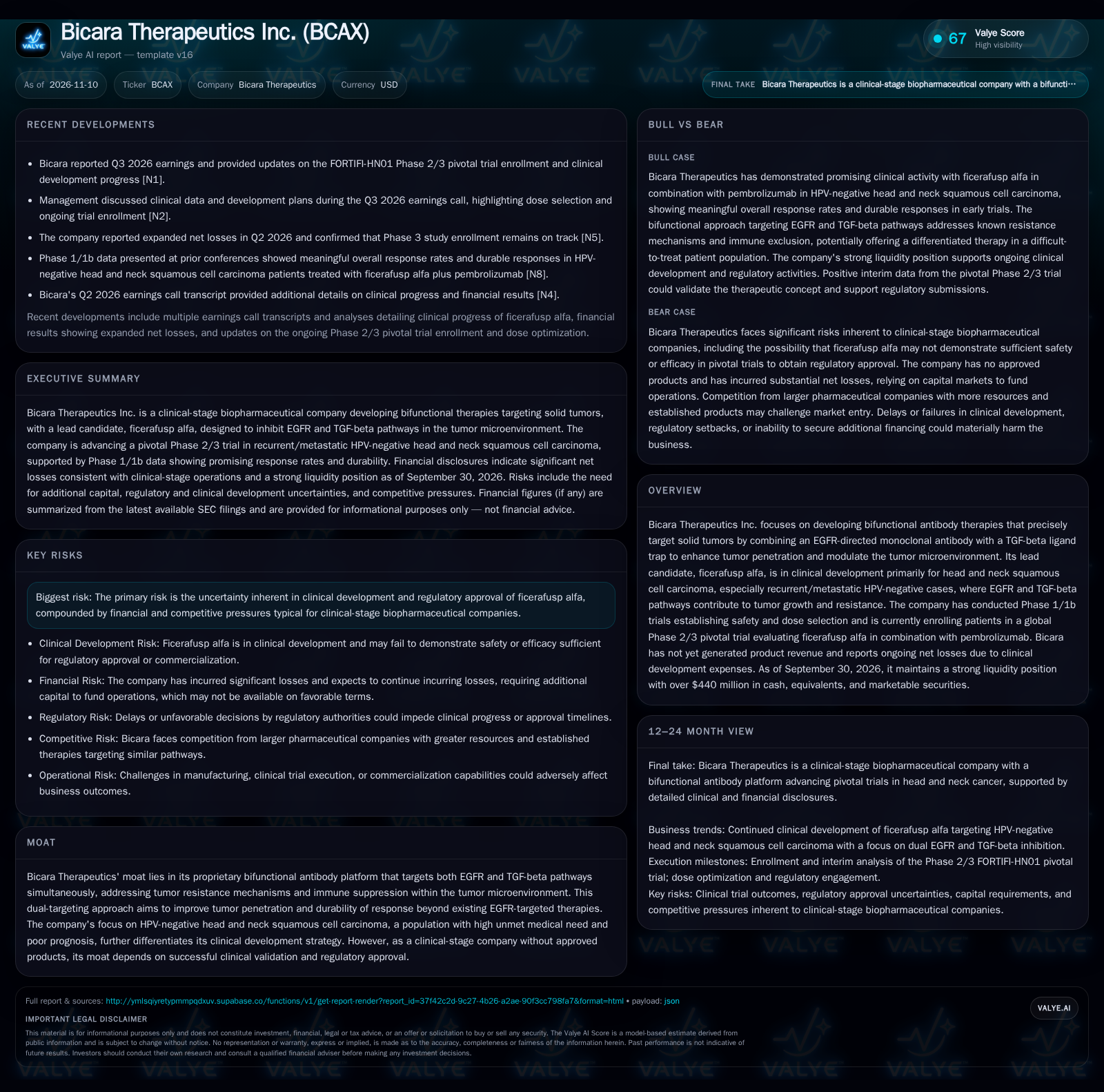
Bicara Therapeutics is a clinical-stage biotech focused on bifunctional antibody therapies for solid tumors, notably developing ficerafusp alfa for HPV-negative head and neck cancer. The company reported over $440 million in liquidity as of September 30, 2026, but remains pre-revenue and faces ongoing net losses tied to clinical development. Its future depends on the success of pivotal trials, regulatory approval, and its ability to differentiate in a crowded oncology market. [S2] [N5]
Bicara Therapeutics is at a critical juncture as it advances its bifunctional antibody platform, with ficerafusp alfa moving through late-stage clinical development for a high-need oncology indication. The company’s focus on dual inhibition of EGFR and TGF-beta pathways addresses both tumor growth and immune evasion—mechanisms implicated in poor outcomes for HPV-negative head and neck squamous cell carcinoma. The next 12-24 months will be pivotal in testing whether Bicara’s scientific approach can translate into regulatory and commercial traction. [S2] [N5]
Recent Developments Define the Stakes for Bicara’s Pivotal Oncology Program
Bicara Therapeutics’ most material current facts include its ongoing clinical progress with lead candidate ficerafusp alfa, which is in pivotal trials for HPV-negative head and neck squamous cell carcinoma—a setting with high unmet need. Management recently highlighted dose selection and enrollment milestones on its Q3 2026 earnings call, confirming that the Phase 3 study remains on track. The company reported cash and liquidity metrics for the period; these figures do not by themselves establish operating runway, investment capacity, financial flexibility, or financing capacity. However, the company has not generated product revenue to date, and its financials reflect the capital-intensive nature of late-stage drug development. [S2] [N2] [N5]
How Bicara’s Platform Could Unlock Value—And What Drives the Cost Structure
Bicara’s business model is fundamentally tied to the high-risk, high-reward economics of clinical-stage biopharma. The company’s lead asset, ficerafusp alfa, is designed as a bifunctional antibody that targets both EGFR and TGF-beta pathways, aiming for differentiated efficacy in solid tumors where monotherapies have struggled. If successful, this approach could command premium pricing—especially in indications with poor prognosis and limited therapeutic options—potentially supporting blockbuster revenue if the therapy demonstrates clear clinical benefit and safety.
However, until regulatory approval and commercial launch, Bicara’s economics are dominated by R&D costs: clinical trial expenses, manufacturing scale-up, and regulatory engagement. These are mostly fixed or step-variable costs, with operating leverage only realized if and when a product reaches the market. The company’s cash burn rate is likely substantial given the ongoing pivotal trial, and future capital needs remain a possibility if timelines extend or new programs are advanced.
The bifunctional antibody design inherently introduces complexity into the manufacturing process, which can significantly influence cost structure and scalability. Producing a molecule that simultaneously binds two distinct targets requires advanced bioprocessing techniques, potentially increasing production time and costs compared to conventional monoclonal antibodies. This complexity also extends to quality control and batch consistency, which are critical for regulatory approval and commercial supply reliability. Therefore, Bicara’s ability to optimize manufacturing efficiency and maintain stringent quality standards will be pivotal in controlling costs and ensuring timely product availability upon approval.
From a market access perspective, the pricing and reimbursement environment for novel bifunctional therapies targeting solid tumors can be challenging. Payers increasingly demand robust evidence of clinical benefit and cost-effectiveness relative to existing standards of care. If Bicara’s therapy demonstrates meaningful improvement in survival or quality of life, it may justify premium pricing. However, reimbursement negotiations will likely hinge on comparative effectiveness data and real-world outcomes post-launch. Strategic planning around health economics and outcomes research will be essential to support market uptake and maximize revenue potential in a competitive oncology landscape.
Dual-Targeting Innovation Versus Entrenched Oncology Giants
Bicara’s competitive position is anchored in its proprietary bifunctional antibody platform, which seeks to address two resistance mechanisms—tumor cell proliferation (via EGFR) and immune suppression (via TGF-beta)—in a single molecule. This could offer clinical and operational advantages over single-pathway inhibitors or combination regimens requiring separate agents. The company’s focus on HPV-negative head and neck squamous cell carcinoma is strategically sound, addressing a population with limited options and high unmet need.
However, the oncology landscape, particularly for EGFR and TGF-beta pathways, is intensely competitive. Large pharmaceutical companies already market EGFR inhibitors, and several are developing next-generation immune modulators. Bicara must demonstrate not only superior efficacy and safety, but also meaningful differentiation to secure adoption. The absence of commercial infrastructure could also be a hurdle if the company seeks to launch independently rather than via partnership or acquisition. In addition, scientific risk remains: bifunctional antibodies are technically complex, and success in early trials does not guarantee Phase 3 or regulatory validation.
If Ficerafusp Alfa Delivers: A Pathway to Oncology Franchise Potential
The most favorable scenario for Bicara is that pivotal data from the ongoing Phase 3 trial of ficerafusp alfa demonstrate robust efficacy, durable responses, and manageable safety in HPV-negative head and neck cancer. Positive outcomes could open the door to regulatory approval, rapid uptake in a population with few alternatives, and potentially expansion into additional solid tumor indications where EGFR and TGF-beta pathways are implicated.
Evidence that would confirm this scenario includes statistically significant improvement in overall survival or progression-free survival versus standard of care, strong safety/tolerability data, and positive regulatory interactions (e.g., breakthrough therapy designation, priority review). Early partnering interest or licensing deals with larger oncology players would further validate the commercial potential and could provide non-dilutive capital to support launch and pipeline expansion. Successful execution here could establish Bicara as a platform company with broader oncology ambitions.
Progressing Through Pivotal Trials Amid Sector Volatility
The most plausible scenario is that Bicara continues to advance ficerafusp alfa through Phase 3 with steady enrollment and manageable clinical risk, but encounters the typical uncertainties of oncology drug development. Data could show some efficacy signal but fall short of clear superiority, or safety/tolerability concerns may emerge that complicate regulatory review.
Confirmation of this scenario would come from regular clinical updates showing progress but without game-changing efficacy or major setbacks, continued cash burn in line with industry norms, and ongoing discussions with regulators and potential partners. The outcome would hinge on the specifics of the Phase 3 data readout and the company’s ability to navigate the regulatory process efficiently.
Clinical and Regulatory Setbacks Could Force Strategic Retrenchment
The adverse outcome for Bicara would involve disappointing Phase 3 results—either due to lack of efficacy, unexpected toxicity, or inability to differentiate from existing therapies. Such results could lead to regulatory delays or outright failure to secure approval, forcing the company to halt or radically restructure its development programs.
Evidence confirming this downside would include negative or equivocal top-line trial results, FDA feedback requesting additional studies or raising safety concerns, or the company signaling a pause or shift in clinical strategy. Accelerated cash burn without offsetting inflows, as well as management turnover or pipeline deprioritization, would further validate a deteriorating outlook.
Milestones and Clinical Events That Will Determine Bicara’s Trajectory
Enrollment pace, protocol amendments, and top-line data readouts from the pivotal Phase 3 study of ficerafusp alfa in HPV-negative head and neck cancer.
Updates on clinical efficacy and safety, including interim analyses or conference presentations, would help assess differentiation versus standard of care.
Regulatory feedback, such as acceptance of filings, designations (breakthrough/priority), or requests for additional data, will clarify approval timelines.
Cash burn rate and remaining liquidity as disclosed in quarterly filings; a useful metric would be projected runway under current operating plans.
Any announced licensing, partnership, or co-commercialization agreements, which could validate the platform and provide non-dilutive capital.
Expansion of the pipeline or initiation of new trials in additional indications, if disclosed, would signal platform leverage or capital allocation shifts.
Changes in competitive landscape, such as new data from rival EGFR or TGF-beta inhibitors, could impact perceived differentiation and market opportunity.
Disclaimer: This is research-only, informational analysis and not investment advice. It may include AI-generated interpretation and general industry context. Always verify important details using primary sources.

Comments